






Key Takeaways
- Apple is developing an AirTag-sized wearable AI pin targeting a 2027 launch, according to The Information’s exclusive report.
- Device features: dual cameras (standard + wide-angle), 3 microphones, speaker, physical button, and magnetic wireless charging.
- Production scale: Apple aims for ~20 million units at launch, signalling a significant commitment to the wearable AI category.
- Competition heating up: Launch timeline accelerated to rival OpenAI’s wearable expected in late 2026, with Jony Ive’s design involvement elevating the stakes.
Quick Recap
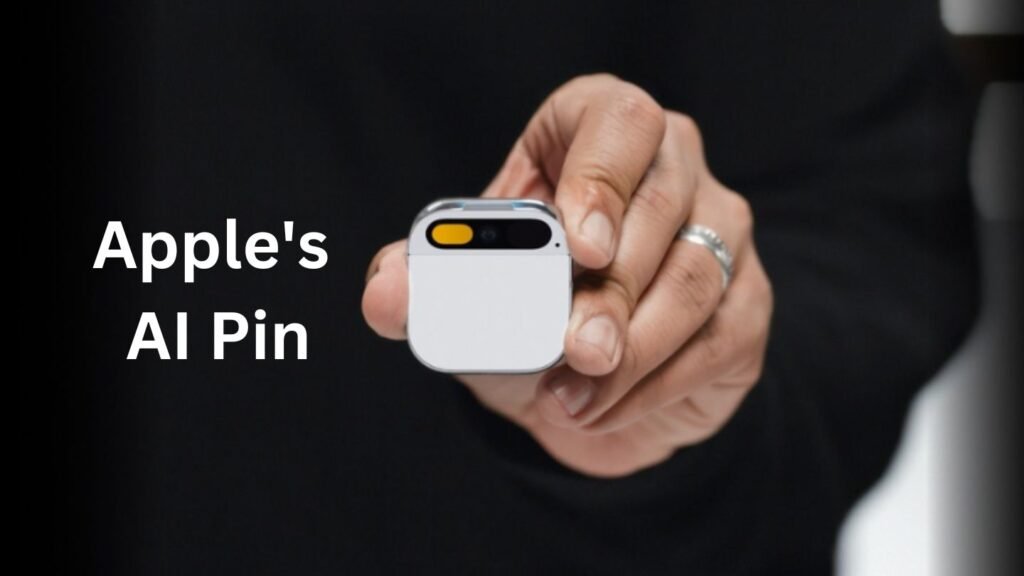
Apple has entered the race for wearable AI supremacy. According to an exclusive report from The Information published January 21, 2026, Apple is developing its own AI-powered wearable pin—a thin, flat circular disc approximately the size of an AirTag—that could launch as early as 2027. The device represents Apple’s aggressive pivot to capture the emerging AI hardware market and directly challenges OpenAI’s forthcoming wearable device, which is expected later in 2026.
Technical Specifications & Hardware Architecture
Apple’s AI pin represents a carefully engineered response to market demands. The device measures approximately 50-60mm in diameter with an aluminium-and-glass casing, maintaining portability while embedding sophisticated sensor arrays.
Imaging & Sensing Capabilities:
The pin is equipped with dual cameras—a standard lens and a wide-angle lens—positioned to capture a comprehensive view of the environment. This dual-camera system enables both detailed photography and broader scene understanding, crucial for multimodal AI processing. The device includes three microphones for spatial audio capture and directional sound awareness, allowing the AI assistant to understand conversational context even in noisy environments.
Power & Interaction Design:
A magnetic inductive wireless charging interface mirrors the Apple Watch ecosystem, enabling seamless integration with Apple’s existing charging infrastructure. A single physical button along the edge provides tactile control, reducing reliance on voice commands in situations requiring discretion. The embedded speaker delivers audio feedback without requiring connected earbuds or AirPods.
Processing Strategy:
Unlike Humane’s failed AI pin—which attempted standalone processing and suffered from performance bottlenecks—Apple’s device appears optimized for hybrid architecture. The pin likely offloads computationally intensive tasks to a connected iPhone, leveraging Apple’s existing silicon advantage (A-series and M-series chips). This architectural choice addresses the primary failure of Humane’s device: insufficient processing power leading to sluggish response times and poor battery performance.
Why This Matters Now?
The wearable AI market stands at an inflection point. The global AI wearables market, valued at approximately $44 billion in 2026, is projected to reach $311 billion by 2033, representing a CAGR of 20%+. This explosive growth projection explains Apple’s aggressive timeline.
Competitive Pressure & Timeline Acceleration:
OpenAI’s announced wearable device, featuring Jony Ive’s design pedigree, has forced Apple’s hand. Ive’s involvement signals institutional-grade design thinking behind OpenAI’s device, raising the bar for all competitors. Chris Lehane, OpenAI’s Chief Global Affairs Officer, confirmed the company would announce its first AI hardware device in the second half of 2026. Apple’s 2027 target places them approximately 12-18 months behind, but with massive manufacturing scale advantages.
The Humane Cautionary Tale:
Humane AI’s spectacular failure looms over this market. Launched in 2024 with significant venture backing, Humane’s AI pin sold fewer than 10,000 units before the company shuttered operations and sold remaining assets to HP for $116 million. Humane’s failures were multifaceted: sluggish processing speed, inadequate battery life (device required midday charging), lack of clear use cases, and $699 pricing without demonstrable utility advantage over smartphones.
Apple’s approach directly addresses these shortcomings through hybrid processing, tighter ecosystem integration, and, presumably, more aggressive pricing enabled by manufacturing scale.
Strategic Partnerships & AI Foundation:
Apple’s recent partnership with Google—integrating Gemini as the foundation for Apple Intelligence and Siri enhancements—provides a critical software advantage. By outsourcing the core LLM to Google’s battle-tested Gemini, Apple can focus on hardware-software integration, sensor fusion, and contextual understanding. This contrasts sharply with Apple’s prolonged AI struggles (Siri remains limited compared to competitors’ assistants) and signals a pragmatic approach to competitive positioning.
Competitive Landscape
The wearable AI market presents three distinct competitive directions: Apple’s upcoming pin, OpenAI’s mysterious Ive-designed device, and emerging challengers like Memories.ai’s Project LUCI.
| Feature/Metric | Apple AI Pin (2027) | OpenAI AI Device (2026) | Memories.ai Project LUCI |
| Expected Form Factor | Circular disc pin (AirTag-sized) | Unknown (Earbuds rumored) | Clip-on wearable with display |
| Camera System | Dual (standard + wide-angle) | Not confirmed | High-resolution with visual memory encoding |
| Microphones | 3x directional array | 2x (estimated) | 2x |
| Processing Architecture | Hybrid (on-device + iPhone offload) | Standalone (presumed) | On-device with cloud sync |
| AI Foundation Model | Google Gemini | OpenAI GPT models | Memories.ai visual models + partnerships |
| Launch Timeline | Q1-Q4 2027 | H2 2026 (announcement) | Q2 2026 (developer access) |
| Production Volume Target | ~20 million units | Unknown | Limited (developer platform first) |
| Battery Life Focus | Extended (hybrid architecture advantage) | Unknown | Day-long (typical wearable) |
| Price Positioning | Premium but mass-market (presumed $399-599) | Premium (OpenAI positioning) | Mid-market ($299-399 developer tier) |
OpenAI holds first-mover advantage with a 2026 announcement and Jony Ive’s design credentials, potentially establishing category definition. However, Apple’s 2027 launch carries manufacturing scale advantages—the projected 20 million units dwarfs Humane’s capacity and would establish Apple as market volume leader immediately. Project LUCI strategically targets developers and OEMs rather than consumers, creating an ecosystem play distinct from direct competition. Apple wins on distribution, scale, and ecosystem integration; OpenAI wins on innovation narrative and design prestige; Project LUCI wins on flexibility and enterprise positioning.
TechnoTrenz’s Takeaway
I think this is significant, but I’m genuinely skeptical whether Apple can succeed where multiple teams have stumbled. Let me be frank: the AI pin category has a credibility problem. Humane burned through investor capital to prove that consumers don’t want a dedicated device that replicates smartphone functionality poorly.
Here’s what gives me cautious optimism: Apple’s hybrid architecture strategy demonstrates real problem-solving. Processing offloading to iPhone directly addresses Humane’s fatal flaw—sluggish performance and battery depletion. By leveraging existing silicon advantages and making iPhone the computational backbone, Apple sidesteps years of hardware optimization that competitors are still attempting.
But here’s my concern: I generally don’t see compelling use cases beyond “I want to free up my hands occasionally.” Vision Pro taught Apple a harsh lesson about consumers’ willingness to adopt new categories without clear, near-daily utility. The AI pin risks the same fate—it’s elegant hardware solving a problem people haven’t articulated.
That said, Apple’s manufacturing prowess and the projected $311 billion market opportunity by 2033 make this bet rational. If anyone can execute the wearable AI transition, Apple has the ecosystem density, brand loyalty, and supply chain advantages to do it. But execution matters far more than hardware specs here. The device itself is almost secondary to whether Apple can convince users that a screenless, conversational AI companion legitimately improves daily life versus simply adding another device to charge.
My verdict: bullish on Apple’s likelihood of shipping this device and capturing market share, but bearish on whether the category achieves mainstream adoption. This is a 2027-2029 inflection point—we’ll know within 18 months whether AI wearables become aspirational or remain niche.

Sources