






Key Takeaways
- €1.8 million secured: Ghent-based voice AI startup Ringtime closed a seed round in March 2026 led by Volta Ventures, with four additional co-investors participating
- Blue-collar focus: The platform automates inbound and outbound recruitment calls, candidate screening, and job matching specifically for logistics, food processing, retail, and construction roles across 22 languages
- Early revenue traction: Despite being only six months old, Ringtime reports €400,000 in annual recurring revenue (ARR) with paying clients including Trixxo Jobs, Synergie Jobs, and House of HR
- Market tailwind: The global AI recruitment market was valued at USD 706.54 million in 2025 and is projected to expand at a CAGR of 6.8% through 2032, with Europe contributing 35.5% of growth during the forecast period
Quick Recap
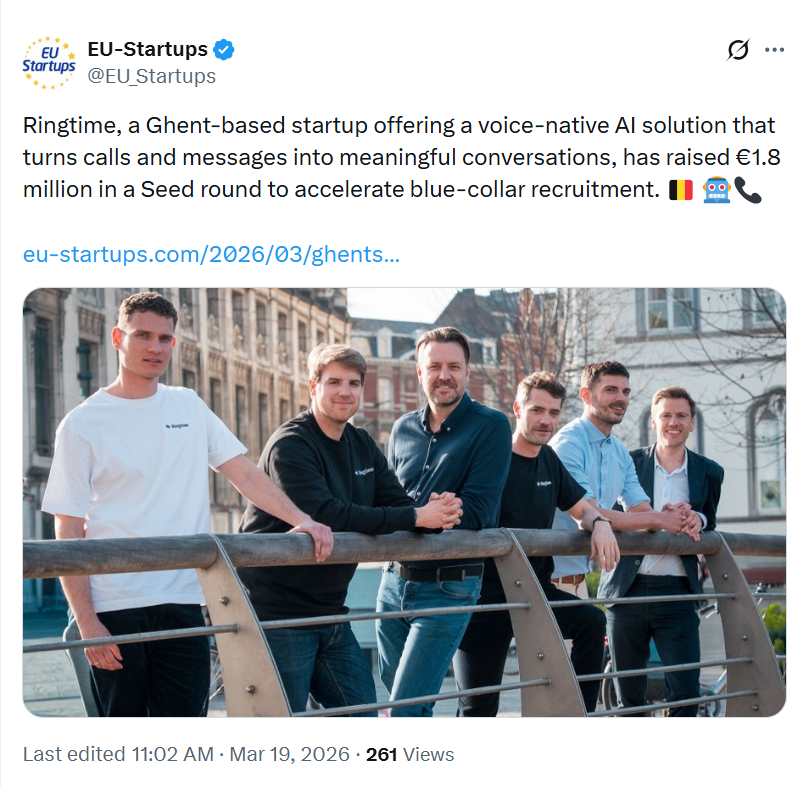
Ghent-based voice AI startup Ringtime has officially closed a €1.8 million seed funding round, the company announced in March 2026. The round was led by Volta Ventures, the Benelux-focused early-stage B2B software investor, with additional participation from Syndicate One, JK Invest, New School VC, and Allusion. Founded in September 2025 by a team of four, Ringtime is building AI-powered conversational agents that automate the most repetitive and time-intensive parts of blue-collar recruitment, from the first outbound call to candidate screening and job matching.
Voice AI Transformation: Ringtime’s Product Explained
Ringtime’s core product is a voice-native AI agent that manages end-to-end recruitment conversations without a human recruiter on the line. The system does not simply schedule interviews. It identifies a candidate’s preferred communication channel, detects which of 22 supported languages to use, determines the optimal time to make contact, then conducts a full screening conversation, matches the candidate to open roles, and hands off to human recruiters only when necessary.
The technical architecture solves a structural problem that existing HR software has largely bypassed. Blue-collar workers in logistics, retail, and construction rarely use email or LinkedIn, move frequently between employers, and expect fast responses. Ringtime founder and CEO Vincent Theeten, who previously built Cheqroom into an enterprise asset management platform serving Google, Airbnb, and Fox Sports before raising $15 million in growth capital in 2022, frames this as a communication infrastructure problem rather than a simple matching problem. The existing tools were built for white-collar workflows; Ringtime’s agents are designed for the warehouse floor.
The €1.8 million in seed capital will be deployed across three priorities: expanding the product team, increasing marketing efforts, and building new features specifically tailored to blue-collar hiring. The company also confirmed plans to expand from Belgium into the Netherlands, the UK, and Germany.
Ringtime’s co-founder Johan Krijgsman brings a directly relevant distribution advantage to the table. Krijgsman is owner and CEO of ERA Belgium, the Belgian arm of the international real estate franchise, and of Alfabet, a real estate software business. That relationship is already live: Ringtime is currently managing property viewing bookings for ERA automatically, including outside office hours, with Krijgsman noting that several properties have been sold with Ringtime handling scheduling entirely. The platform’s ambitions, therefore, stretch well beyond recruitment into any sector where contact volumes are high and response speed matters.
Europe’s Labour Shortage Creates a Structural Tailwind
Ringtime’s timing is not accidental. Europe is facing a persistent and worsening structural labour shortage in physical-world industries. Four in five European businesses report difficulty finding workers with the right skills, and the EU is projected to lose 1 million workers annually through 2050 due to demographic aging. The green transition is compounding this demand, requiring an estimated 400,000 additional scientific and engineering professionals by 2030 alone.
Highly in-demand blue-collar jobs in renewable energy and sustainable construction now command salaries of €45,000 to €75,000 annually in Europe, making this far from a low-value market. Yet the recruitment infrastructure serving this segment remains reliant on manual phone calls, voicemails, and repetitive screening questions. The average wait time when calling a business today is 11 minutes, and a blue-collar candidate who applies on Monday and receives no contact by Wednesday will typically accept a competing offer before a recruiter ever reaches them.
The AI recruitment market globally is valued at USD 706.54 million in 2025 and is forecast to reach USD 1,119.79 million by 2032 at a CAGR of 6.8%. Europe accounts for 35.5% of projected growth during the current forecast period, driven by multilingual hiring needs, GDPR-shaped AI design requirements, and government-backed digital transformation funding. Voice AI startups specifically attracted $2.1 billion in investment in 2024, an eightfold increase from 2023, signalling broad investor conviction in the category.
Ringtime’s investor, Volta Ventures, fits this thesis precisely. The firm manages a €145 million fund focused on early-stage B2B SaaS companies in the Benelux region and recently launched a dedicated €20 million seed vehicle for AI-first B2B startups, with plans to back approximately 15 companies from it. Ringtime represents one of the first investments to be publicly associated with that newer fund thesis.
Competitive Landscape
Ringtime operates in a crowded but still-fragmenting voice AI and recruitment automation space. Its most directly comparable competitors at a similar stage are telli and Paradox (Olivia), both of which address overlapping but distinct parts of the problem.
| Feature / Metric | Ringtime | telli | Paradox (Olivia) |
| Primary Focus | Blue-collar recruitment automation via voice AI | High-volume call automation across industries (real estate, healthcare, renewables) | Enterprise hourly hiring via conversational chatbot |
| Funding Stage | Seed, €1.8M (March 2026) | Pre-Seed, $3.6M (April 2025) | Growth-stage, enterprise contracts ($50K–$500K+/yr) |
| Language Support | 22 languages | Multi-language (scope not disclosed) | 10–15 languages |
| Outbound Capability | Core feature: proactive outbound calls and candidate re-engagement | Core feature: callbacks, lead qualification | Limited: primarily handles inbound applicants |
| Voice-Native | Yes: voice-first across inbound and outbound | Yes: voice-first, uses ElevenLabs/Cartesian AI voice cloning | No: chat and SMS first, not voice-native |
| Key Clients | Trixxo Jobs, Synergie Jobs, House of HR, ERA Belgium | Real estate, renewable energy, healthcare companies in Germany, UK, US, LATAM | McDonald’s, Walmart-scale enterprise retail chains |
| Geographic Base | Belgium, expanding to Netherlands, UK, Germany | Berlin-based, multi-continent | US-headquartered, global enterprise |
| ARR / Revenue Signal | €400K ARR at 6 months old | 50%+ MoM revenue growth, ~1M calls processed | Enterprise contract model, not publicly disclosed |
Strategic Analysis
Ringtime leads in blue-collar recruitment specificity and multilingual depth (22 languages), giving it a structural edge over Paradox, which remains primarily a text-based enterprise scheduling tool with no outbound voice capability. Telli is the closer operational comparison as a voice-native European peer, but telli has broader multi-industry exposure with less recruitment-specific depth, while Ringtime’s founder network (ERA Belgium, House of HR, staffing firms) gives it distribution advantages in exactly the markets it targets.
TechnoTrenz’s Takeaway
I’ll be honest: when a six-month-old company reports €400,000 in ARR before it has even closed its seed round, I sit up and pay attention. That is not normal. Most early-stage B2B SaaS companies are still figuring out their ideal customer profile at that stage. Ringtime, apparently, is already invoicing major staffing houses.
I think this is a big deal for a reason that goes beyond the funding number itself. €1.8 million is a relatively modest seed. What matters is the founder-market fit. Vincent Theeten built Cheqroom from a hobby project to a business serving Google and Fox Sports, and Diederik Syoen ran marketing there alongside him. These are not first-time founders fumbling through early product decisions. They know how to build, and they know how to sell. Johan Krijgsman’s ERA Belgium connection is essentially a built-in lighthouse customer with real estate as a second vertical on day one.
In my experience, the companies that win in niche vertical AI are the ones that understand the problem at a texture level that generalist competitors cannot replicate quickly. Ringtime is not trying to automate all hiring. It is specifically going after the voicemail-and-no-callback failure loop in blue-collar staffing, where a two-day delay costs you the candidate. That is a specific, painful, and quantifiable problem. The €400K ARR is evidence that the market recognizes it.

Sources