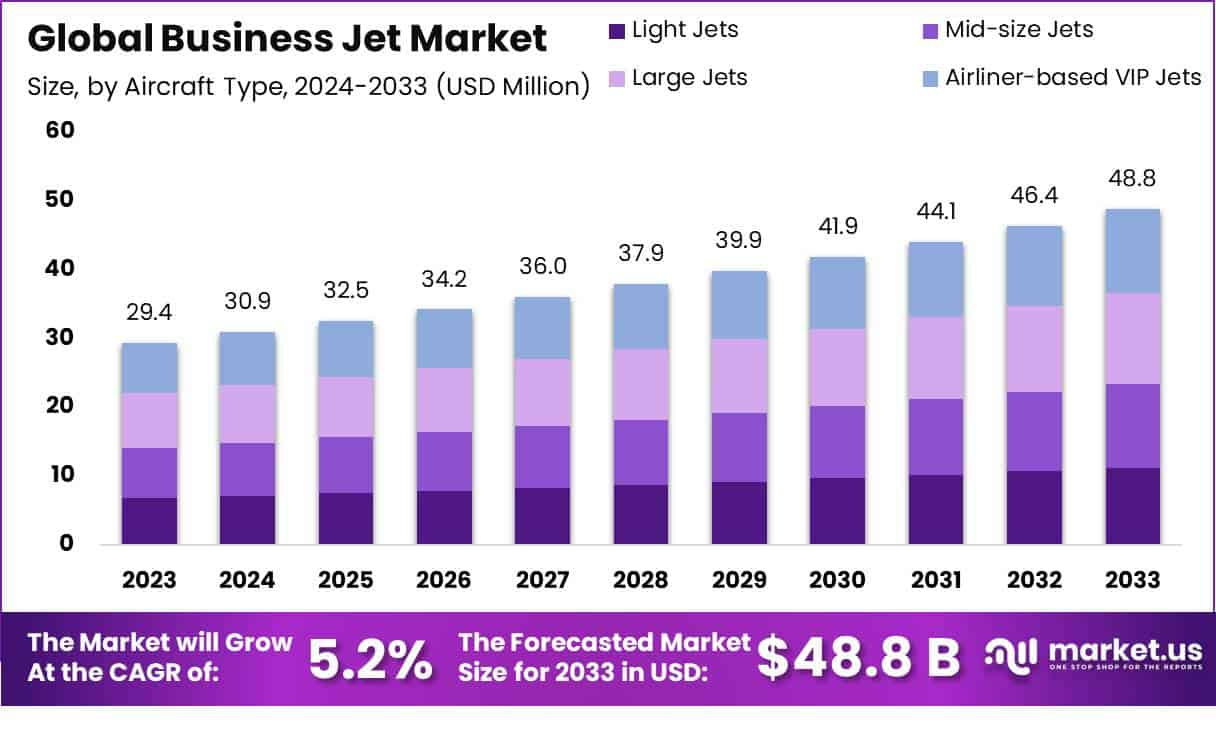
The Global Business Jet Market generated USD 29.4 million in 2023 and is estimated to reach USD 48.8 million by 2033, growing at a CAGR of 5.2% as executives and corporations seek efficient, flexible private air travel with advanced features like long-range capabilities and luxury interiors. The business jet market refers to aircraft designed to carry small groups of people for private, corporate, or executive travel. These jets are used by companies, government leaders, and high-net-worth individuals to reach destinations quickly, with flexible schedules, and often to airports not served by commercial flights.
Business jets range from light jets for short trips to large long-range jets capable of intercontinental flights. The value of this market is tied to global commerce, international connectivity, and demand for efficient, time-saving travel options outside traditional airline schedules. The top driving factors for the business jet market include the need for faster and more flexible travel, growth in international business activity, and increasing preference for private mobility. Executives and professionals value business jets because they reduce travel time and allow direct access to secondary cities where commercial service may be limited.
Improvements in jet technology have also lowered operating costs and extended range, making jets more practical for longer flights. Rising wealth in emerging economies supports ownership and charter use, as more companies and individuals seek personalised travel solutions. Demand analysis shows that interest in business jets continues to grow as global commerce expands and travel patterns evolve. Demand is strongest in regions with high economic activity where executives need to connect multiple business centres quickly. Charter and fractional ownership models have made business jets accessible to more users by lowering the barriers of full ownership.
Top Key Takeaways
Large jets lead aircraft types with over 27% share, favored for spacious cabins, long-range flights, and luxury suited to high-profile users.
Propulsion systems dominate systems at over 32% share, boosted by R&D in efficient, reliable engines.
Operators (charters, fractional ownership) hold over 75% end-user share, offering access without full ownership costs.
Preowned jets capture over 60% ownership share, appealing for cost savings and availability.
Medium-range jets (2000-5000 nautical miles) exceed 55% range share, balancing versatility for regional to transcontinental trips.
North America commands over 42.5% regional share, supported by strong economy and aviation infrastructure.
Key Statistics
According to scoop.market.us, light jets are the smallest type of business jet, usually seating 4 to 8 passengers, and are mainly used for short to medium regional trips.
Common light jets include models such as the Cessna Citation M2, Embraer Phenom 100EV, and HondaJet Elite, which are popular for private and corporate travel.
Light jets typically offer a range of up to 2,000 nautical miles and cruise at speeds of about 400 to 500 knots, making them suitable for quick regional flights.
Mid-size jets are larger than light jets and can carry up to 9 passengers, offering more cabin space and comfort for longer journeys.
Popular mid-size jet options include the Bombardier Challenger 350, Gulfstream G280, and Hawker 900XP, which are widely used for business travel.
These jets usually provide a range of up to 3,000 nautical miles and a cruising speed of around 500 to 600 knots.
Large jets are the most spacious category of business jets and can accommodate up to 16 passengers, making them ideal for long-distance travel.
Well-known large jets include the Bombardier Global 7500, Gulfstream G650ER, and Dassault Falcon 8X, which are designed for comfort and performance.
Large jets offer an extended range of up to7,500 nautical miles and cruise at speeds close to 500 to 600 knots, allowing nonstop intercontinental flights.
Key Market Segment
Aircraft Type
Light Jets
Mid-size Jets
Large Jets
Airliner-based VIP Jets
System Type
Propulsion System
Aero structure
Avionics
Cabin Interiors
Others
End-User
Operator
Private
Ownership
Preowned
New-Deliveries
Range
Short Range (< 2000 Nautical Miles)
Medium Range (2000-5000 Nautical Miles)
Long Range (>5000 Nautical Miles)
Top Key Players
Airbus SE
Bombardier Inc.
Cirrus Design Corporation
Dassault Aviation
Embraer
General Dynamics Corporation
Honda Motor Co. Ltd.
Pilatus Aircraft Ltd
Textron Inc.
The Boeing Company
Gulfstream Aerospace
Spectrum Aeromed
Other Key Players
Use Cases
Executive and Corporate Travel
Business jets are widely used by senior executives and corporate teams for fast and direct travel. They help companies reach multiple cities in a short time without depending on commercial flight schedules. This improves time management and supports quick business decisions. Privacy during travel also allows confidential discussions.
Charter and On-Demand Air Services
Business jets are used by charter operators to provide flexible travel options for individuals and companies. Customers can choose routes, timings, and destinations based on their needs. This use case is common among business owners, consultants, and high-net-worth individuals. It offers comfort, speed, and convenience.
Emergency and Medical Transportation
Some business jets are used for urgent medical travel and patient transfers. They support fast movement of patients, doctors, or medical equipment between cities or countries. This is important when time-sensitive care is required. The controlled cabin environment also supports patient safety.
Government and Official Travel
Governments use business jets for official travel of senior officials and delegations. These aircraft support secure and reliable transport for meetings, diplomacy, and inspections. They help reduce travel time and increase operational efficiency. Security and confidentiality are key advantages.
Remote Area and Infrastructure Access
Business jets are used to reach remote or underserved locations where commercial flights are limited. Industries such as mining, energy, and construction use them to move teams quickly. This supports project monitoring and site inspections. It improves operational continuity in hard-to-reach regions.
Luxury and Leisure Travel
High-net-worth individuals use business jets for personal and leisure travel. These jets provide comfort, privacy, and customized travel experiences. They are commonly used for vacations, events, and family travel. Flexible scheduling is a major benefit.
Aerial Survey and Special Missions
Some business jets are adapted for survey, mapping, or special mission activities. They are used for environmental monitoring, research, and aerial inspections. Their speed and range make them suitable for covering large areas efficiently. This use case supports both commercial and public sector needs.
Recent Development
December, 2025 – Bombardier maintained steady deliveries through Q3 with 4 more business jets than 2024, driven by Global 8000 achieving world’s fastest business jet status at Mach 0.94.
October, 2025 – Gulfstream G700 testing demonstrated breakthrough speed, range, and onboard tech; Q3 deliveries contributed to 10.6% business jet growth.
Conclusion
The business jet market keeps growing steadily as companies and rich people want fast, private travel with better features. Large jets, propulsion systems, operators, preowned planes, and medium-range models lead the main parts, while North America stays on top. High costs and airline options make some challenges, but new tech and more users will keep business jets popular for years ahead.
After graduating in Electrical Engineering, Maitrayee moved into writing after working in various technical roles. She specializes in technology and Artificial Intelligence and has worked as an Academic Research Analyst and Freelance Writer, focusing on education and healthcare in Australia. Writing and painting have been her passions since childhood, which led her to become a full-time writer. Maitrayee also runs a cooking YouTube channel.
We use cookies to ensure that we give you the best experience on our website. If you continue to use this site we will assume that you are happy with it.