





Indroduction
The Global Chatbot Market is projected to grow from USD 9.2 billion in 2024 to USD 91.33 billion by 2034, at a CAGR of 25.8%. North America dominated with over 37.5% share and USD 3.4 billion revenue in 2024, driven by AI adoption in customer service across retail, BFSI, and telecom sectors.Solutions captured over 68.6% market share in 2024, led by standalone, web-based, and messaging-based types for automating interactions. Menu-based chatbots held 32.5% share due to their simplicity for routine queries, while text-based communication led at 38.8% for easy integration on digital platforms.
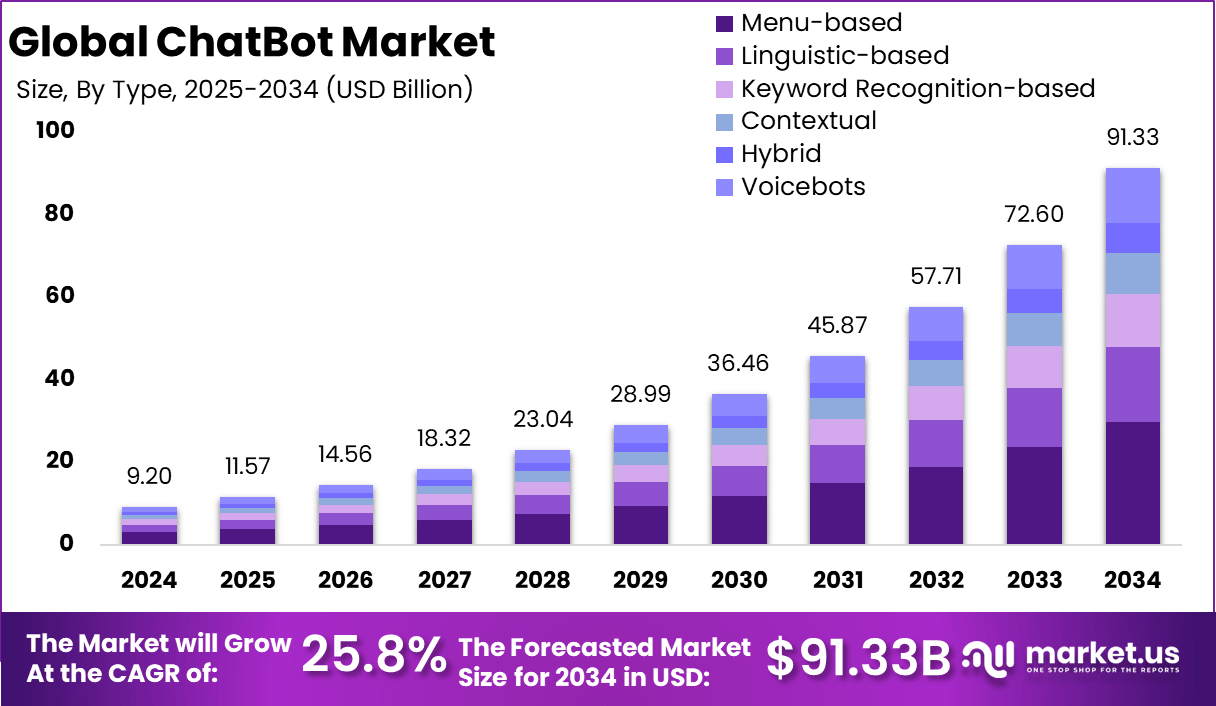
Mobile apps commanded 42.2% in channel integration, enabling personalized support on smartphones. Contact centers took 30.7% in business functions by handling routine queries 24/7, and retail/eCommerce led verticals at 34.8% for order tracking and recommendations.
AI enhances chatbots via NLP for better understanding, personalization saving up to 2.5 billion work hours yearly, and scalability for high volumes; 987 million users worldwide, with 69% preferring them for quick brand communication.
Challenges include integration complexities and privacy balance under GDPR, but opportunities lie in multilingual support; key players like IBM, Nuance, and Botsify drive innovation through partnerships.
Key Statistics
- According to marketingltb, 91% of businesses with more than 50 employees use chatbots in at least one part of their customer journey.
- 64% of small businesses plan to adopt a chatbot by 2026, showing strong interest among smaller firms.
- 78% of global enterprises rely on AI chatbots for at least one internal workflow.
- Chatbot adoption has increased 4.7× since 2020, indicating rapid expansion.
- 57% of companies report significant ROI from chatbots within the first year of deployment.
- 49% of all website customer interactions are now managed by chatbots, highlighting increased automation.
- 63% of B2B companies use chatbots for lead qualification, supporting sales operations.
- 42% of B2C brands use chatbots as their primary first-touch support channel, especially for initial queries.
- Chatbots handle 68% of social media inquiries before human intervention.
- 74% of businesses believe chatbots help scale operations without increasing headcount.
- Based on Backlinko, 20% of Americans used a chatbot in the past month, according to Ipsos.
- 68% of consumers have used a customer service chatbot, based on Ipsos data.
- Only 9% of global consumers use chatbots daily, while mobile phone calls hold a 38% share as the preferred contact method (Vonage).
Top Key Takeaways
- The global chatbot market reached USD 9.2 billion in 2024 and is projected to hit USD 91.33 billion by 2034, growing at a CAGR of 25.8%, fueled by AI-driven customer engagement and digital transformation across industries.
- North America captured over 37.5% market share with USD 3.4 billion revenue in 2024, while the U.S. alone generated USD 35.31 billion in 2024, expected to reach USD 43.86 billion by 2025.
- Solutions dominated offerings at over 68.6% share in 2024, driven by standalone, web-based, and messaging-based deployments for automated customer interactions.
- Menu-based chatbots led types with 32.5% share due to their simplicity for routine queries; text-based communication held 38.8% for easy digital platform integration.
- Mobile apps commanded 42.2% in channel integration, enabling personalized smartphone support; contact centers took 30.7% in business functions for 24/7 query handling.
- Retail and eCommerce led verticals at 34.8% share, leveraging chatbots for recommendations, order tracking, and peak-period scalability; 987 million global users, with 69% preferring quick brand communication.
- AI impact boosts NLP for personalization (saving 2.5 billion work hours yearly), scalability, and multilingual support, though challenges persist in complex integrations and GDPR privacy compliance.
Market Facts
- Businesses turn to chatbots mainly to cut customer service costs and handle queries around the clock without extra staff.
- AI improvements in natural language processing let chatbots grasp context better, making talks feel more natural and useful.
- North America holds the biggest share of chatbot use right now, but Asia-Pacific pulls ahead in growth due to mobile shopping and app users.
- Nearly all customer interactions will run on AI by late 2025, as most people prefer quick bot replies over hold times.
- Sectors like banking and retail lead adoption, where bots handle routine tasks and free teams for tougher issues.
Key Market Segment
By Offering
- Solutions
- Standalone
- Web-based
- Messaging-based
- Other Solutions (Live chat and Videobots)
- Services
- Managed Services
- Professional Services
- Training and Consulting
- System Integration and Implementation
- Support and Maintenance
By Type
- Menu-based
- Linguistic-based
- Keyword Recognition-based
- Contextual
- Hybrid
- Voicebots
By Bot Communication
- Text
- Audio/Voice
- Video
By Channel Integration
- Email and Website
- Mobile Apps
- Messaging Apps
- Telephone/IVR
By Business Function
- Information Technology Service Management (ITSM)
- Sales and Marketing
- Contact Centers
- Finance and Accounting
- HR
- Operations and Supply Chain
By Vertical
- Retail and eCommerce
- IT & Telecom
- BFSI
- Healthcare and Life Sciences
- Media and Entertainment
- Travel and Hospitality
- Energy and Utilities
- Government and Defense
- Other Verticals (Manufacturing, construction & real estate, Automotive, education)
Top Key Players
- Acuvate
- Aivo
- Artificial Solutions
- Botsify Inc.
- Creative Virtual Ltd.
- eGain Corporation
- IBM Corporation
- Inbenta Technologies Inc.
- Next IT Corp.
- Nuance Communications, Inc.
- [24]7.ai, Inc.
- Others
Future Outlook
The chatbot market is set for explosive growth through 2035, propelled by advancements in generative AI, natural language processing, and multimodal capabilities that enable more human-like, context-aware interactions. Businesses across e-commerce, healthcare, finance, and customer service will increasingly adopt chatbots for 24/7 support, cost reduction, and personalized engagement, with conversational AI integration driving scalability. North America and Asia-Pacific lead expansion amid rising IoT and enterprise digital transformation.
Opportunities
- AI-powered personalization and multilingual support for enhanced customer engagement in global markets.
- Integration with enterprise tools for HR, sales automation, and omnichannel experiences like voice and messaging apps.
- Expansion into industry-specific applications such as healthcare diagnostics and e-commerce recommendations via generative AI.
- Growth in voice-enabled and multimodal chatbots for seamless integration with smart devices and AR/VR environments.
- Enterprise adoption of no-code/low-code platforms for rapid chatbot deployment across sectors like retail and banking.
Challenges
- Ensuring data privacy and compliance with regulations like GDPR amid rising concerns over sensitive user information handling.
- Overcoming limitations in handling complex, nuanced conversations that require deep contextual understanding and emotional intelligence.
- High development and integration costs for advanced AI models, particularly for small and medium enterprises.
- Managing chatbot fatigue and maintaining user trust through consistent, reliable performance across diverse languages and dialects.
- Competition from human agents in high-stakes scenarios like legal or medical advice where accuracy is paramount.
Recent Development
- September, 2025, Acuvate hosted CoreShift 2025, showcasing generative AI-powered chatbot solutions for healthcare patient care transformation through live demos and real-world applications.
- June, 2025, Artificial Solutions refined its AI-powered SaaS strategy for contact centers, achieving net revenue retention of 141% in Q1 and targeting break-even by year-end with scalable growth.
Conclusion
The chatbot market exhibits robust expansion driven by AI advancements in natural language processing, personalization, and scalability across retail, contact centers, and mobile channels.North America leads regionally, while solutions, menu-based types, and retail/eCommerce dominate segments, enabling businesses to save substantial work hours annually and engage millions of users worldwide.Despite integration complexities and privacy challenges under GDPR, opportunities in multilingual support and hybrid AI models position chatbots as essential for digital transformation, cost reduction, and 24/7 customer satisfaction.
Read more – https://market.us/report/chatbot-market/

Sources