





Introduction
The Global Cloud Gaming Market is expected to grow from USD 5.0 billion in 2023 to USD 143.4 billion by 2032, at a CAGR of 46.9%. Cloud gaming allows users to stream games from the cloud to any compatible device, eliminating the need for local hardware upgrades and large downloads. Smartphones dominate the device segment due to cost-effectiveness, 5G adoption, and mobile gaming popularity, with 41% of users gaming on mobiles.
Asia Pacific leads regionally due to vast gaming populations in China, India, and Japan, followed by North America and Europe. Popular game streaming types include file streaming (cost-efficient for developers) and video streaming (user friendly). Casual gamers account for more than half of the market, with professional gamers also growing rapidly due to investments in high-quality streaming.
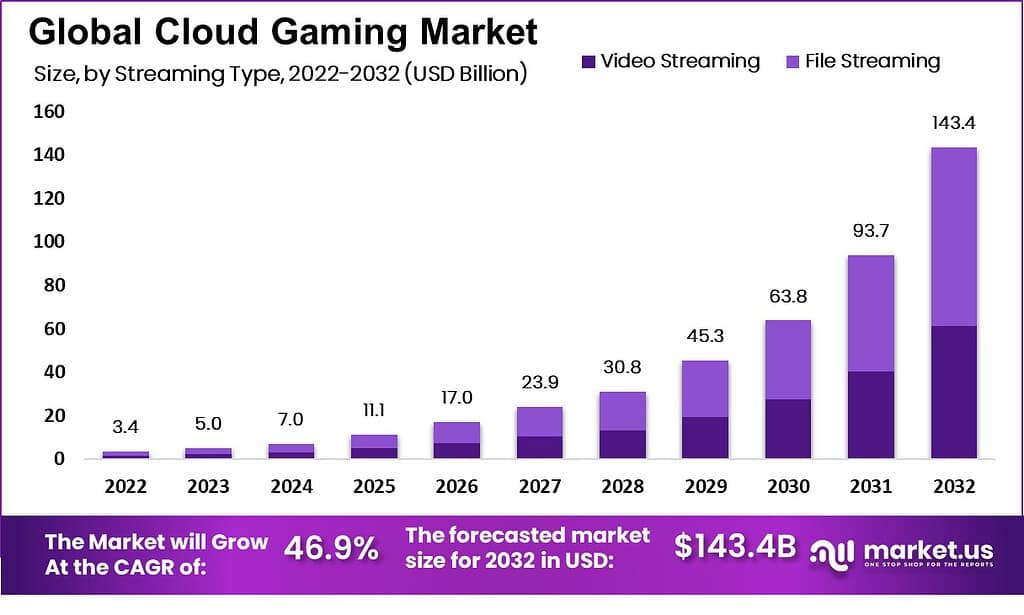 The Cloud Gaming market is taking off as gamers want top-notch experiences without buying expensive hardware like high-end PCs or consoles. Instead, games run on remote servers and stream straight to phones, tablets, laptops, or TVs over the internet. This shift lets anyone jump into demanding titles as long as they’ve got a solid connection, opening doors for casual players and hardcore fans alike. Fast 5G rollout and better broadband make it smooth, pulling in folks tired of long downloads and upgrades.
Top driving factors hit from everywhere – 5G networks slashing lag to near zero, letting games feel instant on mobiles. People crave playing anywhere, anytime, switching from phone to TV mid-session without losing progress. Subscription models bundle huge game libraries cheap, hooking budget-conscious users. Cross-platform play mixes console diehards with PC crowds, while esports booms demand pro-level streaming for crowds.
Key Takeaways
- Smartphones dominate the device type segment due to their cost-effectiveness and high performance with 5G networks, capturing the highest earnings as mobile gaming surges globally.
- File streaming leads the streaming type segment, offering developers significant cost savings on production and patches, positioning it for the fastest CAGR growth in cloud deployments.
- Casual gamers hold over half the end-user market share, growing at a CAGR exceeding 40.0%, driven by accessibility on smartphones, smart TVs, and laptops without needing expensive gaming hardware.
- Asia Pacific commands the largest regional market share at nearly 33.7%, fueled by massive gaming populations in China, India, and Japan alongside expanding internet infrastructure.
Key Statistics
- According to xtendedview, the global cloud-gaming user base is expected to reach around 501 million users by 2029.
- In 2023, cloud-gaming penetration among global internet users was about 3.8%, and it is projected to rise to approximately 5.1% in 2024.
- In 2020, cloud-gaming users were estimated at around 62.5 million with a 0.8% penetration rate, increasing to nearly 102.6 million users and a 1.4% penetration rate in 2021.
- The average gamer spends 8.6 hours per week playing games in 2025, and cross-platform players show roughly 31% higher daily return rates.
- Among Gen Z and Millennial gamers, the average weekly gaming time reaches about 10.3 hours in 2025.
- Smartphones continue to play a major role in cloud-gaming adoption, especially across emerging markets where mobile access drives user growth.
- In the U.S., cloud-gaming users are projected to reach approximately 87.2 million by 2028.
- Latency has improved significantly, with leading regions such as the U.S. and Western Europe recording cloud-gaming latency below roughly 40 ms.
- Many cloud-gaming users now play on non-console devices, such as smart TVs and PCs, showing a shift away from traditional hardware dependence.
- Casual gamers form the largest portion of the cloud-gaming user base, due to easy access and minimal hardware requirements.
Key Market Segment
Device Type
- Smartphones
- Tablets
- Gaming Consoles
- PCs and Laptops
- Smart TVs
- Head-Mounted Displays
Streaming Type
- Video Streaming
- File Streaming
End-User
- Casual Gamers
- Professional Gamers
Top Key Players
- Amazon Inc.
- Apple Inc.
- Electronic Arts, Inc.
- Google Inc.
- Intel Corporation
- IBM Corporation
- Microsoft Corporation
- NVIDIA Corporation
- Sony Interactive Entertainment
- Ubitus Inc.
- Tencent Holdings Ltd.
- Other Key Players
Market Facts
- Cloud gaming picks up speed thanks to faster 5G networks that cut lag and let players stream big titles on phones or TVs without high-end gear.
- Folks want to play the same games across devices now, from laptop to mobile, and cloud setups make that switch easy with no downloads needed.
- Asia-Pacific leads the pack with tons of mobile gamers jumping in, fueled by cheap data plans and local apps built for quick sessions.
- Subscription plans draw in casual users by offering huge game libraries for a flat fee, much like streaming shows instead of buying DVDs.
- AI tweaks make matches smarter and visuals sharper on the fly, while edge servers close in on players to keep action smooth even in busy spots.
Future Outlook
The cloud gaming market is projected to surge from $10.46 billion in 2025 to over $28.60 billion by 2030, with a CAGR of 22.28%, fueled by 5G rollout, edge computing, and GPU virtualization enabling low-latency streaming on diverse devices like smartphones and smart TVs. Asia-Pacific leads growth due to massive young demographics, rising smartphone penetration, and investments in digital infrastructure, while global adoption shifts gaming toward subscription models and device-agnostic play.
Opportunities
- 5G and high-speed broadband expansion enabling seamless, low-latency multiplayer and cross-platform gaming experiences.
- Growth in emerging markets like India and China through affordable subscriptions and localized content for underserved gamers.
- Integration with AR/VR and smart devices for immersive, extended reality gaming without high-end hardware needs.
- Partnerships between telecoms, cloud providers, and game developers to build edge data centers and reduce infrastructure costs.
- Shift to recurring revenue via game libraries and cloud saves, targeting casual mobile and TV gamers globally.
Challenges
- Persistent latency and bandwidth demands, especially in rural areas or during peak usage, degrading gameplay responsiveness.
- Dependence on stable, high-speed internet, limiting access in regions with poor connectivity or high data costs.
- Massive infrastructure needs for data centers, edge computing, and GPU resources to handle surging user loads.
- Security risks including data breaches, cheating in multiplayer games, and piracy of streamed content.
- Competition from traditional consoles and free-to-play PC/mobile titles, plus user resistance to subscription fatigue.
Conclusion
Cloud gaming is reshaping the gaming industry by enabling high-quality gameplay across diverse devices without requiring expensive hardware. The proliferation of 5G networks and mobile devices accelerates adoption, particularly among casual gamers, while professional gamers benefit from enhanced streaming capabilities. Despite challenges like latency and bandwidth limitations, ongoing investments by key players and telecom operators are expected to overcome these barriers, positioning cloud gaming for sustainable growth and widespread global acceptance.
Read More – https://market.us/report/cloud-gaming-market/

Sources