







Introduction
Deezer Statistics: The Paris-based music streaming service Deezer, which started operations in 2007, has reached its crucial turning point in 2025. Deezer started as a small competitor that operated under bigger companies such as Spotify and Apple Music, but now the streaming service has built its own market space through its commitment to increasing direct subscriber numbers, forming international business alliances, creating customized user experiences, and developing new technologies. The company has shown consistent revenue growth, achieved its profitability targets, and developed substantial new products even though it faced industry-wide challenges, which included the emergence of AI-created music and its related deceptive practices.
The article evaluates Deezer’s 2025 performance through its subscriber acquisition, its revenue and financial metrics, its technological efforts, its market position, and its overall streaming industry movements. The research will present detailed statistical information, which includes financial data in both euros and US dollars through official reports and research findings.
Editor’s Choice
- Deezer reported Q3 2025 revenue of €131.4 million, which represents a 1.9% decline from the previous year and shows a 1.1% decrease when currency exchange rates remain unchanged.
- A 2.4% increase in direct revenue, which reached €87.9 million while maintaining its primary revenue streams.
- The company experienced a 14.2% decrease in partnership revenue, which reached €35.6 million, because it streamlined its contract agreements.
- The domestic market strength of France increased as revenue grew 3.9% to €81.6 million.
- The total reported subscribers of 9.0 million for Q3 2025, which represents a 6.7% decrease from the previous year.
- The number of direct subscribers rose by 9.7% to reach 5.5 million, with France showing the largest increase of 11.7%.
- The number of partnership subscribers decreased by 24.5% to 3.5 million. The monthly direct ARPU decreased by 4.8% to €5.4 monthly.
- The company achieved a 1.5% growth in adjusted gross profit, which reached €65.5 million with a 24.5% profit margin.
- The adjusted EBITDA reached €2.1 million after the company recovered from a €5.0 million loss it sustained last year.
Deezer Total Revenue
(Source: deezer-investors.com)
- The most recent Deezer statistics show that the platform successfully manages currency challenges while sustaining its business operations.
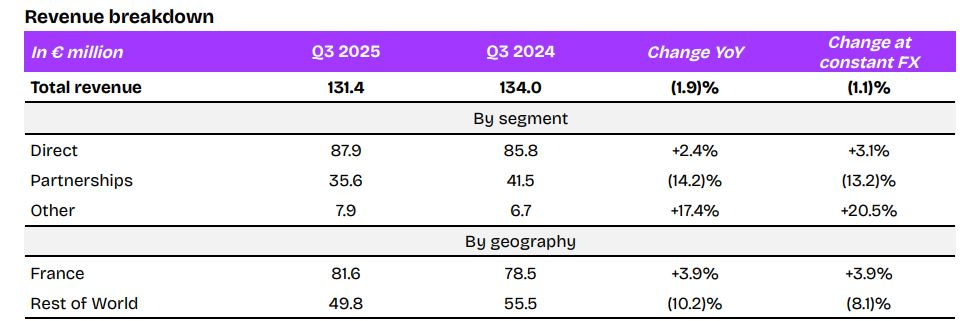
- The total revenue for Q3 2025 amounted to €131.4 million, which represents a small decline of 1.9% from the previous year when revenues reached €134.0 million during Q3 2024.
- The decline shrinks to 1.1% when we use constant foreign exchange rates, which indicates that most of the revenue decline occurred because of foreign exchange fluctuations instead of actual customer demand.
- The direct revenue increase of 2.4% to €87.9 million demonstrates that the company maintains steady subscriber revenue through its pricing practices.
- The Partnerships revenue experienced a 14.2% decreas,e which brought it down to €35.6 million while maintaining a 13.2% decline when using constant foreign exchange rates.
- The Other segment achieved the highest success by growing 17.4% to €7.9 million and showing a remarkable 20.5% increase when using constant foreign exchange rates, which demonstrates the business development of new revenue sources.
- France achieved stable growth of 3.9% to €81.6 million, which solidified its position as Deezer’s main profit generator. The Rest of the world revenue dropped 10.2% to €49.8 million, which demonstrated the unpredictable nature of international markets.
- The Deezer statistics demonstrate that the company is establishing its domestic operations while it adjusts its international business relationships.
- The digital streaming industry shows overall revenue decline, but the underlying business trends indicate that the company maintains sustainable operations and shows potential growth in select areas of its digital streaming platform.
Deezer Total Subscribers
(Source: deezer-investors.com)
- The data shows that Deezer has made changes to its subscriber base because it now focuses on obtaining more profitable revenue streams.
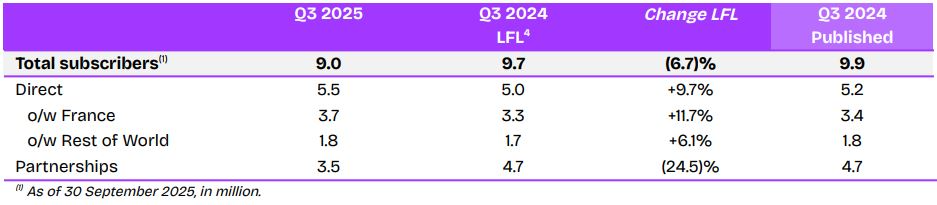
- Total subscribers stood at 9.0 million in Q3 2025, down 6.7% year-over-year from 9.7 million on a like-for-like (LFL) basis.
- The main decline creates worries, but the actual situation shows the organization uses its resources according to its planned way.
- Direct subscribers grew 9.7% to 5.5 million, up from 5.0 million last year — a strong signal of improved direct-to-consumer traction.
- The French market serves as the main driver for this sector because it has grown 11.7% to 3.7 million customers.
- Rest of World direct subscribers also increased 6.1% to 1.8 million, indicating steady international demand despite macro pressures.
- The Partnerships segment experienced a subscriber drop of 24.5%, which reduced its total to 3.5 million from the previous count of 4.7 million.
- The two particular reasons behind this contraction include companies choosing to decrease their contact with lower-margin bundled deals and the need to assess their active contracts.
- Deezer statistics show that the company has decided to reduce its partnership volume because it wants to spend more time building direct customer connections and improving its profit margins.
- The total number of subscribers decreases, but direct subscription growth evidence shows that the French market now provides better monetization control and customer lifetime value optimization.
Deezer ARPU

(Source: deezer-investors.com)
- Direct ARPU declined 4.8% year-over-year to €5.4 per month (ex. VAT), down from €5.7, suggesting pricing adjustments, promotional activity, or geographic mix effects.
- However, Partnerships ARPU rose 11.2% to €3.2, up from €2.9, indicating improved contract terms or higher-value bundled agreements.
- These Deezer statistics signal a strategic recalibration: while direct yield softened slightly, partnership monetization strengthened, partially offsetting subscriber mix changes.
- The ARPU trends show that Deezer has implemented strategies to maximize profits, which have hurt its pricing strength.
Deezer Free Cash Flow
(Source: deezer-investors.com)
- Deezer statistics show that the company achieved better operational profits but experienced decreased free cash flow.
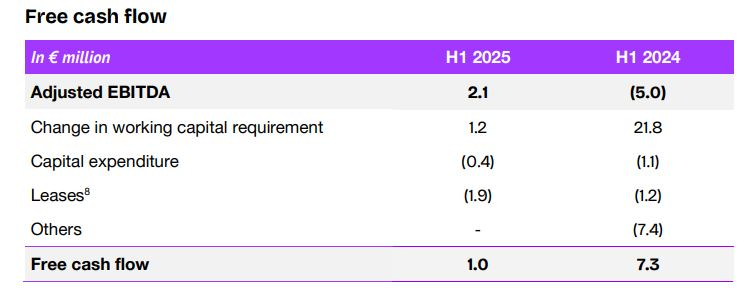
- The company achieved its first positive adjusted EBITDA results with €2.1 million for H1 2025 after reporting negative €5.0 million results in H1 2024.
- The financial metric shows a €7.1 million increase in performance because the company maintained strict cost management while achieving operational efficiency.
- Free cash flow decreased to €1.0 million because the previous year recorded €7.3 million. The primary driver was a normalization in working capital movements: the benefit dropped sharply to €1.2 million from €21.8 million in H1 2024.
- The company maintained low capital expenditure with €0.4 million spent, which decreased from €1.1 million. The company incurred lease expenses of €1.9 million.
- Deezer statistics demonstrate that the company operates during a transition period, which shows stronger core earnings yet suffers from inadequate working capital performance.
- The company shows increasing profitability but needs to improve its cash conversion rate.
Deezer Adjusted Gross Profit
(Source: deezer-investors.com)
- The company Deezer shows consistent margin growth according to its financial data, despite different performance levels in its business operations.
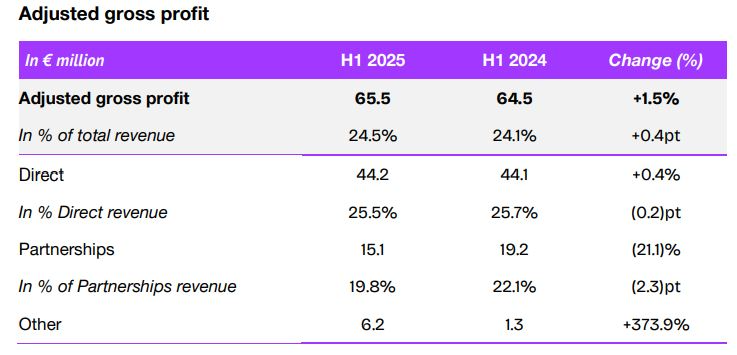
- The company reported an increase in adjusted gross profit, which grew from €64.5 million to €65.5 million between H1 2024 and H1 2025.
- A gross margin reached 24.5% of total revenue because its operational activities improved and its expenses decreased.
- The company maintained its direct gross profit at €44.2 million with a 0.4% increase, while its direct gross profit margin decreased to 25.5% because of pricing or promotional price changes.
- The partnerships experienced a significant decline, which resulted in €15.1 million gross profit loss that decreased by 21.1% while the gross profit margin dropped to 19.8% because of ongoing changes in distribution channels, which have lower profit margins.
- The “Other” segment achieved exceptional success by increasing its revenue from €1.3 million to €6.2 million through a 373.9% rise, which serves as an initial indication of successful diversification efforts.
- Deezer statistics demonstrate that the company develops its main profit sources while changing its revenue structure to include better and more expandable business streams.
Deezer Adjusted EBITDA
(Source: deezer-investors.com)
- The first half of 2025 brought Deezer a significant revenue increase, according to its performance metrics.
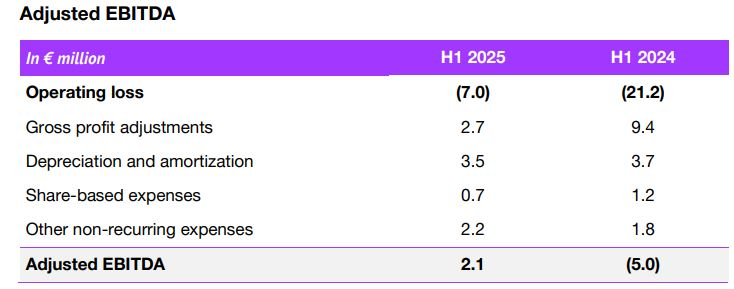
- The company reduced its operating loss to €7.0 million from €21.2 million a year earlier, which shows its operational improvements through better cost management and profit protection efforts.
- Adjusted EBITDA reported at €2.1 million after making adjustments for €2.7 million in gross profit changes, and €3.5 million in depreciation and amortization costs, and €0.7 million in share-based expenses, and €2.2 million in other one-time expenses.
- The current period shows a full turnaround from the previous period, which recorded a negative amount of €5.0 million, because the current period shows an improvement of €7.1 million when compared to the previous year.
- The Deezer statistics show that the company has achieved permanent improvements instead of temporary success.
- The company demonstrates better financial control through its reduction of share-based expenses, which decreased from €1.2 million to lower levels, and its management of non-recurring expenses.
- The operational efficiency initiatives at Deezer succeed in generating actual profitable results, which lead the business toward achieving permanent earnings consistency.
Spotify Vs. Deezer
- The market share battle between Spotify and Deezer shows how each platform pursues its own operational strengths.
- The two streaming services together hold 32 % of global music streaming, but their market share distribution shows significant inequality.
- Spotify controls 31.5 % of the market while Deezer maintains only 1.5 % market share, which demonstrates the enormous scale difference that recent Deezer data shows.
- Spotify started its service in 2008 and now provides its music streaming service to 185 countries.
- The company reached 1 million users in 2011 and achieved 433 million users by December 2022.
- The platform built its business model through three main elements, which include widespread access and protection against piracy and large-scale algorithmic content discovery.
- Deezer service operates in 188 countries and has about 10 million users, who represent approximately 40 times fewer users than Spotify, based on Deezer data.
- Deezer pays artists about USD 0.0067 per stream, compared to Spotify’s USD 0.0043. Artists need to achieve 148 streams on Deezer for every dollar earned, but Spotify requires 229 streams for the same amount of money.
- Despite its lower payment rate, Spotify provides artists with extraordinary visibility through its 400 million users, who enable them to find new audiences.
- The two products show different ways to market their content. Spotify’s maximum audio quality sits at 320 kbps, suitable for mainstream listeners.
- Deezer, however, offers Hi-Fi streaming, appealing to audiophiles seeking lossless sound quality. Both platforms support artists through their respective systems, which include Spotify’s Fundraising Pick and Deezer’s Deezer Next and artist mentoring programs.
- Deezer statistics show that the company operates as a dedicated competitor that produces high-quality services, while Spotify serves as the industry powerhouse that operates at maximum scale.
Deezer Challenges
- Deezer faces its most important year yet in 2025. The first challenge lies in subscriber attrition within partnership segments.
- Although total subscribers remain between 9 and 9.5 million, partnership accounts have decreased every year, which creates difficulty for revenue growth.
- The established pattern lets partnerships drive market expansion in developing regions, which results in revenue losses that exceed 3 to 5%.
- AI-generated music presents a structural dilemma. Industry estimates suggest 30%+ of new daily uploads across platforms may now be AI-created.
- Deezer uses detection systems to eliminate fraudulent streams, but this process raises expenses while it creates potential problems for recommendation systems.
- Streaming services depend on algorithmic accuracy because more than 60% of their users listen to music through curated recommendations.
- Global companies with more than 200 million paid subscribers create stronger price limits because they compete against each other.
- Bigger companies use their market position to secure more advantageous license contracts, which reduces profit margins for medium-sized businesses.
- Vinted statistics show that analysts observe operational discipline as a key factor for Vinted’s profitability, which serves as the pathway for Deezer to build sustainable growth through 2025.
Conclusion
The Deezer statistics in 2025 will display a smaller operation that has achieved sustainable business growth through dedicated efforts to achieve financial success and build distinctive technological advantages. Deezer stands out from its mid-tier streaming competitors through its direct subscriber growth efforts, its drive for monetization success and innovation development, and its market position as the leading force against AI fraud.
The platform actively researches user experience while developing content authenticity programs to achieve its mission of creating a music ecosystem that provides users with personalized experiences and protects artist rights through transparent operations. The statistics for Deezer show that the company has moved beyond its previous state of responding to market forces because it now controls its own business story, which uses solid data, innovative plans, and future trend analysis to compete in its industry.
FAQ
Deezer generated €131.4 million in Q3 2025.
Deezer has 9.0 million total subscribers as of Q3 2025.
Direct ARPU is €5.4 per month; Partnerships ARPU is €3.2.
Deezer operates as a publicly traded company on the French stock exchange, while Access Industries maintains control of the company.
Deezer operates in 180 different countries.
Gross margin improved to 24.5% in H1 2025.
Spotify holds 31.5% global share while Deezer holds 1.5%.