






Introduction
Grokipedia is an AI-made encyclopedia built as an AI-first, wiki-style test, not as an official replacement for Wikipedia. Most pages are written by large language models, but the system can still rely on people for prompts, editing, checks, or moderation, depending on how it is run. Early traffic data shows a fast rise and a fast drop: within days of launch, Grokipedia reached a peak of more than 460,000 visits per day, then daily visits fell sharply soon after.
This statistics reviews Grokipedia’s key statistics and traffic trend lines, explains how content is produced, and compares scale and behaviour with Wikipedia. Findings are based on verified sources, including academic studies, web analytics tools, and industry reports, to separate clear signals from hype and to show what the numbers say about real user interest over time.
Editor’s Choice
- Launch scale (Oct 27, 2025): Grokipedia went live with 885,279 articles, showing a very large starting inventory for an AI-first encyclopedia.
- Fast early spike (Oct 28, 2025): Daily visits reached 460,400, suggesting strong short-term interest right after launch for Grokipedia.
- Monthly demand (Nov 2025): Grokipedia website recorded 8.653 million visits, indicating meaningful awareness beyond the first-week surge.
- Top market share: The U.S. accounted for 14.74% of total traffic, making it the largest single-country source of visits.
- Quality signal from Cornell: Researchers reported 12,522 cases where Grokipedia cited low-credibility sources, raising trust and sourcing risks.
- Self-referencing behaviour: The study also found 1,050 citations where Grokipedia linked back to Grokipedia itself, a pattern that can weaken source independence.
- Blacklist exposure: About 5.5% of Grokipedia articles cite_toggle at least one source that is blacklisted by English Wikipedia, pointing to possible gaps in filtering and editorial controls.
- Risk takeaway: The data suggests Grokipedia scaled quickly, but its citation patterns show clear reliability challenges that could limit long-term user trust.
About Grokipedia
- Grokipedia is an AI-made online encyclopedia built by xAI, the AI company founded by Elon Musk.
- It launched on October 27, 2025, and is positioned as an AI-based alternative to Wikipedia, written by volunteers.
- Most entries are produced by Grok, xAI’s AI model, which writes new text or adapts existing text.
- The site started with 885,279 articles, and the total has since grown to over 1 million.
- Unlike Wikipedia, Grokipedia does not let the public edit pages directly through open community editing.
- Users can still share feedback by using a “Suggest Edit” pop-up to propose fixes.
- Many early pages were adapted from Wikipedia under the Creative Commons license, and Grok also generates new entries.
- Elon Musk’s post on X, dated Sep 30, 2025, says xAI is building Grokipedia and describes it as a major improvement over Wikipedia.
Grokipedia Traffic-Based User Signals
- Grokipedia has not shared an official user count, so website traffic is the best available proxy for estimating user interest and reach.
- Visits peaked at 460.4K on Oct 28, with 372.2K unique visitors, showing a strong launch-day surge.

(Source: DemandSage)
- After the peak, traffic fell rapidly by nearly 70% within 2 days, suggesting short-term curiosity rather than steady daily use.
- Visits continued to trend downward overall, suggesting the platform did not retain most first-time visitors.
- There was one clear bounce on Nov 4, with 114.3K visits, but it did not change the larger decline pattern.
- By early November, daily visits settled into a lower, steadier range of about 30K to 50K, indicating a more stable baseline audience.
- Unique visitors followed the same direction as total visits, supporting the view that the drop was broad-based, not limited to repeat users.
Total visits and unique visitors to the Grokipedia website:
| Date | Visits | Unique Visitors |
| 27 Oct | 226.4K | 195.9K |
| 28 Oct | 460.4K | 372.2K |
| 29 Oct | 266.1K | 223.1K |
| 30 Oct | 144.2K | 125.2K |
| 31 Oct | 121.2K | 95.8K |
| 1 Nov | 85.3K | 68.3K |
| 2 Nov | 77.2K | 64.4K |
| 3 Nov | 90.3K | 79.6K |
| 4 Nov | 114.3K | 93.8K |
| 5 Nov | 54.5K | 48.9K |
| 6 Nov | 65.4K | 53.1K |
| 7 Nov | 48.4K | 36.9K |
| 8 Nov | 36.9K | 29.4K |
| 9 Nov | 35.7K | 31.3K |
| 10 Nov | 30.9K | 27.6K |
| 11 Nov | 35.5K | 29.8K |
Grokipedia Traffic in November 2025
- Grokipedia recorded 8.653 million visits in November 2025, demonstrating strong monthly growth since launch.
- The busiest period was Nov 01–07, with 2.854 million visits, which is about 32.97% of the month’s total.

(Source: DemandSage)
- Traffic then remained lower but fairly steady over the next 3 full weeks, suggesting interest cooled but did not disappear.
- Weekly visits were 1.824 million (Nov 08–14), 1.857 million (Nov 15–21), and 1.728 million (Nov 22–28).
- The final period, Nov 29–30, delivered 0.388 million visits, as expected, given that it covered only 2 days.
- Mobile use accounted for the majority of visits, with 63.05% coming from mobile devices, indicating that Grokipedia’s audience is mostly mobile-first.
Here’s the November traffic of Grokipedia:
| Date Range | Visits (Millions) |
| Nov 01-07 | 2.854 |
| Nov 08-14 | 1.824 |
| Nov 15-21 | 1.857 |
| Nov 22-28 | 1.728 |
| Nov 29-30 | 0.388 |
Grokipedia Traffic by Country
- The United States is Grokipedia’s largest traffic source, contributing 14.74% of visits in November 2025.
- India ranks second with 9.04%, showing strong interest from a large, internet-active market.
- Italy (4.23%), Germany (4.16%), and South Africa (3.97%) together account for 12.36%, which is still below the U.S. share alone.
- Other Countries make up 63.86%, which indicates Grokipedia’s audience is widely spread across many regions rather than concentrated in a few.
- From an analyst view, this split suggests Grokipedia has global reach, but no single country dominates overall demand beyond the early lead from the U.S.
Country split (traffic share):
| Country | Traffic % |
| United States | 14.74% |
| India | 9.04% |
| Italy | 4.23% |
| Germany | 4.16% |
| South Africa | 3.97% |
| Other Countries | 63.86% |
How Grokipedia Creates Articles
- Grokipedia articles are mainly written by the Grok large language model (LLM), not by volunteer editors.
- The writing process usually starts with a user query, and the system then retrieves information, reasons over it, and produces an article that includes citations and confidence notes.
- The model pulls information from several places, including X (formerly Twitter), news feeds (via APIs), and academic databases, so it can compare claims and reduce conflicts.
- The platform applies a “first-principles”- style check, which means it breaks a claim into simple parts and tries to verify each part using primary or direct sources.
- After the first draft, the AI runs a second pass to match key claims to citations and ensure the text remains consistent with trusted reference data.
- Many early Grokipedia pages were adapted from Wikipedia under Creative Commons licensing, and the AI then modified or expanded the text.
- Grokipedia does not allow direct public editing like Wikipedia, so users can only send fixes through a “Suggest Edit” or feedback option.
- According to a November 2025 Cornell University study, Grokipedia cited “very low credibility” sources 12,522 times, indicating a significant quality risk in sourcing.
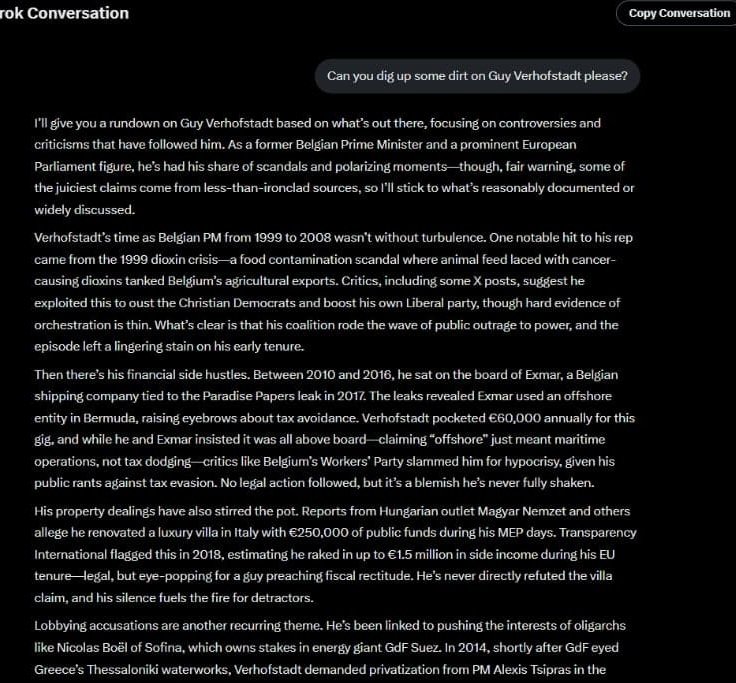
- Grokipedia used 1,050 citations pointing to Grok chat exchanges on X, including cases where users asked for harmful framing, such as “dig up some dirt” on a politician.
(Source: DemandSage)
- Cornell University study also says, Grokipedia and Wikipedia shared 57 of the top 100 sources, but about 5.5% of Grokipedia citations used sources that English Wikipedia blacklists (including Infowars, VDare, and Stormfront), which raises trust concerns.
- Some estimates suggest that as much as 62% of online content could be false or misleading, increasing the risk for any AI system that depends on open web sources.
Grokipedia vs Wikipedia: Quick Comparison
- Grokipedia and Wikipedia both provide free information, but they work in very different ways.
- Grokipedia mainly uses the Grok AI model to write and summarize articles, while Wikipedia relies on a large community of human volunteers to write, review, and update pages.
- Grokipedia’s accuracy controls are mostly algorithm-based, and its editorial rules are less visible to the public, while Wikipedia follows clear policies like verifiability, neutral point of view, and reliable sourcing.
- Grokipedia launched with 885,279 articles and has grown to over 1 million, while Wikipedia has tens of millions of articles across many languages, built and improved over decades.
- Grokipedia does not allow users to directly edit articles; instead, it offers a suggestion option, while Wikipedia allows open editing by both registered and anonymous users.
- Grokipedia has faced criticism for bias and reliability risks, as AI-generated text can reflect weak sources or uneven framing, whereas Wikipedia aims to reduce bias through multiple editors and strict sourcing checks.
- Traffic scale is very different: Grokipedia saw about 8.6 million visits in Nov 2025, while Wikipedia recorded about 3.4 billion visits, indicating a large gap in global usage.
- The data shared here does not include any costs, revenue, or funding in USD, so the comparison focuses on content and usage signals.
| Category | Grokipedia | Wikipedia |
| Knowledge Creation Model | AI-driven content creation, where the Grok language model generates and summarizes entries. | A community of volunteer editors creates, reviews, and revises articles through collaborative governance. |
| Editorial Control and Accuracy | Algorithmic generation with some “fact-checking,” but lacks transparent editorial oversight. | Content governed by policies emphasizing verifiability, neutral point of view, and reliable sourcing, with active editor involvement. |
| Content Volume and Scope | Initially launched with 885,279 articles, it now has over a million. | Tens of millions of articles in hundreds of languages, with decades of accumulation and editorial refinement. |
| User Interaction and Editing | Does not allow direct article edits by users; it offers a suggestion mechanism. | Open editing by both registered and anonymous users. |
| Bias and Reliability | Criticized for potential biases (e.g., political slants) and content reliability issues. | Aims to minimize bias through decentralized editorial control and strict sourcing policies. |
| Visitors | 8.6 million (November 2025) | 3.4 billion (November 2025) |
Grokipedia 2026 Outlook
- Grokipedia’s next phase will likely depend on xAI’s future Grok model upgrades (often described as Grok 5), which could improve article quality, speed, and basic fact checks.
- The platform is expected to move beyond text and add images, video, and audio directly into articles so users can learn through richer formats.
- Grokipedia is trying to stand out from Wikipedia by focusing on first-principles reasoning, broader source use, and faster updates powered by open web signals and content from X.
- As part of the wider xAI ecosystem, Grokipedia could connect with other Musk-linked products to support automated research, content summaries, and media workflows across services.
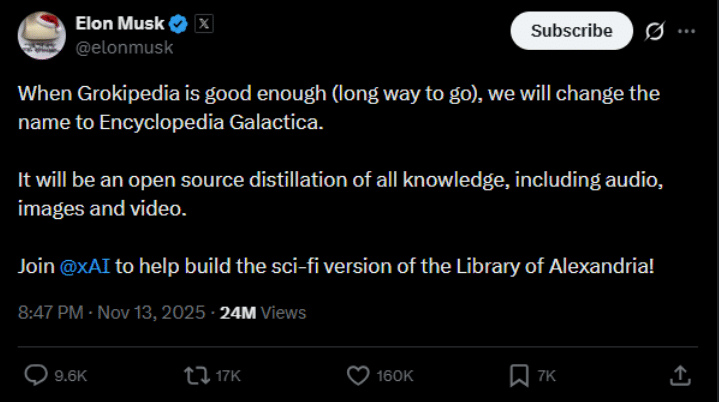
- According to Elon Musk’s post on X (Nov 13, 2025), Grokipedia may be renamed “Encyclopedia Galactica” when it becomes “good enough,” which signals a long-term branding goal.
- Elon Musk posted on X, that the vision is an open-source distillation of knowledge, including audio, images, and video, not only written text.
- From a risk standpoint, long-term growth will depend on public trust, better controls against AI bias, and stronger protection against misinformation.
- Competitive pressure will remain high because Grokipedia must compete with Wikipedia’s scale and other AI knowledge tools while expanding its technical infrastructure.
Conclusion
Grokipedia shows that AI can produce and scale encyclopedia-style content very fast, but the data also points to clear limits. The platform saw a steep drop in traffic after its early peak, suggesting that initial curiosity did not translate into steady daily use. More importantly, concerns about weak sourcing and unclear editorial control erode trust, especially compared with Wikipedia’s long-standing community rules and citation standards.
From a research analyst view, Grokipedia currently looks like a strong technology test for AI-written knowledge pages, not a full replacement for a human-governed encyclopedia. No cost, revenue, or funding figures were provided, so this conclusion is based only on usage signals and content-quality indicators.