






Introduction
Pickleball Statistics: Pickleball is a paddle sport that blends elements of tennis, badminton, and table tennis. It is played with a solid paddle and a lightweight, perforated plastic ball on a court approximately the size of a badminton court. The rules are simple and approachable, making the sport easy for beginners to learn and enjoy, while still offering potential for more competitive, fast‑paced play.
The pickleball industry has experienced remarkable growth in recent years, especially in the United States. As of 2024, the sport boasted about 19.8 million players nationwide, representing a growth rate of over 300% in the last three years alone. Participation is diverse, with an average player age of around 34 to 38 years, and increasing involvement from younger players aged 25 to 34.
The sport’s appeal spans multiple generations, with seniors also comprising a significant player segment. Over 68,000 dedicated pickleball courts exist in the U.S., reflecting an ongoing rapid expansion of infrastructure to support growing demand. Despite this, facility availability still lags behind participation growth, highlighting opportunities for further investment.
Editor’s Choice
- The global pickleball market is projected to reach approximately USD 9.1 billion by 2034, increasing from USD 2.2 billion in 2024, reflecting a strong 15.3% CAGR during the 2025 to 2034 period, supported by rising participation and broader acceptance across recreational and competitive formats.
- Pickleball participation in the United States reached an estimated 19.8 million players in 2024, a 45.8% increase from 2023, confirming sustained momentum in player adoption.
- Over the last three years, pickleball participation in the U.S. has expanded by more than 311%, making it the fastest-growing sport in the country for four consecutive years.
- The average age of pickleball players declined to 34.8 years, highlighting a demographic shift toward younger players and potential for long-term engagement.
- The 25 to 34 age group emerged as the largest player segment, accounting for approximately 2.3 million players, while participation among children increased by more than 1 million new entrants.
- Players aged 18 to 34 represent 28.8% of total participants nationwide, indicating strong penetration among young adults and working-age populations.
- Infrastructure development accelerated significantly, with more than 68,458 pickleball courts currently available in the United States and an average of 860 new courts being added each month.
- Dedicated pickleball court availability expanded by over 50%, reflecting strong investment by municipalities, private clubs, and real estate developers.
- USA Pickleball reported 78,766 registered members in 2024, alongside the approval of 1,225 new paddles and 81 new ball models, supported by the registration of 476 new manufacturers and brands.
- The pickleball paddle segment recorded steady growth of approximately 0.64% per month, translating to an annual expansion rate of 7.7%, driven by frequent equipment upgrades and product innovation.
- Pickleball is now played in more than 70 countries, confirming its transition from a regional activity to a globally recognized sport.
- The United States continues to lead global participation, with estimates reaching 48.3 million players, reinforcing its position as the core market for equipment sales, tournaments, and media exposure.
- Injury-related studies indicate that among players aged 50 and above, nearly 90% of emergency room visits are associated with sprains or fractures, highlighting the importance of safety awareness and preventive equipment adoption.
History of Pickleball
- 1965: Pickleball was invented on Bainbridge Island, Washington, by Joel Pritchard, Bill Bell, and Barney McCallum. They improvised with a badminton net, ping-pong paddles, and a Wiffle ball to create the new game.
- 1967: The first permanent pickleball court was built by Joel Pritchard’s neighbour, Bill O’Brien.
- 1972: Pickle-Ball Inc., a corporation, was created by the founders to protect the sport and formalise its rules.
- 1975: Pickleball received national attention with a feature article in The National Observer newspaper.
- 1976: Tennis Magazine published an article calling pickleball “America’s newest racquet sport,” and the first-known pickleball tournament was held in Tukwila, Washington.
- 1984: The United States Amateur Pickleball Association (USAPA) was founded to grow the sport nationwide. The first official rulebook was published, and Boeing engineer Arlen Paranto invented the first composite pickleball paddle. The USAPA held its first national doubles tournament in Tacoma, Washington.
- 1990: Pickleball was officially played in all 50 U.S. states.
- 1997: Joel Pritchard, one of the sport’s founders, passed away.
- 2005: The USAPA was reorganized as a not-for-profit corporation to promote continued growth.
- 2009: The first USAPA National Tournament for all ages was held in Buckeye, Arizona, with nearly 400 players from 26 states and Canada.
- 2010: The International Federation of Pickleball (IFP) was formed to support global growth.
- 2016: The first U.S. Open Pickleball Championships took place in Naples, Florida. The event was nationally televised on CBS Sports Network, showcasing the sport’s rising profile.
- 2019: Two professional pickleball tours were launched, the Professional Pickleball Association (PPA) and the Association of Pickleball Professionals (APP), marking the sport’s professional era.
- 2021: Major League Pickleball was established, introducing a unique team format for professional players.
- 2022: Pickleball was named the official state sport of Washington.
- 2023: Pickleball was recognised as the fastest-growing sport in America for the third consecutive year, according to the Sports & Fitness Industry Association.
Total Number of Pickleball Players In US
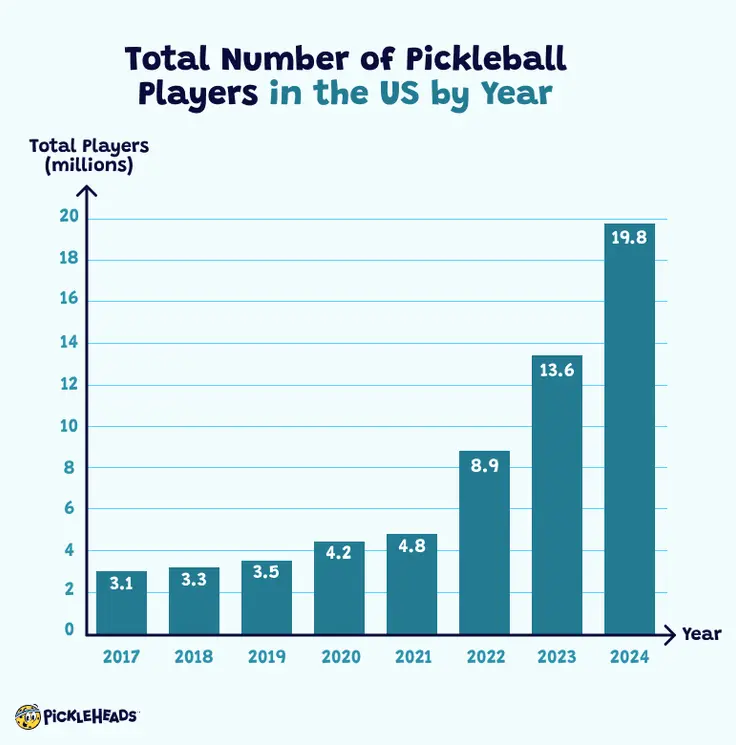
- 19.8 million people played pickleball in the U.S. in 2024, according to the SFIA Topline Participation Report 2025, confirming the most recent and widely cited participation benchmark.
- Participation increased by 45.8% in 2024 compared with 2023, highlighting strong year over year momentum and sustained consumer interest.
- Over the last three years, pickleball participation recorded an average growth of 311%, positioning it as one of the fastest growing recreational sports in the U.S.
- Alternative industry estimates from the APP indicate that nearly 50 million adults played pickleball in 2023, representing 19% of the U.S. adult population and reflecting broader informal and recreational adoption beyond organized play.
- The APP data also reported a 35% increase from 36.5 million players in 2022, reinforcing the long term expansion trend despite methodological differences between sources.
- Historical annual growth rates show steady acceleration, with moderate growth between 2017 and 2019, followed by sharp expansion after 2020, peaking at 85.7% in 2022 and remaining elevated at 51.8% in 2023 and 45.8% in 2024.
(Source: pickleheads.com)
Here’s that same growth data in a table:
| Year | Annual pickleball growth rate % |
| 2017 | 11.3% |
| 2018 | 5.4% |
| 2019 | 4.8% |
| 2020 | 21.4% |
| 2021 | 14.8% |
| 2022 | 85.7% |
| 2023 | 51.8% |
| 2024 | 45.8% |
Rules and Regulations Statistics
- Pickleball is played as singles (1v1) or doubles (2v2), with doubles being the most common format.
- The court measures 20 feet wide by 44 feet long, the same for singles and doubles.
- The net height is 36 inches at the sidelines and 34 inches at the center.
- The ball must be served underhand, and the paddle cannot strike the ball above the waist.
- The server must keep at least one foot behind the baseline and serve diagonally crosscourt into the opponent’s service box.
- Only one serve attempt is allowed per point (no second serve).
- The receiving team must let the serve bounce before returning it.
- After the initial two bounces (one on each side), the ball can be volleyed or played off a bounce.
- The non-volley zone, called the “kitchen,” extends 7 feet from the net on both sides and volleying in this zone is forbidden to prevent net rushing.
- Points are scored only by the serving side when the server or team wins the rally or the opponent commits a fault.
- Faults include hitting the ball out of bounds, not clearing the net, volleying in the kitchen, or double bouncing the ball.
- Games are generally played to 11 points, with a two-point lead required to win. Tournament games may go to 15 or 21 points.
- In doubles, players alternate serves, switching service courts after each point won.
- Paddle size is regulated, with length up to 17 inches and combined length and width capped at 24 inches.
- The ball is a lightweight perforated plastic ball with 26 to 40 holes, designed for indoor or outdoor play.
- Fair play and sportsmanship are emphasized, with players responsible for calling faults and lines on their side and referees overseeing tournaments.
Pickleball Market Size
- The Pickleball Market was valued at USD 2.2 billion in 2024 and is projected to reach USD 9.1 billion by 2034, expanding at a 15.3% CAGR.
- Equipment led by product type in 2023, holding 41.5% share, driven by strong demand for paddles and balls.
- By end user, Men dominated with 51.7% share in 2023, reflecting higher participation levels.
- Online sales channels accounted for 55.8% share in 2023, supported by the growth of e-commerce convenience.
- North America led regionally in 2023, capturing 42.9% share, valued at USD 0.94 billion, driven by the rising popularity of pickleball.

(Image Credit: Market.us)
Regional Analysis
- In 2024, North America held a dominant position in the pickleball market, capturing more than 42.9% share and generating approximately USD 0.94 billion in revenue. This leadership can be attributed to the sport’s strong cultural integration and widespread community adoption across the region.
- New York leads with 11.3% of the local population, equal to about 5.5 million players.
- Los Angeles follows, where 9.6% of residents play pickleball, totaling 4.7 million players.
- Dallas–Fort Worth records 5.2% participation, representing around 2.5 million players.

(Image Credit: Market.us)
Pickleball Player Age Distribution
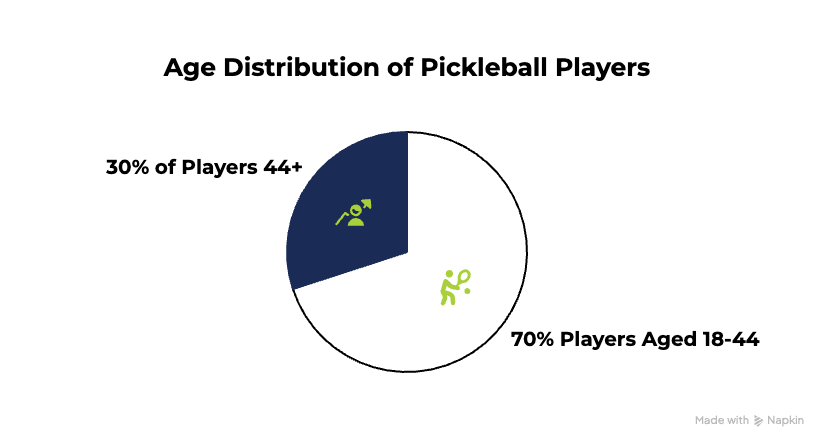
- Over 70% of pickleball players are within the 18 to 44 age group, indicating strong participation from younger and mid age adults.
- This age concentration confirms that pickleball has established a solid presence among Gen Z and millennial players, rather than being limited to older demographics.
- The high share of players aged 18–44 is contributing directly to the sport’s rapid adoption and expansion across urban and recreational markets.
(Source: picklerage.com)
Invested in Pickleball Facilities
- Approximately $152.8 million has been invested in building and upgrading pickleball facilities nationwide.
- Dedicated pickleball facilities grew by 55% year-over-year in 2024, showing rapid expansion in infrastructure to meet increasing demand.
- Over the next 5-7 years, an estimated $855 million will be needed to construct new courts to keep up with the sport’s growth.

(Image Credit: picklerage.com)
Court Counts and Construction
- The U.S. currently has over 10,724 dedicated pickleball courts.
- In 2024 alone, 536 new courts were built, roughly averaging more than one new court per day across the country.
- Large-scale indoor facilities are also emerging, such as a planned premier indoor complex near Scottsdale, Arizona, spanning 186,000 square feet with 50 courts.
Pickleball Pro Players Statistics
Below are the current pickleball player rankings as reported by the PPA Tour, as of February 2025.
Men’s Singles
| Ranking | Player | Country |
| #1 | Federico Staksrud | Argentina |
| #2 | Ben Johns | USA |
| #3 | Connor Garnett | USA |
| #4 | Hunter Johnson | USA |
| #5 | Tyson McGuffin | USA |
Women’s Singles:
| Ranking | Player | Country |
| #1 | Anna Leigh Waters | USA |
| #2 | Brooke Buckner | USA |
| #3 | Lea Jansen | USA |
| #4 | Catherine Parenteau | Canada |
| #5 | Mary Brascia | USA |
Men’s Doubles:
| Ranking | Player | Country |
| #1 | Federico Staksrud | Argentina |
| #2 | Collin Johns | USA |
| #3 | JW Johnson | USA |
| #4 | Ben Johns | USA |
| #5 | Dylan Frazier | USA |
Women’s Doubles:
| Ranking | Player | Country |
| #1 | Anna Leigh Waters | USA |
| #2 | Catherine Parenteau | Canada |
| #3 | Anna Bright | USA |
| #4 | Rachel Rohrabacher | USA |
| #5 | Tyra Black | USA |
Mixed Doubles:
| Ranking | Player | Country |
| #1 | Ben Johns | USA |
| #2 | Anna Leigh Waters | USA |
| #3 | Jorja Johnson | USA |
| #4 | Anna Bright | USA |
| #5 | JW Johnson | USA |
Geographic and Market Trends
- Despite nationwide growth, some regions (Mountain, West North Central, East South Central) face court shortages relative to player growth.
- Major metropolitan areas like New York, Los Angeles, and Chicago have doubled their dedicated courts per capita but still lag about 92% below the national average court density.
- North America dominates the pickleball court automation market with 55% market share in 2025, while Asia-Pacific is the fastest-growing region for these technologies.
Player and Participation Growth
- About 36.5 million Americans have played pickleball at least once, more than 1 in 10 people nationally.
- Participation increased by 130% over the past five years, with the average player age trending younger, around 35 years old in 2025.
Court and Facility Size
- A standard pickleball court is 44 feet long and 20 feet wide.
- Indoor facilities are increasingly larger; many now start with 12 to 15 courts, and some expand to over 50 courts in a single complex.
Infrastructure Growth
- There are currently about 68,458 pickleball courts in the US, with a 55% year-over-year increase in dedicated facilities in 2024.
- The sport still faces a shortage of courts, with an estimated $855 million investment needed in court construction over the next 5-7 years.
- In India, infrastructure growth is rapid as well, with pickleball courts costing less to build than other sports — approximately Rs 5 lakh per court versus Rs 30 lakh for cricket turf.
- Large-scale facilities such as PURE Pickleball & Padel at Riverwalk near Scottsdale, AZ, are being developed with up to 50 courts, including championship courts, indicating significant commercial investment in infrastructure.
Common Pickleball Injury Statistics
- About 49.3% of pickleball injuries result from falls or trips.
- Overuse injuries account for 25.5% of the cases.
- Cardiac arrest makes up 15.3% of pickleball-related injuries.
- Syncope, or fainting, accounts for 5.4% of injuries.
- Injuries caused by being hit by an object account for 4.2%.
- Heat exhaustion is the least frequent injury category at 0.4%.

(Image credit: piastawalker.com)