





Introduction
The Global Wearable Technology Market is projected to reach USD 231 billion by 2032, up from approximately USD 70 billion in 2023, corresponding to a compound annual growth rate (CAGR) of 14.6 % over 2023–2032.The growth is attributed to advances in miniaturization, sensor technology, improved connectivity, and increasing consumer demand for health and fitness monitoring.
Wearable technology is moving from a niche accessory category to an everyday layer of the digital ecosystem. Devices are now worn on the wrist, in the ear, on the face, and even built into clothing, and they are used not only for fitness tracking but also for payments, safety, chronic disease management, and workplace productivity.
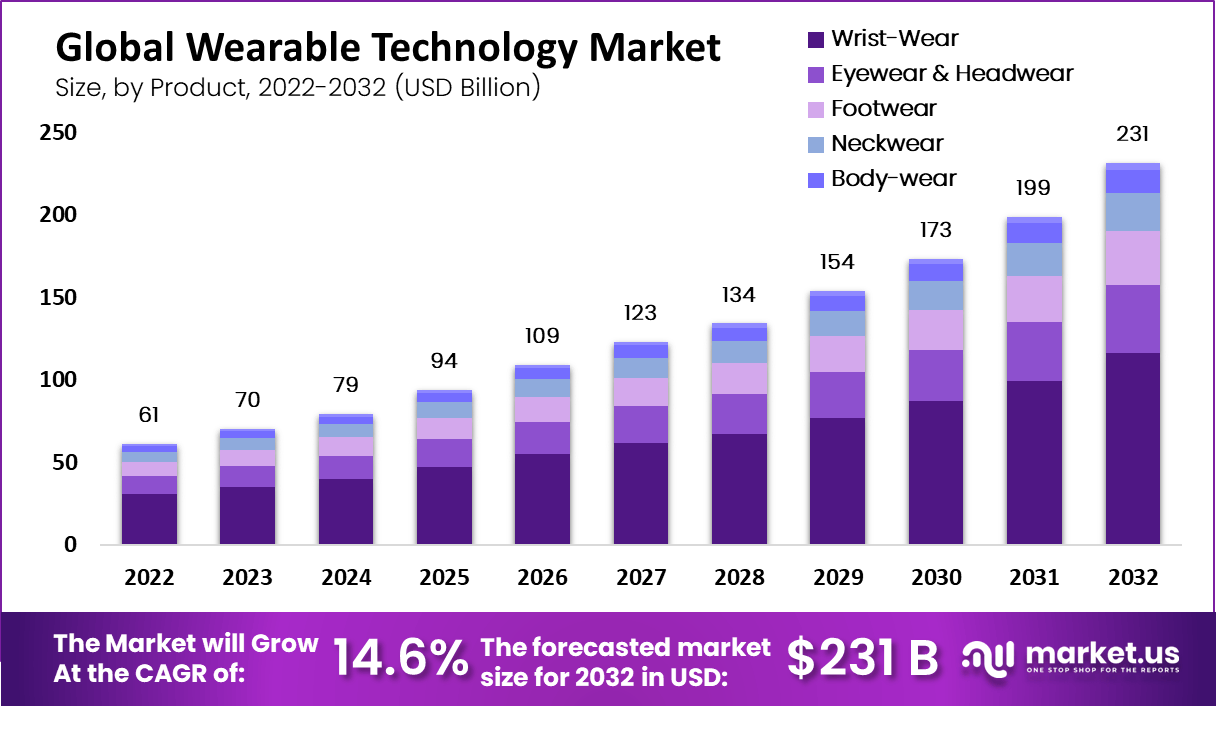
Wrist-worn devices (smartwatches, fitness trackers) currently represent the largest product category, supported by high adoption among consumers focused on physical activity tracking, sleep monitoring, and well-being. The consumer electronics application segment leads in revenue share, driven by demand for fitness bands, AR/VR headsets, and other wearable gadgets for daily use and entertainment.
Regional dynamics show that North America remains the dominant market due to early adoption and technological maturity; concurrently, Asia-Pacific region is expected to show the fastest growth, supported by growing health awareness, expanding middle-class population, and increasing affordability of devices.
Key Takeaways
- The market value is expected to more than triple by 2032 from USD 70 Bn in 2023 to USD 231 Bn indicating rapid expansion in the wearable technology industry.
- Nearly half of the global revenue 49.45 % comes from wrist-worn devices, underscoring the dominance of smartwatches and fitness trackers.
- The consumer electronics application accounts for roughly 49 % of total revenue, showing that mainstream usage (not just medical or niche) remains the major driver.
- The combination of technological improvements (sensors, connectivity), increasing health consciousness, and demand for convenience fuels growth. These factors are projected to continue supporting market expansion.
Key Statistics
- According to scoop.market.us, The number of connected wearable devices worldwide has shown a consistent upward trend over the years. Reflecting the growing popularity and integration of wearable technology into daily life.
- In 2019, there were 722 million connected wearables in use globally.
- This figure saw a notable increase in 2020, reaching 835 million, demonstrating a surge in adoption.
- The momentum continued into 2021, with the number of connected wearables rising to 929 million.
- As of 2022, the global market for connected wearables has expanded even further, with a remarkable 1,110 million devices worldwide.
- These numbers underscore the pervasive presence of wearable technology, which has become an integral part of the digital landscape. Catering to a wide range of applications and user preferences.
- As of March 2024, wearable device ownership levels vary across countries based on survey responses.
- In India, 57% of respondents own wearable devices and 43% do not.
- In Mainland China, 53% of people own wearables while 47% do not.
- In the United Kingdom, 52% own wearables and 48% do not.
- In Sweden, ownership is evenly split at 50% and 50%.
- In the Netherlands, 44% of respondents own wearables and 56% do not.
- In Germany, 42% own wearable devices and 5b8% do not.
- In the United States and Canada, ownership stands at 41% while 59% do not use wearables.
- In South Korea, 40% of people own wearables and 60% do not.
- In Brazil, wearable device ownership is 33% while 67% of respondents do not own such devices.
Top Driving Factors
- Portability and compactness enable slimmer, stylish devices like smartwatches and glasses, boosting appeal across daily use.
- Advancements in miniaturization and sensor tech make wearables multifunctional for health, fitness, and real-time data.
- Rising demand for fitness tracking, sleep monitoring, and wellness insights drives consumer adoption.
- Expanding use in medical, industrial, military, and construction sectors accelerates market growth.
- Connectivity boosts AR overlays, payments, and IoT integration for smart homes and delivery tasks.
Top Restraints
- High costs of early-stage tech limit affordability for middle-class consumers.
- Limited market players keep prices elevated compared to standard electronics.
- Slower consumer acceptance of cyborg-like wearable forms hinders uptake.
- Dependence on niche, expensive products slows mass adoption.
- Battery life and durability concerns in compact designs cap broader appeal.
Key Market Segment
By Product
- Wrist-Wear
- Eyewear and Headwear
- Footwear
- Neckwear
- Body-Wear
- Others
By Application
- Consumer Electronics
- Healthcare
- Enterprise and Industrial Applications
- Others
By Component
- Hardware
- Software
By Technology
- Display Technologies
- Computing Technologies
- Networking Technologies
- Sensor Technologies
By Region
- North America
- Europe
- Asia Pacific
- Latin America
- Middle East and Africa
Top Key Players
- Alphabet Inc.
- Samsung Electronics Co., Ltd.
- Sony Corp.
- Huawei Technologies Group Co., Ltd.
- Apple Inc.
- Xiaomi Corp.
- Adidas AG
- Nike, Inc.
- Fitbit, Inc.
- Garmin Ltd.
- Other Key Players
Future Outlook
The future of the wearable technology market is expected to be shaped by advances in sensors, AI-driven insights, and seamless integration with smartphones and healthcare systems. Demand for continuous health monitoring, fitness tracking, and connected lifestyle devices is projected to expand steadily. Growth is likely to accelerate as devices become smaller, more accurate, and more affordable, with strong momentum coming from AR/VR headsets, medical wearables, and enterprise-focused solutions. Adoption in Asia-Pacific is expected to rise rapidly as consumer awareness and digital maturity continue to increase.
Opportunities
- Rising demand for real-time health monitoring in chronic disease management.
- Growth of AR/VR devices in gaming, training, retail, and enterprise workflows.
- Expansion of AI-powered analytics for personalized wellness insights.
- Increasing adoption of wearable medical devices in remote healthcare delivery.
- New use cases emerging in industrial safety, workplace monitoring, and logistics.
Challenges
- Concerns regarding data privacy and safe handling of personal health information.
- High cost of advanced devices limiting adoption in price-sensitive markets.
- Short device lifecycle driven by rapid technology upgrades.
- Battery limitations restricting performance and multi-day usage.
- Fragmented ecosystem causing compatibility issues across devices and platforms.
Recent Development
- February, 2024, Samsung released the Galaxy Fit 3 in India, featuring a 1.6-inch AMOLED display 45% larger than its predecessor and an aluminum frame in grey, silver, and pink gold.
- January, 2024, Noise launched the NoiseFit Vortex Plus smartwatch with Bluetooth calling for enhanced user connectivity
Conclusion
The wearable technology market is positioned for robust growth through 2032, driven by increasing consumer demand for health, fitness, and convenience-oriented devices. Wrist-worn wearables are likely to maintain dominance in market share, while non-wrist segments such as eyewear and headwear (especially AR/VR devices) are set to grow significantly. Consumer electronics remains the core application area, but healthcare and enterprise applications offer meaningful growth potential as devices evolve in functionality.Growth prospects appear especially favourable in emerging markets, notably Asia-Pacific, where rising health awareness, increasing disposable incomes, and growing technological adoption may accelerate uptake.
Read More – https://market.us/report/wearable-technology-market/

Sources