Metaverse companies are businesses that build or support shared virtual worlds where people can meet, play, work, learn, and buy digital goods. They create 3D apps, games, headsets, and online platforms that enable these immersive experiences. Some focus on virtual or augmented reality; others develop tools, payment systems, or digital items that live within these worlds. Together, they try to blend the internet, social media, and gaming into one connected, interactive space that feels like a living digital universe. Their goal is to keep users engaged, creative, and social in digital spaces that feel almost as real as the real world.
Metaverse Market Size
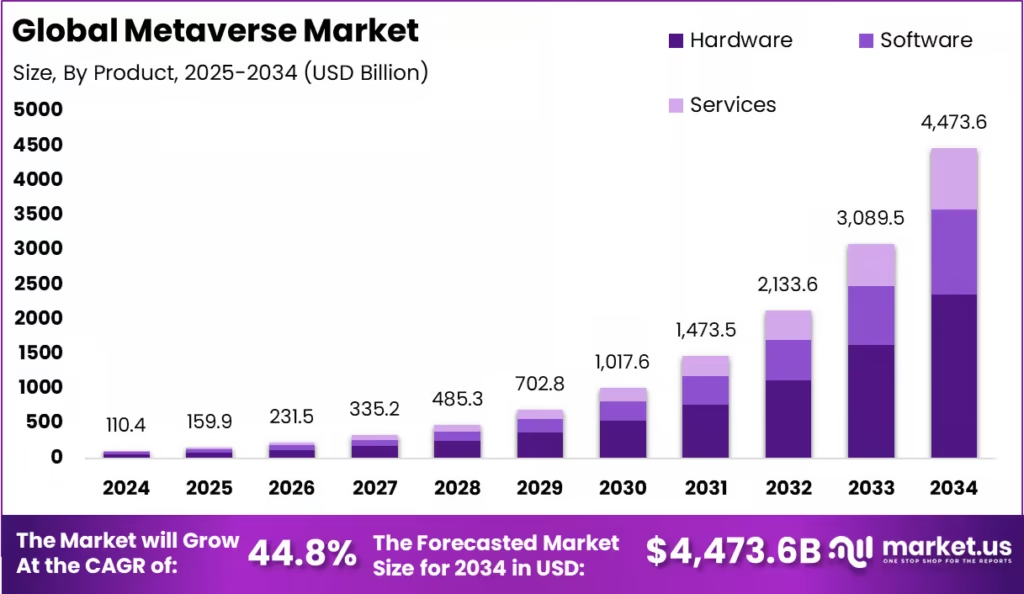
The global metaverse market is predicted to grow from about USD 110.4 billion in 2024 to around USD 4,473.6 billion by 2034, with a very fast yearly growth rate of 44.8% between 2025 and 2034.
In 2024, North America accounted for more than 40% of the world’s metaverse revenue, generating about USD 44.16 billion.
The United States metaverse market alone is about USD 34.4 billion in 2024 and is expected to increase at a yearly growth rate of 42.6%.
Hardware such as headsets, sensors, and haptic devices made up 52.8% of the global metaverse market in 2024, showing that physical devices are still the biggest part of this industry. Desktop computers were the most common way to access the metaverse in 2024, accounting for 48.7% of platform usage.
Virtual and Augmented Reality technologies together accounted for 34.2% of the market in 2024, confirming that these tools are central to metaverse experiences.
Gaming was the main use of the metaverse in 2024, accounting for 25.3% of the total market value, driven by online multiplayer worlds and user-generated content.
The aerospace and defence industry held 22.9% of metaverse end-user demand, using virtual environments for training, remote tasks, and strategic planning.
The metaverse has more than 600 million active users worldwide, of whom about 51% are younger than 13, indicating strong interest among children.
Some estimates value the metaverse market at around USD 74.4 billion today, and by 2026, one in four people may spend at least one hour every day in virtual worlds.
Around 54% of experts think the metaverse will become an important part of daily life for about 500 million people by 2040.
Nearly 24% of adults in the United States believe the metaverse could one day replace traditional social media platforms.
Roblox is currently seen as a leading metaverse-style platform, with about 70.2 million users per day, though some reports list closer to 55 million.
By 2030, the metaverse could add around USD 5 trillion to the global economy, underscoring its potential financial impact.
Awareness of the metaverse is still limited, and about 31% of adults in the United States say they have never heard the term at all.
Around 68% of technology experts expect the metaverse to expand rapidly over the next five years.
About 17% of all investments in the metaverse come from the computer and information technology industries, highlighting their strong involvement.
Around 60% of gamers use metaverse spaces for more than just playing, including hanging out with friends, going to virtual events, and shopping in digital environments.
Top 10 Metaverse Companies in the World
Metaverse companies are mostly grouped into three segments: Core Tech and Infrastructure, Platforms and Virtual Worlds, and Creation Engines and Development Tools.
In core technology and infrastructure, companies such as NVIDIA, Microsoft, Google, and Apple Inc. are well-positioned, as they provide foundational capabilities through chips, cloud services, operating systems, and hardware devices that support immersive computing.
Under platforms and virtual worlds, Meta Platforms Inc., Roblox Corporation, Decentraland, and The Sandbox are included because they operate user-facing virtual environments that enable social interaction, content consumption, and digital economies.
Under creation engines and development tools, Epic Games and Unity Technologies (Unity Software Inc.) are included because their software engines and developer tools are used to build 3D worlds, interactive experiences, and metaverse applications.
NVIDIA
Title
Details
Company Name
NVIDIA Corporation
Company Type
Public company; fabless semiconductor and AI computing company focused on GPUs, data-center AI chips and platforms such as NVIDIA Omniverse for industrial and metaverse-style 3D simulation.
Parent Organization
None – operates as an independent, publicly listed corporation (no parent company).
CEO
Jensen Huang (co-founder, President and Chief Executive Officer).
Number of Employees
Around 36,000 employees as of fiscal year 2025.
Established (Date & Year)
Founded on 5 April 1993 in Sunnyvale, California, by Jensen Huang, Chris Malachowsky and Curtis Priem.
GeForce and RTX GPUs for gaming and creators; data-center and AI GPUs (e.g., A100, H100, Blackwell generation); NVIDIA Omniverse for industrial/metaverse 3D worlds and digital twins; CUDA software platform; automotive and robotics AI platforms; GeForce NOW cloud gaming and other AI/graphics solutions. (IT Pro)
Headquarters
2788 San Tomas Expressway, Santa Clara, California 95051, United States. (NVIDIA)
Geographical Presence
Serves customers worldwide, with more than 50 offices across the Americas, Europe and Asia, and operations in about 36 countries. (Wikipedia)
NVIDIA positions its Omniverse platform as the core of its metaverse strategy, enabling real-time 3D collaboration, digital twins, and “industrial metaverse” applications across many sectors.
According to NVIDIA’s corporate brief, Omniverse has more than 300,000 individual users and a pipeline of about 700 companies building digital-twin and metaverse-style applications on the platform.
Earlier reports noted that Omniverse had over 50,000 individual creators during its open-beta phase thanks to integrations with tools like Blender and Adobe, expanding access to millions of potential creators.
NVIDIA says it is working with hundreds of manufacturing organizations that are rapidly adopting industrial-metaverse technology, using Omniverse to build highly detailed digital twins for factories and production lines.
BMW Group, one of NVIDIA’s flagship customers, uses Omniverse Enterprise to run real-time digital twin simulations across more than 30 production sites worldwide, including virtual factories spanning over 1 million square meters.
NVIDIA estimates that, over the long term, Omniverse-related enterprise software for metaverse and 3D applications could represent roughly USD150 billion of its total AI market opportunity.
In March 2025, NVIDIA announced that the Omniverse Physical AI Operating System was expanding into more industries and partners, positioning it as a standard stack for industrial metaverse and digital twin workloads.
At CES 2025, NVIDIA introduced “Mega,” an Omniverse blueprint for developing and testing large fleets of robots in photorealistic digital twins before deployment in real facilities.
In August 2025 at SIGGRAPH, NVIDIA unveiled new Omniverse libraries, NVIDIA Cosmos workflows, and advanced RTX PRO servers and DGX Cloud integrations to accelerate digital-twin and “physical AI” development.
In June 2025, BMW Group announced it is industrializing its “Virtual Factory” using NVIDIA Omniverse to create digital twins of all its plants, enabling much faster and cheaper production-planning changes.
Recent news highlights Omniverse being used beyond factories, including a metropolitan digital twin of Barcelona built with Aretian, Lenovo, and local partners, and an “AI Megafactory” for Samsung that uses Omniverse to model semiconductor and robotics operations.
NVIDIA also recently announced an Omniverse DSX blueprint for gigawatt-scale “AI factory” data centres, using Omniverse digital twins to optimise everything from power and cooling to compute and networking before construction.
Microsoft
Title
Details
Company Name
Microsoft Corporation
Company Type
Public company; American multinational technology corporation (Big Tech) focused on software, cloud, AI, gaming, and mixed-reality/metaverse platforms such as Microsoft Mesh and HoloLens.
Parent Organization
None – operates as an independent, publicly listed corporation (no parent company).
CEO
Satya Nadella, Chairman and Chief Executive Officer.
Number of Employees
About 228,000 employees worldwide as of 2025.
Established (Date & Year)
Founded on 4 April 1975 in Albuquerque, New Mexico, by Bill Gates and Paul Allen.
Subsidiaries (examples)
LinkedIn, GitHub, Mojang Studios (Minecraft), Activision Blizzard, ZeniMax Media/Bethesda, Microsoft Ireland Operations and numerous regional subsidiaries.
Products
Windows OS, Microsoft 365 (Office, Teams, Outlook), Azure cloud, Xbox consoles and Game Pass, LinkedIn, GitHub, Dynamics 365, Surface devices, HoloLens mixed-reality headsets, and Microsoft Mesh/metaverse collaboration tools.
Headquarters
Microsoft Redmond campus, One Microsoft Way, Redmond, Washington, United States.
Geographical Presence
Serves customers worldwide, with major operations and offices across the Americas, Europe, Asia, Africa, and the Middle East.
As of November 2025, about 1,050 companies and 8,041 developers are using Microsoft HoloLens, showing that Microsoft’s mixed-reality hardware is still widely used in business even as the device is being phased out.
A 2023 Forrester study found that a manufacturing firm using HoloLens 2 with Microsoft’s mixed-reality apps achieved a 216% return on investment over three years, thanks to 20–24% faster training and 35% lower training-material costs.
The same study reported that HoloLens-based mixed reality cut unplanned machine downtime by about 23.5%, improved field-technician productivity by 25%, and sped up new-factory ramp-up by around 14 days, which are all strong “industrial metaverse” style benefits.
Microsoft Mesh, its 3D meeting and metaverse platform, became generally available on January 24, 2024 inside Microsoft Teams and on Meta Quest, bringing immersive spaces and avatars to customers on common Microsoft 365 and Office 365 business licenses.
Microsoft and NVIDIA are working together so that Azure can host NVIDIA Omniverse Cloud and DGX Cloud, with the goal of giving “hundreds of millions” of Microsoft enterprise users access to industrial-metaverse and AI supercomputing tools.
In 2024, Microsoft shipped frequent Mesh updates (for example, the “Mesh 2408” release) and added features such as better avatar creation and richer event tools, making virtual meetings feel more lifelike and easier to manage.
In 2025, Microsoft announced that it will retire Microsoft Mesh apps, the Mesh website, and the 3D Immersive Space view in Teams on December 1, 2025, and that developers should move to the new “immersive events” experience built directly into Teams.
Microsoft has stopped producing HoloLens 2, but it promises security and major-functionality updates for existing devices until December 31, 2027, while shifting its focus to software and partner headsets rather than its own AR hardware.
Microsoft’s current XR and metaverse strategy centers on software such as Mesh, Azure Mixed Reality, Dynamics 365 Guides and spatial annotations, and tight integrations of Microsoft 365 apps with devices from partners like Meta, Apple, and RealWear.
Through its Industrial Metaverse initiatives and Azure Digital Twins, Microsoft showcases customers such as major brewers, construction firms, and manufacturers that use digital models of factories, infrastructure, and supply chains to monitor assets and improve productivity.
Apple Inc
Title
Details
Company Name
Apple Inc.
Company Type
Public company; American multinational technology company (often classed as “Big Tech”) focused on consumer electronics, software, online services, and spatial computing devices like Apple Vision Pro. (Wikipedia)
Parent Organization
None – Apple operates as an independent, publicly listed corporation with no parent company.
CEO
Tim Cook, Chief Executive Officer of Apple since 2011.
Number of Employees
Around 166,000 employees worldwide as of 2025.
Established (Date & Year)
Founded on 1 April 1976 (as Apple Computer Company) by Steve Jobs, Steve Wozniak and Ronald Wayne; incorporated as Apple Computer, Inc. in 1977 and renamed Apple Inc. in 2007.
Subsidiaries (examples)
Beats Electronics, Braeburn Capital, Claris, Apple Studios, Beddit, Apple Asia LLC, Apple Operations International, Drive.ai and various country-specific entities such as Apple Canada Inc. and Apple Japan Inc.
Products
iPhone, iPad, Mac, Apple Watch, AirPods, Apple TV, Apple Vision Pro, HomePod, plus services such as the App Store, Apple Music, iCloud, Apple TV+, Apple Arcade, Apple Pay and more.
Headquarters
Apple Park, One Apple Park Way, Cupertino, California 95014, United States (in Silicon Valley).
Geographical Presence
Serves customers worldwide, with over 500+ Apple Stores in about 23 countries and a global supply chain spanning more than 50 countries and regions.
Analysts estimate that Apple sold roughly 370,000 to 500,000 Vision Pro headsets in 2024, making it a small but important share of the premium XR/metaverse hardware market.
One report says Apple sold about 200,000 Vision Pro units in the first launch weekend alone, showing strong early demand from developers and early adopters.
IDC and other market watchers estimate that Apple’s premium headsets accounted for only around 5–6% of global VR/XR shipments in 2024, compared to about 5.6 million units shipped by Meta’s cheaper headsets.
At launch in February 2024, Apple stated that over 600 apps and games were built specifically for Vision Pro, with more than 1 million existing iPhone and iPad apps also running on the device.
By mid-2024, Apple reported over 2,000 “spatial” apps designed for visionOS and more than 1.5 million compatible iOS and iPadOS apps, giving Vision Pro one of the largest content libraries in the XR space.
By August 2024, independent counts suggested that there were around 2,500 native Vision Pro apps, roughly on par with the size of Meta Quest’s dedicated app store.
Apple has framed Vision Pro as a key tool for the enterprise “spatial computing” and metaverse market, highlighting use cases like 3D design collaboration, custom workspaces, immersive training, and guided remote fieldwork for industries such as aviation, healthcare, and manufacturing.
A 2024 analysis found that adoption of Vision Pro among developers and enterprise users is outpacing the early adoption curve of the original Apple Watch, signaling strong interest in Apple’s metaverse/spatial platform even at a high price point.
With visionOS 2, announced at WWDC 2024, Apple introduced new spatial-computing features and developer tools that make it easier to build more “volumetric and shareable” 3D apps, reinforcing Vision Pro as Apple’s main metaverse gateway.
In 2025, reports indicated that Apple is working on at least seven AR/VR head-worn devices across two product families, signaling a long-term roadmap to dominate the spatial-computing and metaverse hardware market beyond the first-generation Vision Pro.
Recent reporting says Apple has paused a full Vision Pro 2 overhaul and shifted resources to AI-powered smart glasses, with an iPhone-tethered version targeted before 2027 and a more advanced glasses model with its own display aimed around 2028.
Gaming on Vision Pro has improved thanks to NVIDIA GeForce NOW integration, which lets users stream more than 100 PC and console-style games in up to 4K at 120 FPS, strengthening Apple’s position in the entertainment side of the metaverse ecosystem.
Industry commentary in 2025 notes that, despite mixed first-year sales, Apple is doubling down on spatial computing and the metaverse, iterating on Vision headsets while exploring lighter, cheaper devices to broaden adoption over the next few years.
Google
Title
Details
Company Name
Google LLC
Company Type
Subsidiary; American multinational technology company focused on internet services, cloud computing, software, hardware, artificial intelligence and online advertising, with AR/VR and immersive experiences that support metaverse-style applications.
Parent Organization
Alphabet Inc., a public multinational technology holding company.
CEO
Sundar Pichai, Chief Executive Officer of Google and Alphabet.
Number of Employees
Approximately 183,000 employees worldwide (Alphabet group, including Google and other subsidiaries) as of end 2024; Google itself reported 187,000 employees in 2022.
Established (Date & Year)
Founded on 4 September 1998 in Menlo Park, California, by Larry Page and Sergey Brin.
Subsidiaries (examples)
YouTube, Nest Labs, Waze, Fitbit, X Development, Google Fiber, AdMob, Kaggle, Mandiant and others.
Products
Google Search, Android, Google Chrome, Google Maps/Earth, Gmail, Google Cloud, Google Workspace, YouTube, Google Play, Google Drive, Pixel phones, ChromeOS and Chromebooks, Nest smart-home devices, Fitbit wearables, and AI products like Gemini and Google Assistant.
Headquarters
Googleplex campus, Mountain View, California, United States.
Geographical Presence
Serves customers worldwide, with over 78 offices in more than 50 countries and a total of around 86 global office locations across North America, Latin America, Europe, Asia-Pacific, Africa and the Middle East.
Google’s AR platform ARCore is now compatible with around 1.4 billion Android devices worldwide, giving Google one of the largest potential AR/metaverse-capable hardware bases.
Visual search through Google Lens runs on roughly 3.09 billion devices, making it one of the most widely deployed consumer AR-like experiences in the world.
Google’s Immersive Stream for XR lets companies stream high-fidelity 3D and AR scenes from Google Cloud to almost any phone via a link or QR code, and it powers features like Immersive View in Google Maps and AR product visualizations for automotive and retail brands.
Google Maps, which is relied on by over 2 billion users each month, is increasingly adding metaverse-style features such as 3D photorealistic tiles and Immersive View for routes to help people explore cities more like a virtual world.
In December 2024, Google announced Android XR, a new operating system for headsets and glasses built with Samsung and Qualcomm, designed as a foundation for next-generation mixed-reality apps using tools like Android Studio, Unity, and OpenXR.
In October 2025, Samsung launched its Galaxy XR headset running Android XR, priced at USD1,799 and integrating Google’s Gemini AI, positioning Google’s software at the heart of one of the main competitors to Apple’s Vision Pro.
At Google I/O 2025, Google introduced a line of AI smart glasses with partners Warby Parker and Gentle Monster under “Project Aura,” featuring in-lens displays, cameras, microphones, and live functions like messaging, navigation, and translation on top of Android XR.
Also at I/O 2025, Google and Xreal revealed another Android XR smart-glasses project (also called Project Aura in some reports), using see-through AR lenses, embedded cameras, and Gemini AI to encourage developers to build mixed-reality apps ahead of launch.
Industry observers noted that Google offered little visible support for Android XR at GDC 2025, worrying indie developers who fear the platform could repeat past missteps like Stadia and Daydream if Google does not engage more deeply with the XR dev community.
Overall, Google’s metaverse and XR strategy currently centers on combining its huge AR-ready mobile base (ARCore and Lens), cloud-streamed XR via Immersive Stream, and the new Android XR ecosystem with partner hardware such as Samsung’s Galaxy XR and upcoming smart glasses.
Meta Platforms, Inc.
Title
Details
Company Name
Meta Platforms, Inc. (trading name: Meta)
Company Type
Public company; American multinational technology conglomerate focused on social media, online advertising, virtual reality, and metaverse technologies.
Parent Organization
None – Meta Platforms, Inc. is itself the publicly listed parent of its family of apps and VR businesses.
CEO
Mark Zuckerberg, Co-founder, Chairman and Chief Executive Officer.
Number of Employees
About 78,450 employees worldwide as of 30 September 2025.
Established (Date & Year)
Founded on 4 February 2004 in Cambridge, Massachusetts, USA (originally as TheFacebook).
Subsidiaries (examples)
Facebook (core platform), Instagram, WhatsApp, Oculus/Reality Labs (VR), Mapillary, CrowdTangle and other acquired companies.
Products
Facebook, Instagram, WhatsApp, Messenger, Threads, Workplace, Quest VR headsets and Meta Horizon/Reality Labs metaverse platforms, plus related advertising and business tools.
Headquarters
1 Meta Way / 1 Hacker Way, Menlo Park, California 94025, United States.
Geographical Presence
Serves users and advertisers worldwide, with offices and data centers across North America, Latin America, Europe, the Middle East, Africa and Asia-Pacific.
Meta’s Reality Labs division, which houses its metaverse and XR efforts, generated about USD 1.08 billion in revenue in Q4 2024 but cost USD 6.05 billion to run, resulting in a quarterly loss of roughly USD 4.97 billion.
For the full year 2024, Reality Labs brought in around USD 2.1 billion in revenue but lost about USD 17.7 billion, contributing to cumulative losses of more than USD 60 billion on Meta’s metaverse bet since 2020.
Meta as a whole closed 2024 with record results, posting USD 164.5 billion in total revenue and a headcount of 74,067 employees, while continuing to invest heavily in Reality Labs and AI.
In 2024, Meta retained its position as the global leader in VR and MR device shipments with about 73% market share, helped by the cheaper Quest 3S headset, which drove an 11% year-over-year increase in Quest shipments.
IDC and other trackers report that in late 2024, Meta held over 70% of global AR/VR headset shipments, and in some quarters its share exceeded 80% as Quest 3 and 3S dominated the market.
By early 2025, Meta’s own developer data showed that over USD2 billion had been spent on Meta Quest titles, with total developer payouts up about 12% in 2024 and users spending 30% more monthly time in VR than the year before.
Counterpoint Research notes that Meta captured around 60.6% of the combined AR/VR plus display-less smart-glasses market in Q2 2025, confirming its leading hardware position in early metaverse devices.
Meta’s Ray-Ban Meta smart glasses sold over 1 million units in 2024, and the manufacturer later reported selling around 2 million pairs by mid-2025, while Meta itself captured over 70% of global smart-glasses shipments in H1 2025.
Recent reports describe 2025 as a turning point, with Meta’s XR revenue increasingly driven by AI-powered smart glasses rather than VR headsets, and cumulative Reality Labs losses still growing despite strong Ray-Ban sales.
In Horizon Worlds, Meta’s social VR/metaverse app, the company has rolled out new avatars, an AI-based clothing generator, Meta Credits virtual currency, and a PC-based Horizon Studio editor, while expanding access to more countries across Europe and Asia-Pacific.
On the organizational side, Meta has carried out multiple rounds of layoffs in Reality Labs and Oculus Studios in 2025, including cuts on the Supernatural fitness team and the departure of Reality Labs COO Dan Reed, as part of a broader restructuring of its metaverse division.
Meta is simultaneously pushing forward on new hardware such as Ray-Ban Meta “Display” smart glasses with in-lens screens and Oakley-branded sports glasses, signaling a shift of its metaverse strategy toward lighter, everyday wearable devices.
Roblox Corporation
Title
Details
Company Name
Roblox Corporation
Company Type
Public company; American video game and technology company focused on an online immersive 3D creation and social platform (Roblox).
Parent Organization
None – Roblox Corporation operates as an independent, publicly listed company (no parent).
CEO
David Baszucki, Co-founder and Chief Executive Officer.
Number of Employees
About 2,474 employees as of 31 December 2024.
Established (Date & Year)
Founded in 2004 in Menlo Park, California, by David Baszucki and Erik Cassel.
Subsidiaries (examples)
Guilded, Inc.; LoomAI, LLC; Hamul, LLC; Byfron Technologies; Imbellus, Inc.; Bash Video; plus regional entities such as Roblox Australia Pty Ltd, Roblox Canada Inc., Roblox India Services Private Limited and Roblox Godo Kaisha (Japan).
Products
The Roblox platform (online 3D game creation and social experience), Roblox Studio creation tools, Guilded communications platform, and related services including virtual economy features using Robux.
Headquarters
San Mateo, California, United States.
Geographical Presence
Serves users worldwide, with corporate subsidiaries in North America, Europe, and Asia-Pacific (including the U.S., Canada, Australia, India, Japan, Hong Kong, China and others).
Roblox positions itself as a leading metaverse company, reporting 151.5 million daily active users, 39.6 billion hours engaged, and 3.5 million developers creating immersive content on the platform as of Q3 2025.
Third-party estimates suggest Roblox has around 380 million monthly active users globally in 2024–2025, putting it in the same scale as major social networks rather than just a single game.
For full year 2024, Roblox generated about USD 3.6 billion in revenue and USD 4.37 billion in bookings, growing 29% and 24% year-over-year respectively and placing it among the top 10 video game companies worldwide by revenue.
In Q3 2025, Roblox’s metaverse economy accelerated further with revenue of roughly USD 1.36 billion and bookings of about USD 1.92 billion, both up around 50–70% year-over-year alongside surging user engagement.
Reflecting its scale as a creator-driven metaverse, Roblox says creators earned more than USD 1 billion globally in the 12 months to Q1 2025 through its Developer Exchange program, up about 31% year-over-year, after earning USD 923 million in 2024 alone.
Roblox’s Q3 2025 shareholder letter reports that Developer Exchange fees grew 85% year-over-year to USD 427.9 million in the quarter, representing 31.5% of revenue and 22.3% of bookings, showing how much of the platform’s economics now flow to creators.
Economic-impact reporting highlights that there are tens of thousands of DevEx creators, with the top 1,000 averaging over USD 1.1 million each in annual earnings, underscoring Roblox’s role as a real metaverse job and business platform, not just a hobby space.
Demographic studies show that about 39–40% of Roblox users are 13 or under and roughly 60% are older than 13, with a near-even gender split, indicating that the platform is aging up into a broad metaverse social network rather than remaining only a kids’ game.
As a recent metaverse development, Roblox has rolled out new AI creation tools such as Cube 3D and first-of-their-kind AI features that generate fully functional “4D” objects, real-time voice translation, and smarter in-Studio assistants to help creators build worlds faster.
Roblox announced “Roblox Moments,” a TikTok-style short-form video app in beta, plus an 8.5% increase in the Robux-to-cash conversion rate for DevEx, aiming to keep gameplay clips and ad revenue on its own metaverse platform and to reward successful creators more generously.
On the safety side, Roblox says its AI moderation systems now scan billions of pieces of content per day across around 25 languages in real time, and it is increasingly using AI to flag toxic chat, inappropriate assets, and suspicious behaviour at a metaverse scale.
In 2025, the company announced that it would roll out facial age-estimation and stricter age-based communication rules worldwide, limiting communication between adults and minors unless certain trust or parental-consent conditions were met, in an effort to make its metaverse safer for children.
At the same time, Roblox faces growing regulatory scrutiny, including lawsuits from states such as Louisiana and Texas alleging failures to protect children from exploitation, which is pushing the company to keep expanding its safety, verification, and moderation features as its metaverse grows.
Epic Games
Title
Details
Company Name
Epic Games, Inc.
Company Type
Private company; American video game and software developer and publisher, and provider of 3D engine technology (Unreal Engine) used for games and metaverse-style real-time 3D experiences.
Parent Organization
Independent company (not a subsidiary). Majority controlled by founder Tim Sweeney, with major minority stakes held by Tencent, The Walt Disney Company, Sony, Mark Rein and Kirkbi.
CEO
Tim Sweeney (founder and Chief Executive Officer).
Number of Employees
4,000+ employees worldwide (reported for 2023, latest widely cited figure).
Established (Date & Year)
Founded in 1991 as Potomac Computer Systems in Potomac, Maryland, USA; later renamed Epic MegaGames and then Epic Games.
Subsidiaries (examples)
Owns or controls companies such as Psyonix (Rocket League), Tonic Games Group / Mediatonic, Harmonix, Quixel, 3Lateral, ArtStation, Sketchfab, Cubic Motion, Capturing Reality and Epic Game Tools (RAD Game Tools).
Products
Unreal Engine, Fortnite, Epic Games Store, Bink Video, Unreal series, legacy Gears of War series, plus tools and services like MetaHuman Creator and Epic Online Services used for real-time 3D and metaverse experiences.
Headquarters
620 Crossroads Blvd, Cary, North Carolina 27518, United States.
Geographical Presence
Serves customers worldwide, with dozens of offices and development studios across North America, Europe and Asia-Pacific (including Australia, Brazil, China, Germany, Japan, Korea, Sweden, UK, Canada and more).
Epic Games is estimated to have generated about USD5.7 billion in revenue in 2024, making it roughly the 7th-largest video game company in the world by revenue.
Across its ecosystem, Epic reported 295 million Epic Games Store PC users in 2024 and about 898 million total cross-platform Epic accounts, underscoring the huge audience it can tap into for metaverse-style experiences.
Fortnite, Epic’s flagship metaverse-style world, has reached around 650 million registered users and is estimated to draw tens of millions of daily players, with several sources placing current daily usage in the 30 million range.
By late 2024, Fortnite’s creator ecosystem had grown to more than 70,000 creators who had published nearly 200,000 “islands” (individual worlds or experiences) inside Fortnite.
Epic’s Creator Economy 2.0 shares 40% of Fortnite’s net revenue with creators based on user engagement, making the platform one of the most generous metaverse-style creator economies.
In February 2024, Disney announced a USD1.5 billion equity investment in Epic Games and a multiyear plan to build an “expansive and open games and entertainment universe” connected to Fortnite.
By late 2025, that Disney partnership started to materialize with “Disneyland Game Rush”, a set of theme-park-style experiences inside Fortnite that acts as an early prototype of a persistent Disney virtual theme park.
In 2025, Epic and Unity announced a major partnership to let developers publish Unity-made games directly into Fortnite starting in 2026, potentially bringing parts of Unity’s 1.3 million+ monthly active editor users into Fortnite’s metaverse economy.
Epic is evolving Unreal Engine itself toward the metaverse, with the announced Unreal Engine 6 planned to combine “the best parts of the Unreal Engine 5 and Fortnite ecosystems” into a more unified real-time 3D platform.
The LEGO x Fortnite collaboration keeps expanding, and in June 2025 Epic and LEGO added brick-by-brick building tools and new templates in Unreal Editor for Fortnite (UEFN), deepening Fortnite’s role as a family-friendly creative metaverse.
At the State of Unreal 2025, Epic unveiled AI-powered NPCs for Fortnite, an Epic Developer Assistant that helps creators code in Verse, and new IP content packs like Squid Game, Avatar: The Last Airbender, and Star Wars assets for creators to use in their worlds.
The Epic Games Store itself is becoming part of Epic’s metaverse push, with over 295 million PC users, more than 4,000 game titles by 2024, and a mobile store rollout that reached 40 million installs by mid-2025 and is targeting 70 million by the end of 2025.
Unity Technologies / Unity Software Inc.
Title
Details
Company Name
Unity Software Inc. (trade name: Unity Technologies) (Wikipedia)
Company Type
Public company; American software and technology firm specializing in real-time 3D (RT3D) tools and game engine technology used for games, simulations, digital twins and metaverse-style experiences.
Parent Organization
None – operates as an independent, publicly listed corporation (no parent company).
CEO
Matthew (Matt) Bromberg, President and Chief Executive Officer (appointed May 2024).
Number of Employees
Around 4,987 employees as of 31 December 2024 (latest reported figure).
Established (Date & Year)
Founded in 2004 in Copenhagen, Denmark, originally as Over the Edge Entertainment (later renamed Unity Technologies and then Unity Software Inc.).
Subsidiaries (examples)
ChilliConnect, deltaDNA, Multiplay, Vivox, Artomatix, Ziva Dynamics, ironSource, Interactive Data Visualization, Inc. (SpeedTree/IDV) and various regional entities such as Unity Technologies ApS.
Products
Unity Engine and editor, Unity Ads, Unity Asset Store, Unity Cloud/DevOps tools, Unity Analytics and multiplayer services, plus RT3D solutions across gaming, film, automotive, industrial, architecture and digital-twin/metaverse use cases.
Headquarters
Corporate headquarters in San Francisco, California, United States.
Geographical Presence
Serves customers worldwide, with offices and entities in North America, Europe and Asia-Pacific, including Denmark (Unity Technologies ApS in Copenhagen) and other regional hubs.
Unity’s engine powers over 70% of the top 1,000 mobile games, and more than 70% of the top-selling VR games on Steam, making it one of the key software backbones of metaverse-style 3D experiences.
Unity estimates that its technology is used in roughly half of all games across mobile, PC, and console platforms, meaning a large share of today’s virtual worlds and proto-metaverse games run on Unity.
For the full year 2024, Unity reported USD 1.81 billion in revenue, down 17% year over year, and a GAAP net loss of USD 664 million, indicating the company is still investing heavily as it restructures its metaverse and ads businesses.
In Q1, Q2, and Q3 2025, Unity generated USD 435 million, USD 441 million, and USD 471 million in quarterly revenue, respectively, with positive adjusted EBITDA but continued GAAP net losses, which underlines its scale as a core metaverse-enabling platform.
Unity says that more than 70% of the top mobile games and 82 of the top 100 mobile titles use Unity services to grow their games, which ties Unity’s ad and analytics stack directly to metaverse-style in-game economies.
In the industrial metaverse, Hyundai Motor is partnering with Unity to build a “Meta-Factory” digital twin of its smart-factory hub, HMGICS, allowing engineers to simulate and optimise production in a virtual environment before making changes to the real plant.
Unity’s own industry reports highlight that real-time 3D is being used by customers across automotive, manufacturing, retail, and architecture to create immersive training, collaborative design reviews, and customer experiences—classic industrial metaverse use cases.
Unity 6, the next major version of the engine, officially launched on October 17, 2024, with a two-year LTS window, and the 2025 roadmap includes Unity 6.1 and beyond with improvements in rendering, physics, animation, and UI aimed at large, persistent 3D worlds.
Between mid-2022 and early 2025, Unity laid off an estimated 3,200+ employees and cut about 25% of its workforce (1,800 people) in January 2024, as part of a “company reset” after backlash over its runtime fee and a shift in strategy toward live services, AI, and ads.
Recent articles describe Unity’s 2025 strategy as focusing on live services, AI tools, cross-platform reach (“fidelity for ubiquity”), and commerce, with new payment products designed to reduce developers’ dependence on app-store commissions—important for future metaverse economies.
In November 2025, Unity and Epic Games announced that Unity developers will be able to publish Unity-built games directly into Fortnite starting in 2026, plugging Unity’s 1.3+ million editor users into Fortnite’s creator economy and moving both companies toward a more interoperable metaverse.
Despite the turmoil, Unity is still presented by analysts as one of the “world’s leading platforms for creating and operating interactive real-time 3D (RT3D) content,” and is frequently listed among the top metaverse-enabling stocks because so many virtual worlds depend on its engine.
Decentraland
Title
Details
Company Name
Decentraland (platform) / Decentraland Foundation (non-profit behind the project).
Company Type
Private web3 / entertainment-software company plus a non-profit foundation that develops and oversees a blockchain-based virtual-world (metaverse) platform on Ethereum.
Parent Organization
None in the traditional corporate sense; Decentraland is overseen by the Decentraland Foundation and governed on-chain by the community-run Decentraland DAO.
CEO
The foundation does not publicly use a classic “CEO of Decentraland” title. The top leadership role is Executive Director of the Decentraland Foundation, currently held by co-founder Yemel Jardi (earlier sources list Agustín Ferreira as CEO & Executive Director).
Number of Employees
Around 140 employees; PitchBook lists 141 employees, and other job/HR sites place Decentraland in the 51–200 employees range.
Established (Date & Year)
Project work began around 2015; Decentraland as a company is often cited as founded in 2017 in Buenos Aires by Esteban Ordano and Ariel (Ari) Meilich. The platform opened to the public in February 2020.
Subsidiaries
No major traditional corporate subsidiaries are widely reported; the key structural entities are the Decentraland Foundation (non-profit) and the Decentraland DAO, which collectively support and govern the ecosystem.
Products
Decentraland 3D virtual-world platform; LAND NFTs and MANA token; in-world Marketplace; creator tools and SDK; browser client and Decentraland 2.0 desktop client for exploring the metaverse.
Headquarters
Commonly listed corporate base in Buenos Aires, Argentina (with a remote-first, globally distributed team). (
Geographical Presence
Operates as a global, online virtual world accessible worldwide; team and hiring footprint span multiple regions, with employee-count listings as a remote company (51–200 people) and users from many countries.
In October 2022, the Decentraland Foundation said it had around 8,000 daily active users, based on its own internal metrics for people who actually move around the world and interact with scenes.
A mid-year recap for 2025 reports that Decentraland had over 2.3 million unique visitors, 163,000 client downloads, 202,000 engaged wallets, and an average session length of about 45 minutes, showing that the platform still has a small but fairly engaged user base.
Decentraland’s official 2024 recap highlights the launch of “Decentraland 2.0” (a new desktop client), the first in-person community summits, more than 14 million emotes played, and 627,000+ hours spent in-world during the year.
On the economic side, Decentraland’s token MANA currently has a circulating supply of roughly 1.85 billion tokens and a market cap of about USD 850–900 million, after the original 2.8 billion supply was reduced by 600+ million MANA burned through LAND auctions and a 2.5% burn on marketplace trades.
Recent NFT data shows that in one 7-day period in 2025, 33 Decentraland NFTs were sold for a total of about USD 4,110, with an average price around USD 124 per NFT, illustrating that trading volume exists but is relatively modest compared with peak hype years.
Metaverse-land prices have fallen sharply from the boom, with estimates that the floor price of Decentraland land dropped from roughly 1.73 ETH in 2022 to about 0.18 ETH in 2024, an approximate 89% decline from its peak.
Independent trackers like DappRadar have at times counted fewer than 50 active daily users performing on-chain transactions, while other analyses cited “about 30 active users,” which contrasts with Decentraland’s broader activity metrics and shows how different measurement methods can give very different pictures of its metaverse usage.
According to Decentraland’s updated whitepaper, creators keep 97.5% of the revenue from their sales on the platform, which the project describes as the highest revenue share in the industry for user-generated content as of 2024.
In its 2024–2025 roadmap, the Decentraland Foundation set a goal of releasing a new, more powerful multi-engine desktop client and “removing entry barriers for new users,” under a theme they call “Forging the Future’s Foundations.”
A major recent development is the Decentraland Music Festival 2025, a free four-day virtual event running December 3–6, 2025, featuring Twitch-native musicians and digital artists, plus an IRL party at DevConnect in Buenos Aires and USD 500 in MANA performance fees for selected artists. (Decentraland)
CoinMarketCap’s late-2025 update notes that the platform is simultaneously preparing for this festival while also reacting to Binance delisting MANA perpetual futures, which may reduce derivatives liquidity but does not affect spot trading of the token.
The Sandbox
Title
Details
Company Name
The Sandbox (operating via TSB Gaming Ltd, formerly Pixowl).
Company Type
Private company and subsidiary; metaverse and video-game developer focused on a blockchain-based virtual-world platform where users can build, own, and monetize experiences using NFTs and the SAND token.
Parent Organization
Animoca Brands Corporation Ltd, a Hong Kong–based blockchain and gaming company, which owns The Sandbox as one of its key Web3/metaverse subsidiaries.
CEO
Robby Yung is the current CEO of The Sandbox after a 2025 restructuring, taking over from co-founder Arthur Madrid, who moved into a non-executive/chairman role.
Number of Employees
The Sandbox had around 250 employees at the start of 2025, but reports state that over 50% of staff were laid off during its 2025 restructuring; earlier business listings placed it roughly in the 200–350 employee range.
Established (Date & Year)
The company traces its origins to 2011, when The Sandbox game developer (Pixowl/TSB Gaming) was founded; Animoca Brands acquired Pixowl in 2018 and evolved The Sandbox into its current 3D blockchain metaverse platform, with the new version launching around 2020–2021.
Subsidiaries
As a subsidiary itself, The Sandbox does not have many widely publicized sub-subsidiaries; one notable acquisition is Cualit, a Uruguayan full-stack technology firm acquired to strengthen The Sandbox platform’s development.
Products
Core products include The Sandbox metaverse platform (a 3D social gaming world), LAND virtual-real-estate NFTs, the SAND utility token, Game Maker (no-code experience-creation tool), VoxEdit voxel-asset tool, and the in-world Marketplace for trading assets.
Headquarters
Commonly listed headquarters in Hong Kong, China, reflecting its tight integration with parent Animoca Brands, though the corporate entity TSB Gaming Ltd has also been described as based in St. Julian’s, Malta, and the team has historically included hubs in Argentina and France.
Geographical Presence
The Sandbox operates as a global online platform, with employees and contractors across five continents and teams or past offices in regions including Argentina, Uruguay, South Korea, Thailand, Turkey, France, and Hong Kong, serving players and creators worldwide.
In Q3 2024, The Sandbox’s SAND token had a market cap of about USD 691.7 million, with the price down 12.3% quarter-over-quarter to USD 0.29 and around 68.3 million SAND staked on average each day.
In Q4 2024, total LAND sales volume (primary + secondary) reached roughly USD 2.43 million, including about USD 902,000 of primary LAND sales and USD 1.53 million of secondary sales.
During that same Q4 2024 period, The Sandbox averaged about 5,903 daily active buyers across LAND and non-LAND NFTs, and Alpha Season 4 attracted 580,778 unique players, who completed roughly 39.2 million quests and logged about 1.4 million hours of playtime.
In Q1 2025, The Sandbox recorded an average of 12.1 daily LAND buyers and 148.6 daily non-LAND asset buyers, with non-LAND buyers spiking from 37 on March 17 to about 2,907 on March 19 as players rushed to join Alpha Season 5 and related NFT drops.
In Q2 2025, secondary-market sales for LAND and non-LAND assets totaled about USD 850,971, up 10.9% quarter-over-quarter, with non-LAND secondary sales at USD 117,726 (up 52.1% QoQ) and average daily non-LAND buyers rising 78.2% to 264.7, while daily LAND buyers dipped to 8.4.
As of June 30, 2025, only about 0.52% of SAND’s circulating supply (around 42.1 million SAND) was staked, and non-LAND holders accounted for roughly 60.8% of the total staking pool, showing that engagement has shifted more toward cheaper, non-LAND assets.
In The Sandbox’s creator programs, the first Builders’ Challenge saw 680 experiences eligible for earnings from 404 unique creators, where the top creator earned over 400,000 SAND and the top ten together earned more than 1.1 million SAND, and 15 Game Jams brought in over 4,500 creators and 340 new experiences.
Historically, The Sandbox has generated very large virtual-land flows, reportedly selling over USD 350 million of virtual LAND in 2021 alone and raising at least USD 115 million in funding, including a USD 93 million Series B led by SoftBank and a later round that valued the project at about USD 1 billion.
In March 2025, Alpha Season 5 launched as a six-week event featuring 40+ experiences and a major partnership with Jurassic World, where players can earn up to 710 SAND and 65+ NFTs, reinforcing The Sandbox’s IP-driven metaverse strategy.
On August 28, 2025, The Sandbox announced a major restructuring in which more than 50% of its roughly 250 employees were laid off, several global offices were closed, and co-founders Arthur Madrid and Sébastien Borget stepped back from day-to-day management into chairman/ambassador roles.
As part of this shake-up, Animoca Brands executive Robby Yung was appointed CEO of The Sandbox, while the company signaled a shift from a pure metaverse game toward broader Web3 initiatives, including plans for a memecoin-launchpad style platform on Base.
On September 30, 2025, The Sandbox and the SANDChain Foundation unveiled SANDchain, a new Ethereum Layer-2 / ZK-based network focused on the creator economy, where SAND is used for gas and governance, early access opened on October 1, and the testnet launch was scheduled for October 14, 2025, building on a base of 8 million wallets and 400+ brand partners.
Add Techo Trenz as a Preferred Source on Google for instant updates!
Joseph D'Souza started Techno Trenz as a personal project to share statistics, expert analysis, product reviews, and tech gadget experiences. It grew into a full-scale tech blog focused on Technology and it's trends. Since its founding in 2020, Techno Trenz has become a top source for tech news. The blog provides detailed, well-researched statistics, facts, charts, and graphs, all verified by experts. The goal is to explain technological innovations and scientific discoveries in a clear and understandable way.
We use cookies to ensure that we give you the best experience on our website. If you continue to use this site we will assume that you are happy with it.