







Introduction
Lead Generation Statistics: The commercial success of businesses in the current data-centered market depends entirely on their ability to generate new leads. The fundamental business principle of customer conversion for revenue growth remains unchanged, despite the complete transformation of business strategies during the last ten years. Lead generation has become more complex, but much more effective because of AI and automation technologies, customized user experiences, and content-driven business strategies, which companies use to connect with their customers.
Businesses maintain their lead generation investments despite economic constraints because they need to avoid the revenue loss that comes from inactive sales pipelines. According to recent research, lead generation is the number one marketing priority for a majority of companies worldwide.
The article presents essential lead generation statistics, benchmark metrics, cost analysis, ROI insights, channel performance data, and major trends, which will help you create better strategies for achieving sustainable growth in the lead generation market of 2025.
Editor’s Choice
- Email marketing remains the top lead generation channel, with 48% of marketers ranking it as the most effective.
- Websites and optimized landing pages drive lead capture for 44% of marketers, reinforcing the value of owned digital assets.
- Content marketing contributes to lead generation success for 43% of companies, supporting long-term pipeline growth.
- Paid search and online advertising are considered effective by only 23% of marketers, reflecting rising acquisition costs.
- North America’s lead generation market is growing at a 7.8% CAGR through 2025, supported by mature marketing technology adoption.
- The sales process shows major problems because almost 79% of leads do not turn into customers.
- 63% of prospects are not sales-ready for at least three months after initial inquiry.
- B2B marketers believe that 70% of video content helps their businesses generate more leads.
- B2B businesses spend between US$31 and US$60 to acquire each lead because they want to obtain high-quality leads.
- Higher Education institutions face the highest lead acquisition costs, which reach US$982 because of their extended decision-making processes.
- The cost for Cybersecurity and Fintech leads exceeds US$400 per lead because of the market’s strong competition and heavy regulatory requirements.
- Enterprises use AI and big data technology for lead generation and marketing purposes in 45% of cases, according to current enterprise data.
- Companies achieve better lead management results through full integration of CRM and marketing software systems, which 52% of organizations have accomplished.
Top Performing Channels For Modern Lead Acquisition
(Reference: emailtooltester.com)
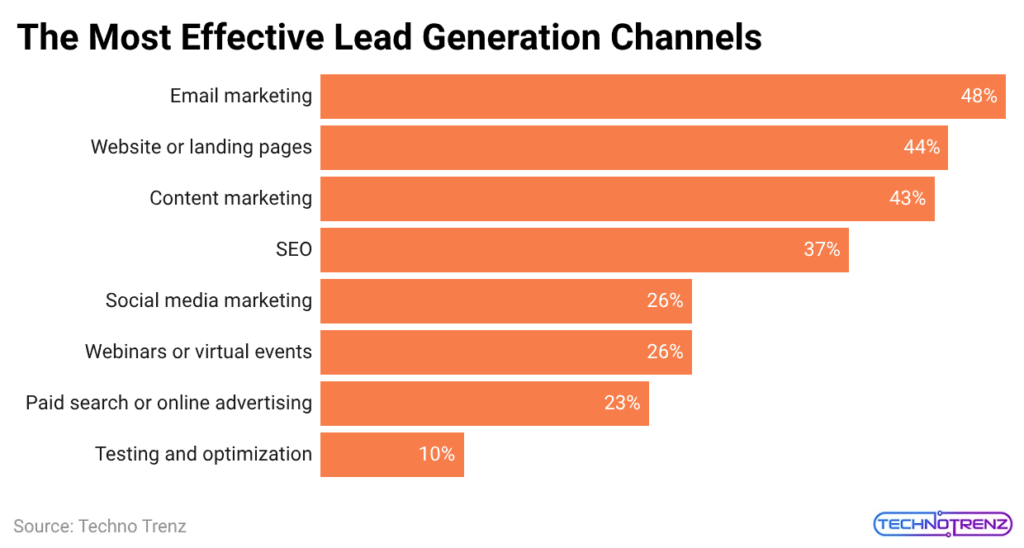
- The data above shows lead generation strategies that an analyst considers most effective, which he evaluates through their performance results.
- Email marketing leads the pack, with 48% of marketers identifying it as their most successful channel.
- Email marketing operations maintain their market dominance because email marketing generates high returns on investment for business operators who can use its personalized features to develop customer relationships that require minimal operational expenditures.
- Marketers use websites and optimized landing pages for their conversion needs because 44% of them consider these digital assets to be essential for their business operations.
- Content marketing follows at 43%, which shows that educating customers through value-based content helps businesses build customer trust and establish ongoing lead generation systems.
- The effectiveness of paid search and online advertising is recognized by 23% of marketers, which shows that growing costs and audience exhaustion are decreasing advertising results.
- The testing and optimization process at the testing and optimization center requires 10% of resources because testing requires time to yield useful results.
- The data shows that marketers achieve better results through organic channels, which focus on building relationships, than through methods that emphasize direct sales.
Regional Lead Generation
- Regional data shows uneven but accelerating expansion across the global lead generation landscape.
- North America will experience a constant 7.8% compound annual growth rate until 2025 because the region contains advanced digital marketing systems and major technology and marketing companies.
- The region experiences enhanced lead generation productivity through businesses that adopt CRM and automation systems and use data for targeted marketing.
- Europe is expected to exceed North America through its 9.5% compound annual growth rate, which will operate between 2019 and 2025. This growth is largely driven by increased investment in content marketing and social media, as businesses shift toward engagement-focused acquisition strategies to comply with stricter data privacy regulations.
- The Asia Pacific region displays its strongest growth rate through an 11.1% CAGR, which results from increased smartphone usage, expanding e-commerce activities, and growing digital advertising expenditures.
- The global growth rate will reach 7.4% because emerging markets now use digital lead generation methods more to attract new customers.
Lead Generation Channels With The Greatest Impact On Purchasing Decisions
(Reference: emailtooltester.com)
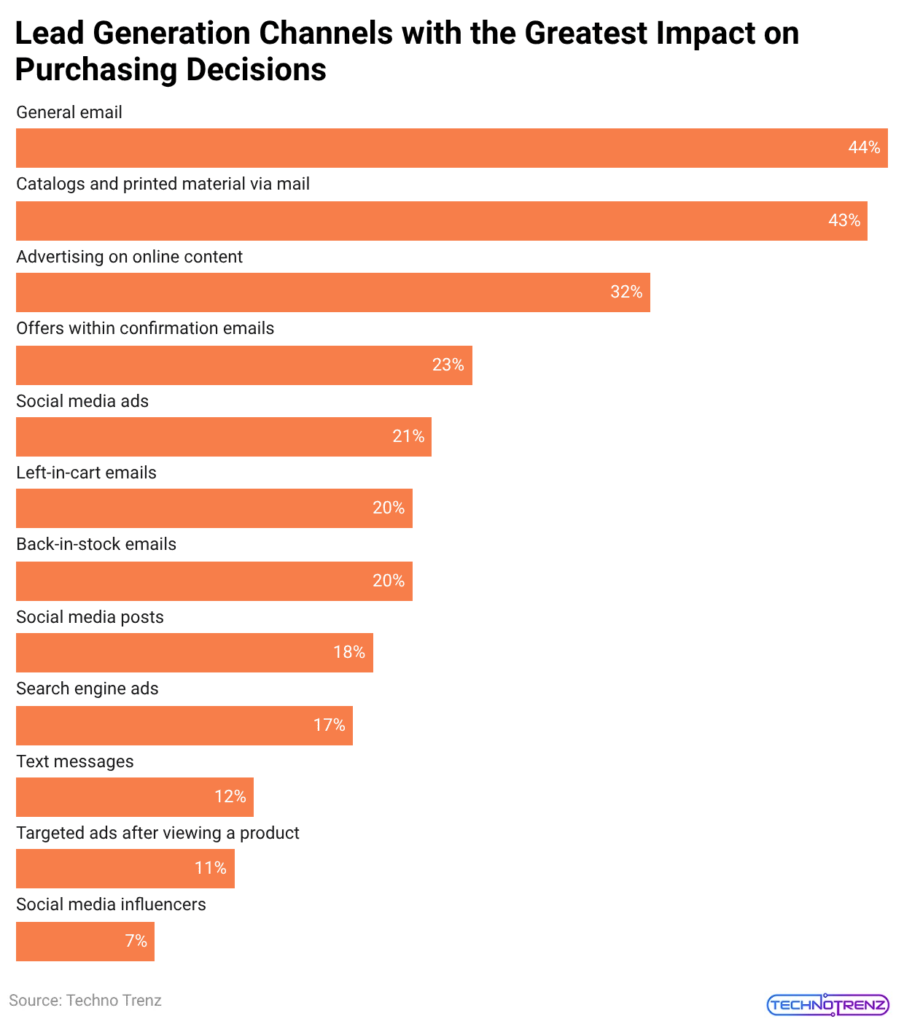
- According to Email Tool Tester, the above data shows how different lead generation channels create different levels of impact on online purchasing decisions.
- Email remains the most effective driver, with 44% of shoppers stating that general promotional emails from retailers have the greatest impact on their purchase behavior.
- The 43% result indicates that both digital and traditional owned channels maintain their essential function in trust-based lead generation because catalogues and printed materials act as secondary elements.
- The third most effective method for establishing intention during browsing activities includes online content advertising, which achieves a 32% success rate.
- Automated systems and algorithm-based methods produce lower results than their initial expectations.
- The offers found in confirmation emails create a 23% impact on shopper behavior, while social media advertisements produce a 21% impact, and cart-related emails create a 20% impact.
- Targeted ads that show users their previously viewed products achieve an 11% success rate, while social media influencers only reach 7% of their audience.
- The research results show that high-intent lead generation channels, which require permission to access leads, result in better conversion rates than lead generation methods that use passive or intrusive approaches.
Lead Conversion Performance And Sales Funnel Efficiency
- Lead conversion represents the most difficult aspect of lead generation, according to analysts, because this process demands continuous effort, together with precise training methods.
- Data shows that 63% of prospects who initially inquire are not ready to convert for at least three months, which demonstrates the need for follow-up throughout the sales process instead of pressuring customers to make immediate purchases.
- The timing of leads, together with their lack of proper qualification and matching messages, accounts for 79% of leads that do not turn into customers.
- B2B marketers have reported that 70% of lead conversion success depends on content, which proves that video material establishes credibility while demonstrating complex value aspects.
- Professional services only manage to convert 9.3% of leads because their customers need additional time to make choices while examining their purchasing options.
- Organizations need lead generation methods to succeed, but they require personalized content and extended digital engagement.
- Organizations can achieve better lead generation results through improved conversion methods, which increase their return on investment for lead generation activities across all business sectors.
B2B Lead Generation Performance And Cost Dynamics
- Lead generation for B2B markets requires more complex processes than B2C markets because B2B sales processes take longer with multiple decision makers involved and higher-value deals.
- The data shows that 68% of B2B marketers use strategic landing pages to gain and assess high-intent leads, which shows that they require specific entry points that contain detailed information.
- Analysts determine that lead generation costs increase rapidly for industries that exhibit high customer lifetime value, complex buying processes, and extensive regulatory requirements.
- The entry-level eCommerce and HVAC sectors show combined cost per lead expenditures of US$ 91 and US$ 92, which result from high-volume demand and short sales cycles.
- Cybersecurity leads cost US$ 406 per lead, while Fintech and Business Insurance leads cost more than US$ 450 because of strong market competition and the need for regulatory compliance.
- The most expensive lead generation environments are Higher Education (US$ 982), Legal Services (US$ 649), and Financial Services (US$ 653), where decision cycles are lengthy, and trust signals hold crucial importance.
- Paid CPLs show a consistent pattern of being more expensive than organic CPLs, which demonstrates how SEO and content-based lead generation methods become more effective over time.
Cost per Lead Patterns Across High-Value Industries
| Industry | Average paid CPL | Average organic CPL | Average CPL (combined) |
| eCommerce | US$ 98 | US$ 83 | US$ 91 |
| HVAC | US$ 115 | US$ 69 | US$ 92 |
| Entertainment | US$ 116 | US$ 111 | US$ 114 |
| Pharmaceutical | US$ 124 | US$ 135 | US$ 131 |
| Solar | US$ 217 | US$ 196 | US$ 206 |
| Construction | US$ 280 | US$ 174 | US$ 227 |
| B2B SaaS | US$ 310 | US$ 164 | US$ 237 |
| Biotech | US$ 274 | US$ 236 | US$ 255 |
| Hotels & Resorts | US$ 308 | US$ 224 | US$ 266 |
| Environmental Services | US$ 346 | US$ 207 | US$ 278 |
| Automotive | US$ 295 | US$ 271 | US$ 283 |
| Engineering | US$ 371 | US$ 201 | US$ 287 |
| Addiction Treatment | US$ 380 | US$ 213 | US$ 297 |
| Healthcare | US$ 401 | US$ 320 | US$ 361 |
| Aerospace & Aviation | US$ 469 | US$ 277 | US$ 373 |
| PCB Design & Manufacturing | US$ 480 | US$ 271 | US$ 376 |
| Cybersecurity | US$ 411 | US$ 404 | US$ 406 |
| Business Insurance | US$ 460 | US$ 388 | US$ 424 |
| Real Estate | US$ 480 | US$ 416 | US$ 448 |
| Fintech | US$ 490 | US$ 413 | US$ 452 |
| Industrial IOT | US$ 590 | US$ 404 | US$ 497 |
| Staffing & Recruiting | US$ 476 | US$ 518 | US$ 497 |
| IT & Managed Services | US$ 617 | US$ 385 | US$ 503 |
| Manufacturing | US$ 691 | US$ 415 | US$ 553 |
| Transportation & Logistics | US$ 670 | US$ 505 | US$ 588 |
| Software Development | US$ 680 | US$ 510 | US$ 591 |
| Oil & Gas | US$ 772 | US$ 502 | US$ 637 |
| Legal Services | US$ 784 | US$ 516 | US$ 649 |
| Financial Services | US$ 761 | US$ 555 | US$ 653 |
| Higher Education | US$ 1,261 | US$ 705 | US$ 982 |
(Source: emailtooltester.com)
- Lead generation costs increase rapidly for industries that exhibit high customer lifetime value and complex buying processes, and extensive regulatory requirements.
- The entry-level eCommerce and HVAC sectors show combined cost per lead expenditures of US$ 91 and US$ 92, which result from high-volume demand and short sales cycles. In contrast, B2B and regulated verticals experience significantly higher costs.
- Cybersecurity leads cost US$ 406 per lead, while Fintech and Business Insurance leads cost more than US$ 450 because of strong market competition and the need for regulatory compliance.
- The most expensive lead generation environments are Higher Education (US$ 982), Legal Services (US$ 649), and Financial Services (US$ 653), where decision cycles are lengthy, and trust signals hold crucial importance.
- Paid CPLs show a consistent pattern of being more expensive than organic CPLs, which demonstrates how SEO and content-based lead generation methods become more effective over time.
- Overall, the figures confirm that larger, high-stakes industries must invest heavily in targeting, qualification, and nurturing to secure conversion-ready leads.
Lead Generation Growth Driven By Marketing Software Adoption
- The development of marketing software has transformed lead generation methods according to an analyst’s evaluation of the market.
- The enterprise adoption data demonstrates a market trend that prefers organizations to adopt advanced intelligent systems that function through automated processes.
- IDC reports that 45% of worldwide businesses use AI and big data technologies in their marketing efforts, which indicates that software-based lead generation has become a standard requirement.
- The investment priorities of CMOs demonstrate this shift because they allocate funds to marketing automation platforms, which help organizations produce content and manage their campaigns and lead development activities.
- All Global 2000 B2B organizations will use AI-based context-driven engagement tools by 2023, which will enhance their lead generation process and improve their conversion rates.
- Marketers use web analytics for lead generation performance measurement because 88% of them consider this method essential.
- Email automation serves as the most developed application among marketers because 79% of them use automated email systems to send triggered emails(82%)and conduct nurture campaigns(67%)while performing segmentation(56%)and A/B testing(45%).
- More than half of businesses(52%) now achieve complete customer relationship management and marketing software integration, which provides them with unified client information and enhanced customer service speed.
- The use of no-code and low-code tools has become common for 33% of teams, which enables them to perform tasks without needing specialized technical knowledge.
- Software-based automation and data intelligence functions as the main mechanism that enables companies to create lead generation systems that produce high-performance outcomes in competitive business environments.
Recent Structural And Regulatory Shifts In The Lead Generation Industry
- The lead generation sector experiences operational challenges because of its current structural changes and the increasing implementation of new regulations.
- The market shows high-value mergers and acquisitions between companies, which demonstrate their faith in data-driven growth strategies.
- Blackstone Real Estate Partners acquired Tricon Residential because of private equity investors who find value in platforms that provide data on consumer behavior.
- The Chevron-Hess merger and Exxon Mobil-Pioneer merger demonstrate how data-heavy industries now merge their customer intelligence systems with digital marketing methods to create combined lead generation systems, which require control of their marketing assets.
- Lead generation companies must enhance their security systems while increasing their data protection methods according to new industry standards because surveys show that 70% of worldwide customers want to protect their personal information.
- The California Consumer Privacy Act (CCPA) and HIPAA regulations for healthcare leads and TCPA and CAN-SPAM federal communication laws create legal obligations that companies must follow.
- Organizations that do not follow regulations face severe financial penalties because each privacy violation can result in multimillion-dollar fines.
- Buyers now assess compliance records from past lending, healthcare, and telemarketing activities because they want to know how regulatory risks affect company valuation.
- Lead generation organizations can achieve sustainable growth through their ability to demonstrate compliance with industry regulations while maintaining data governance standards and developing trust-based operational frameworks.
Conclusion
Lead Generation Statistics: The 2025 lead generation landscape demonstrates an obvious transformation that introduces advanced intelligence systems together with evidence-based solutions and customer trust mechanisms. The increasing expenses associated with protected industries that handle valuable assets make it essential for businesses to practice accurate customer identification, together with extended customer relationship development. The process of marketing software implementation, together with AI and automation technologies, creates new possibilities for organizations to achieve enhanced productivity and business expansion.
The current stage of business expansion depends equally on compliance requirements and governance frameworks, together with technological advancements. The year 2025 requires organizations to establish a sustainable lead generation strategy that combines data intelligence with personalized experiences, operational discipline, and consumer trust.
FAQ
Email marketing is the top-performing channel, with 48% of marketers ranking it as the most effective.
The Asia Pacific region experiences the fastest market growth with an 11.1% compound annual growth rate, which results from increasing mobile usage and expanding e-commerce markets. The European market follows at 9.5% growth, while North America shows steady 7.8% expansion through its implementation of advanced customer relationship management and automation systems.
Promotional emails have the greatest impact, influencing 44% of shoppers.
Data shows that 63% of prospects are not ready to convert for at least three months. The B2B and professional services industries face conversion delays because of their lengthy decision-making processes, mandatory budget approvals and trust development needs.
Higher Education (US$ 982), Financial Services (US$ 653), and Legal Services (US$ 649) have the highest combined CPLs. These industries face long decision cycles, strict regulations, and high customer lifetime value.