







Introduction
Mobile Phone Usage Statistics: With digital screens gradually becoming nearly a part of us, 2025 is the year when mobile phones finally take their crown as the most important technology for mankind. Communication, entertainment, payments, work, and AI (artificial intelligence) are some of the areas in which mobile phones, particularly smartphones, are changing the daily lives, interactions, and business practices of people around the globe. The annual output of researchers, analysts, and market surveys not only gives us the figures that show the current usage trends but also gives us hints on what we can expect in the future.
In 2025, the world will have become more mobile-enabled, more data-oriented, and more technologically advanced than ever before. This all-encompassing article provides comprehensive mobile phone statistics in 2025 by coupling research-based context to present a full view of the global mobile landscape.
Editor’s Choice
- In 2025, global mobile phone ownership reached the level of 82%, thus confirming the status of smartphones as a very widespread technology.
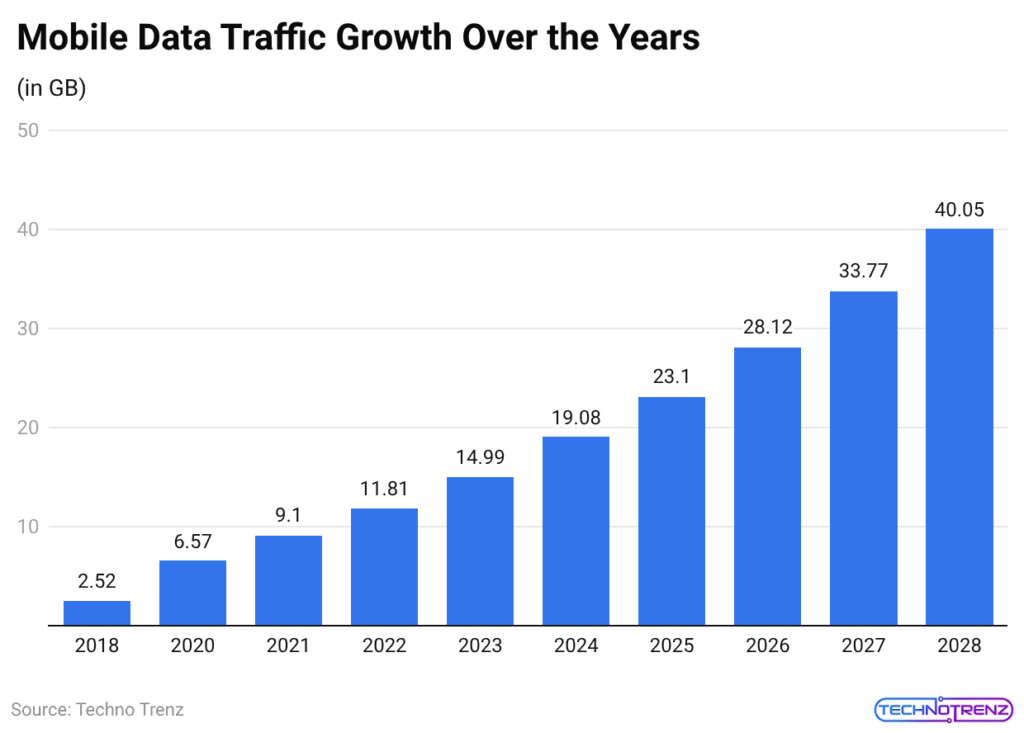
- In 2025, the average monthly consumption of mobile data exceeded 23 GB, and the forecast is that it will be more than 40 GB by 2028.
- The number of smartphone mobile network subscriptions came close to 7.3 billion worldwide, indicating the trend towards universal coverage.
- According to the very recent statistics, m-commerce takes the lion’s share of the total e-commerce market, holding the position of 73% due to the regular mobile shopping habit.
- An average individual has 1.51 mobile connections, which is indicative of the practice of having multiple SIMs and devices.
- Social media usage accounts for more or less 2.5 hours per day per user, and video streaming through mobile devices accounts for more than 90% of the total YouTube watch time.
- Daily mobile app usage time per user is 4.5 hours on average, but users focus their activities on around 30 main apps only.
- The beeper rate in smartphones worldwide reached 82%, whereas the U.S. market went past 91%, which indicates that the developed markets have matured.
- The reason for 36% of users abandoning their shopping carts is poor mobile shopping experiences, which exhibit user experience (UX) as a vital growth-limiting factor.
- The future smartphone adoption was mainly led by the emerging regions, which posted 12% growth in Southeast Asia and Africa.
How Mobile Data Consumption Has Grown Year By Year
(Reference: sqmagazine.co.uk)
- The increase in mobile data usage that has been happening steadily basically shows how much smartphones have become a part of life.
- In 2018, the average monthly data consumption was just 2.52 GB, which was the case when mobile internet was still mainly an add-on.
- The situation changed in 2020 when more than 100% increase in usage was seen, taking it up to 6.57 GB, with streaming services, social networks, and remote working being the main contributing factors to that.
- The average monthly data usage went from 9.10 GB to nearly 15 GB for the first time. This period indicates a change in user behavior as people started to rely more on the capabilities of smartphones for communication, entertainment, and work.
- Video streaming, mobile gaming, and app usage all turned into daily musts rather than market segments.
- Projections for 2024-2028 indicate a very significant change in mobile consumption patterns.
- The increase in monthly usage that will reach 23 GB by 2025 and exceed 40 GB by 2028 is primarily due to the advent of 5G networks, cloud computing, and enhanced digital experiences.
- The loudest signal of this new trend is high-definition video, augmented reality, and very strong internet connectivity, which are all synonymous with a mobile lifestyle that consumes a lot of bandwidth.
Global Growth Of Smartphone Mobile Network Connections

(Reference: sqmagazine.co.uk)
- The smartphone network subscriptions’ growth is a clear indication of how connected the world is.
- By the year 2025, there were almost 7.3 billion global smartphone mobile network subscriptions, and this number was very close to the global population that had access to digital connectivity.
- Predictions of the number of subscriptions exceeding 7.9 billion by the year 2028 point out that mobile access is rapidly moving towards almost total adoption.
- The three countries leading this growth are China, India, and the USA, which have huge populations, vibrant digital environments, and an increasing reliance on mobile phones for daily services.
- The sales in manufacturers’ smartphones have come to a standstill, but the usage of mobile phones is still growing as a result of upgrading by existing users, adding secondary lines, or using mobile services more.
- Markets with less than 70% penetration, like China and India, which are densely populated, have a lot of room to grow, especially as mobile phone prices become more affordable and network coverage increases.
- The global smartphone revenues, which were USD 481 billion in 2021, are expected to dip to USD 463 billion in 2022, but this has been cushioned by the rising average selling prices of smartphones due to the slumping sales volume.
- Samsung and Apple continue to be the dominant players in the market, accounting for nearly 50% of the global shipments.
Global Patterns In Mobile Phone Ownership And Internet Access In 2025
(Source: itu.int)
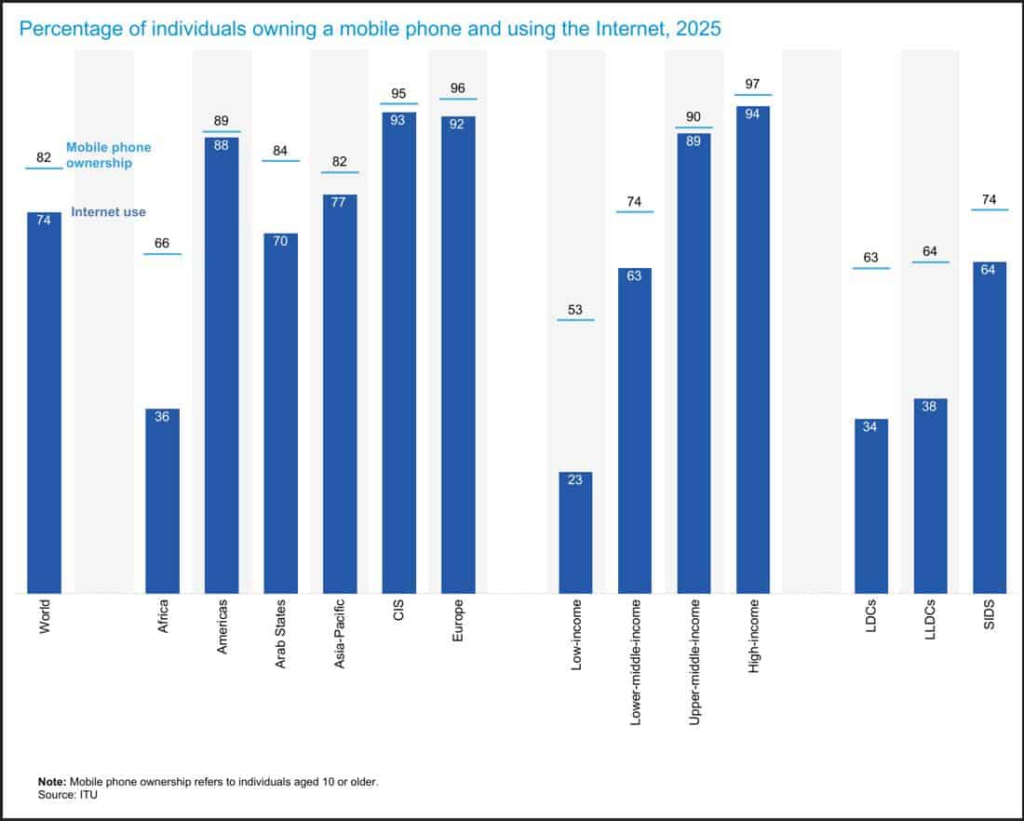
- The data from an analyst’s perspective depicts vividly how global connectivity has become uneven and always on-going slowly a d steady way 2025.
- The ownership of mobile phones worldwide is 82%, while on the other hand, internet usage is 74%, showing that even though devices are common, the full digital participation still lags behind. This gap is especially seen in regions and income groups.
- Mobile phones in the developed regions of Europe and the CIS are virtually saturating the market with ownership numbers exceeding 95%, and internet use closely following.
- The Americas and Arab States show an equally strong alignment of device access and connectivity that indicates mature digital ecosystems where mobile phone usage is deeply rooted in daily life.
- Africa, on the other hand, portrays the largest discrepancy: 66% of the population has a mobile phone, but only 36% use the internet, which points to the large gaps in infrastructure, high prices for communication, and limited data access.
- High-income countries nearly have the whole population using mobile phones and the internet, while low-income countries are still far behind, with only 23% internet use, even though phone ownership is increasing.
- The situation in Least Developed Countries (LDCs) and Landlocked Developing Countries (LLDCs) is the same; thus, the influence of geography and economic capacity on digital inclusion is further reinforced.
Gender Differences In Mobile Phone Ownership Across Regions
(Source: itu.int)
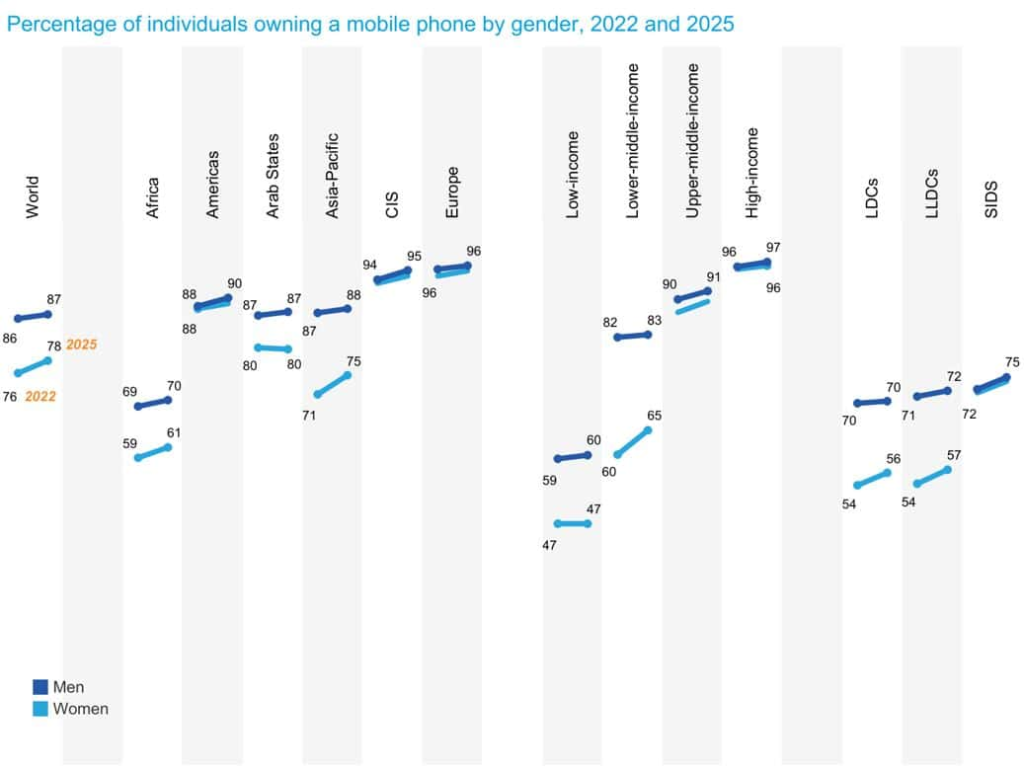
- The graph reflects an unbroken increase in mobile phone ownership from 2022 to 2025, while it has put the gender inequality in the regions and among different income groups in the spotlight.
- The percentage of men who owned cell phones globally went up slightly from about 86% to 87%, while the percentage of women went up more drastically from roughly 76% to 78%. This shows that there is development in the area, yet it still points out the fact that the gender differences in mobile phone consumption are still present in a systemic manner, as they have not been entirely solved.
- By 2025, both men and women in Europe and the CIS will have ownership rates that exceed 94%, indicative of the well-established digital infrastructures where official access is virtually total.
- The developed countries of the world are also in a similar situation, with a slight difference in the percentages and a total close to 96-97%, which implies that the barriers of high prices and poor infrastructure have been removed largely.
- One of the broadest gaps in Africa is where the ownership among men is about 69-70%, while the ownership of women is just under 60% in 2025.
- The same pattern can be found in low-income countries, where women’s access to mobile phones remains considerably behind, even though there have been small increases since 2022.
- On a positive note, women in the Asia-Pacific region and the Arab states have been the most benefited, which shows that the measures of affordability and digital inclusion are indeed working.
Global Snapshot Of Mobile Connectivity And Usage
(Source: sqmagazine.co.uk)
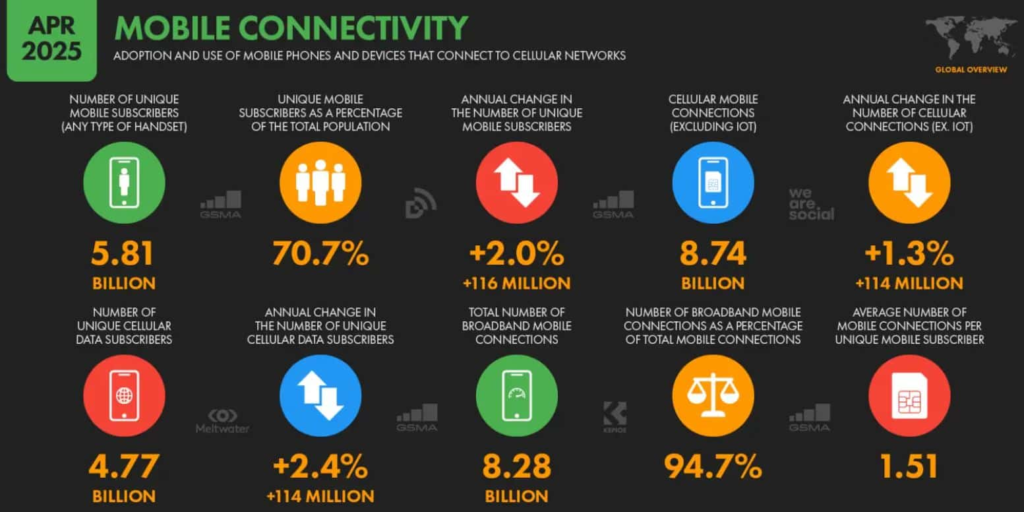
- The statistics presented above illustrate clearly that mobile connectivity has been one of the most thoroughly incorporated into the daily life of modern society.
- Mobile phone usage is no longer a story of growth solely from first-time users but rather deepening engagement with the existing ones, as there are already 5.81 billion unique mobile subscribers, which account for more than 70% of the world’s population.
- The increase of 116 million new subscribers year after year indicates that the market is growing steadily and sustainably, not through explosive adoption.
- The number of cellular connections is 8.74 billion, and the average number of connections per user is 1.51, which means that consumers are obviously using multiple SIMs, devices, or having separate lines for work and personal use—this is an indicator of both flexibility and dependency.
- Moreover, the prevalence of broadband is greatly remarkable, as almost 95% of the total connections can now be high-speed data-supported. This transformation is basically pointing to the case that mobile phone usage is now more data-heavy than ever through activities like streaming, gaming, making digital payments, and using the cloud.
- The increase in the number of cellular data subscribers to 4.77 billion further cements the position of mobile internet as a major player in one’s daily life.
Global Smartphone Adoption And Market Momentum
- The global smartphone market in 2025 is a situation where the developed markets have become mature, while the markets in other regions are steadily growing.
- The total global penetration of smartphones will be 82%, while the U.S. will be at 91%. Growth is no longer driven by new users, but by deeper mobile phone use and upgrading to new devices.
- The emerging markets of Southeast Asia and Africa, which have 12% adoption growth, are the main expansion engine for the smartphone industry now.
- New technologies are changing the demand, for example, foldable smartphones are slowly being adopted.
- Refurbished phones are also gaining a market share of 18%, indicating that people are choosing to purchase wisely.
- The 71% market share of Android shows its presence in all parts of the world. At the same time, Apple is gaining more and more premium users with its iOS.
- The increasing number of shipments and the combination of smartphones and wearables together show that the usage of mobile phones is becoming more connected, more personalized, and more essential in the digital life of everyday people.
Everyday Smartphone Activities And User Behavior Trends
| Smartphone Activity | General-purpose apps |
| Emails | 83% |
| Taking Photos | 83% |
| Surfing the Internet | 76% |
| Maps/Directions | 73% |
| Online Shopping | 71% |
| Check/Post Social Media | 67% |
| Listening To Music/Podcasts | 66% |
| Watch Short Videos (Clips/Messages) | 65% |
| Online Banking | 60% |
| Video Calls | 59% |
| Taking Videos | 58% |
| Reading news | 58% |
| General purpose apps | 57% |
| Playing Games (Apps) | 52% |
| Watch long videos (Movies/TV) | 44% |
| Online Video Gaming | 35% |
(Source: demandsage.com)
- The above data illustrates the transformation of mobile phone usage into a universal digital control center for everyday life.
- Communication and utility features are still up to the mark, and 83% of people rely on smartphones for emails and capturing pictures.
- Internet surfing (76%) and GPS (73%) are other confirmations that smartphones have become indispensable for real-time information and on-the-go decision-making rather than being optional accessories.
- More than 70% of users do their online shopping using smartphones, whereas 60% of them are taking the mobile route for their banking activities, thus indicating a good level of trust in the mobile-first financial ecosystems.
- Digital entertainment has always been a major factor attracting consumers, and currently, short-form video viewing (65%), listening to music and podcasts (66%), and playing games (52%) all bear witness to the variety of digital content and the altered users’ interests.
- Social media (64%) and music streaming (62%) activities take up most people’s time, while nearly 78% watch videos every week.
- The millennial generation is using devices simultaneously for entertainment, research, and transactions—in a balanced manner by comparing products, looking up weather, reading news, and investing online all through their smartphones.
- The not-so-happy users of long-form reading and dating apps indicate the millennials’ preference for quick, visual, and utility-driven experiences.
How 5G Is Reshaping Everyday Mobile Behavior
- 5G is a network upgrade, but to the mobile phone users, it is, at the end of the day, a very big and very expensive toy, one that is shared by many.
- Subscriptions to 5G are expected to reach 58% of total users in 2025, with an average speed five times higher than that of 4G, and users are shifting to lots of exciting, real-time experiences.
- The growing number of subscribers to cloud gaming (35% increase), along with the cities offering 4K video streaming have recently contributed to the enhancement of performance as a tool allowing consumers to have access to the highest quality content everywhere on the go.
- Mobile phone use is also becoming more engaging, evidenced by the fact that the number of people using AR apps has doubled, and live streaming of events is attracting 38% bigger audiences.
- The increasing data consumption and the prolonged productivity sessions are clear indications that mobile phone usage is transforming into a lifestyle that is high-bandwidth, always-connected.
How Mobile Devices Are Shaping Social Media Habits
- Social media platforms have now become an integral part of daily mobile phone usage, with the average smartphone user spending 2.5 hours per day engaging socially on their smartphones in 2025.
- No one can match Facebook’s reach, as 68% of mobile users check the platform daily, which not only confirms but also strengthens its position as a habitual touchpoint.
- Meanwhile, TikTok is changing the rules of the attention economy by using short video loops that are so captivating and immersive that almost an hour is consumed daily by each user.
- Instagram’s 17% hike in session growth indicates constant visual engagement, and at the same time, Snapchat’s incremental advances reveal its cultural importance to the younger generation.
- The professional side is also changing, as LinkedIn’s 14% leap is a clear indication of mobile-first job searching and networking.
- Amazingly, more than 90% of YouTube watch time is currently on mobile devices, which is a clear indication of video’s supremacy over mobile phone usage.
- An increase of 8% in daily active mobile social users every year proves the analysts’ predictions of a future where mobile phones will primarily define social discovery, entertainment, and identity expression instead of the desktop.
How People Are Really Using Mobile Apps Today
- An average smartphone now has 85 apps installed, and a user is active on only 30 of them every month, which exposes a considerable difference between downloading and using mobile phone apps. This selective attention justifies why the total global downloads went up to 260 billion in 2025, but the engagement is still limited to a smaller group of high-value applications.
- Video gaming still holds the top spot in the revenue generation by app category, with 48% of total app revenue coming from it.
- On the other hand, social media such as TikTok and Instagram are dominating the market by usage time, with users spending on average 33 minutes in one session.
- The total time on apps has reached 4.5 hours per day, which is a clear sign that mobile phone consumption has become the major way for people to get entertained, communicate, and get life’s conveniences.
- Subscription-based services are becoming more and more popular, where fitness, meditation, and streaming are the major contributors to a 19% spending increase.
- At the same time, the finance apps experienced the biggest growth in terms of downloads by 23%, which means that more and more people are starting to trust the management of their money through mobile devices.
- The case of productivity and food delivery apps further demonstrates that daily habits now revolve around the mobile phone for both work and consumption.
Mobile Shopping Trends And Consumer Behavior Today
- Mobile commerce is no longer perceived as just a convenient method but has already taken over as the main route for online retail sales.
- The dominance of m-commerce, which now contributes 73% to the total e-commerce activity, clearly indicates how much the use of mobile phones has influenced the buying behaviors of consumers.
- Retail apps are at the heart of this transformation: 35% of the users interact with them several times each week, and an overall percentage of 43 up to the daily habitual user count. This trend indicates a buying pattern that is spontaneous and mobile-friendly instead of being planned and desktop-based.
- There is a strong relationship between social media and mobile phone purchases—social media has been the most significant and powerful factor to influence mobile phone purchases.
- More than half of the buyers (55%) still go on to pay for their items via mobile after they had already seen the products on social media, and brands with very active social media accounts get a lot more sales.
Conclusion
Mobile Phone Usage Statistics: The mobile environment of 2025 is a transition point where the user’s reliance on mobile devices will increase drastically. Mobile phones are no longer seen as simple devices through which one can access the internet; they have become a part of our everyday life in terms of depth, speed, and integration. The surge in data consumption, the near-universal penetration of smartphones, and the prevalence of mobile-first users in the areas of commerce, media, and productivity are the factors that prove that the smartphone has become the main digital interface for billions.
Nevertheless, these same factors also hint at the areas where future growth and policy focus will be required—internet access, gender parity, and user experience. By the time 5G, apps, and mobile ecosystems become fully developed, it will be the companies that make connectivity inclusive, seamless, and meaningful that will be the real winners.
FAQ
The usage of mobile phones in 2025 indicates that there are more than 5.8 billion unique users across the globe, and almost 95% of all mobile connections are via broadband, with an average data usage of over 23 GB per month per user.
In 2025, the typical mobile user will consume around 18 to 23 GB of data a month, thanks to video streaming, social networking, cloud apps, and 5G’s widespread use.
Global smartphone penetration has reached approximately 82%, with developed markets nearing saturation and emerging regions like Africa and Southeast Asia driving new growth.
Users spend an average of 2.5 hours per day on social media through mobile devices, with platforms like Facebook, TikTok, Instagram, and YouTube leading engagement.
Mobile phones drive nearly 73% of e-commerce activity, generate 65% of online shopping traffic, and dominate sales during events like Black Friday and Cyber Monday.