






Key Takeaways
- Strategic Acquisition: OpenAI acquired Torch, a healthcare startup founded in 2024, for approximately $60–$100 million to enhance ChatGPT Health capabilities.
- Unified Medical Memory Technology: Torch’s core innovation consolidates fragmented health data—lab results, medications, doctor visit recordings, and wearable data—into a single AI-readable platform.
- Market Timing: The acquisition arrives as generative AI in healthcare is projected to reach $4.7 billion in 2026, growing at a 45.76% CAGR through 2031
- Competitive Intensity: Anthropic launched Claude for Healthcare one day after OpenAI’s announcement, signaling an accelerating arms race among major AI labs to dominate healthcare AI.
Quick Recap
OpenAI announced on January 13, 2026, that it has acquired Torch Health, a year-old healthcare technology startup specializing in unified medical data management. The deal, valued between $60 million and $100 million in equity, integrates Torch’s four-person team directly into OpenAI’s expanding healthcare division. According to OpenAI’s statement on X, “Bringing this together with ChatGPT Health opens up a new way to understand and manage your health.” Torch co-founder Ilya Abyzov confirmed the acquisition in a post: “The Torch team and I are joining OAI to help build ChatGPT Health into the best AI tool in the world for health and wellness.”
The Unified Medical Memory Engine
Building Context Into Healthcare AI
Torch was designed to solve a fundamental problem in healthcare AI: fragmentation. Patients’ medical records are typically scattered across multiple hospitals, labs, pharmacy systems, electronic health record (EHR) portals, wearables, and consumer health applications. This fragmentation forces both patients and clinicians to manually reconstruct health history during each interaction, losing critical context that AI systems need to provide personalized, accurate guidance.
Torch’s technology functions as a “unified medical memory” that aggregates and normalizes health data into a single context engine. The platform consolidates lab results, medications, visit summaries, clinical diagnoses, wearable data (steps, sleep, heart rate), imaging reports, genetic test results, immunization records, and even doctor visit recordings into a coherent, AI-readable format. By eliminating data silos, Torch enables ChatGPT Health to understand a patient’s complete medical trajectory rather than responding to isolated questions with generalized information.
The founders—Ilya Abyzov, Eugene Huang, and physicians James Hamlin and Ryan Oman—previously worked together at Forward Health, an AI-enabled, direct-to-consumer primary care company that operated technology-enabled clinics called “CarePods” before shutting down in late 2024. This background in healthcare operations gave Torch’s team firsthand experience with the operational friction caused by data fragmentation in clinical workflows. Their solution directly addresses a pain point they had observed: clinicians often work with incomplete patient records because accessing data across multiple systems is time-consuming and technically challenging.
ChatGPT Health Integration and Competitive Landscape
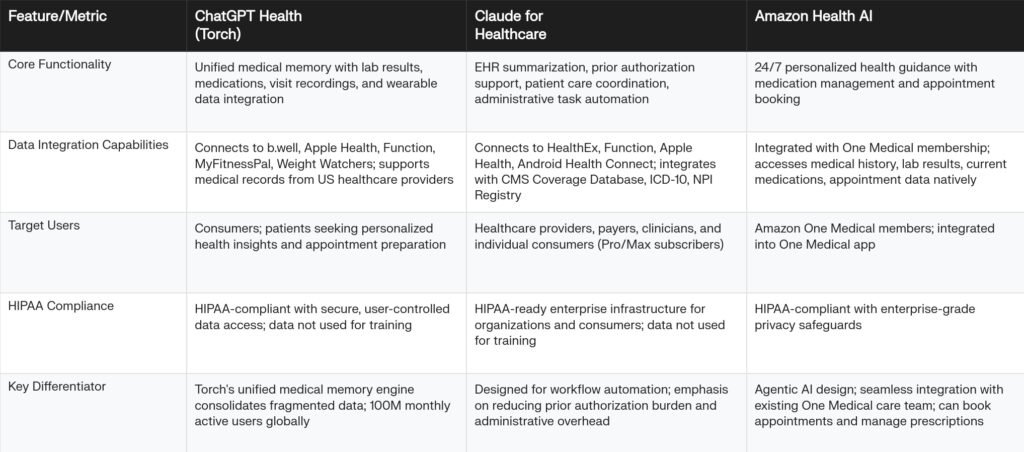
OpenAI launched ChatGPT Health on January 7, 2026, one week before the Torch acquisition. ChatGPT Health allows U.S. consumers to connect their medical records and wellness data through partnerships with b.well (a health records integration platform), Function (a personal health testing company), Apple Health, MyFitnessPal, and Weight Watchers. Users can ask contextualized health questions such as “How is my cholesterol trending?” or “Summarize my latest bloodwork before my appointment,” with ChatGPT providing responses grounded in their actual medical data rather than generic health information.
Torch’s technology significantly strengthens ChatGPT Health’s core capabilities by ensuring that medical context doesn’t degrade as data complexity increases. Instead of requiring manual data entry or fragmented API connections, Torch’s unified engine allows ChatGPT to work with comprehensive, normalized patient records—enabling more accurate trend analysis, better identification of warning signs, and higher-quality clinical summaries.
The competitive environment intensified immediately. On January 11, 2026—just one day after OpenAI’s healthcare enterprise launch and three days before the Torch acquisition—Anthropic unveiled Claude for Healthcare. Claude’s offering includes HIPAA-compliant enterprise infrastructure, connectors to healthcare databases (CMS Coverage Database, ICD-10, NPI Registry), and consumer-facing personal health data integration via HealthEx, Function, Apple Health, and Android Health Connect. Claude emphasizes workflow automation, particularly prior authorization support, a workflow that consumes an estimated 16+ hours per week of physician time and costs the healthcare industry $1.3 billion annually in administrative overhead.
Additionally, Amazon entered the consumer health AI space with Health AI for One Medical, an agentic AI assistant integrated directly into the One Medical app that provides 24/7 personalized health guidance, medication management, and appointment booking capabilities.
Why This Matters Now?
The Torch acquisition signals that healthcare AI has transitioned from experimental to strategic infrastructure. The global AI in healthcare market is projected to reach $54.19 billion in 2026 and $249.72 billion by 2031, growing at a 35.74% CAGR. Generative AI and foundation-model platforms are expanding at a 45.76% CAGR, indicating that foundation models designed for healthcare applications will drive market growth.
Healthcare organizations are adopting commercial AI at 2.2 times the rate of the broader U.S. economy, according to Menlo Ventures’ 2025 State of AI in Healthcare report. This rapid adoption creates competitive pressure: companies that integrate specialized healthcare AI capabilities into existing consumer or enterprise distribution channels will capture disproportionate market share.
The acquisition also reflects a strategic shift toward what industry observers call the “agentic shift”—moving from one-off AI responses to systems that maintain long-term, personalized context and can reason over extended health histories. Torch’s unified medical memory technology directly enables this transition. Rather than ChatGPT answering each health question independently, ChatGPT Health with Torch integration can build and maintain continuous context across medical history, identify patterns over time, and provide increasingly personalized guidance.
Regulatory tailwinds also support this timing. U.S. healthcare regulations—particularly HIPAA—have established clear frameworks for AI systems handling protected health information. OpenAI, Anthropic, and Amazon have all designed HIPAA-compliant architectures that explicitly protect user data from model training, reducing regulatory risk for adoption by healthcare organizations and consumers.
TechnoTrenz’s Takeaway
I think this is a big deal because OpenAI just solved a problem that has plagued healthcare technology for decades: how do you get AI to truly understand a patient’s full medical story?
In my experience covering the healthcare tech space, most attempts at AI health tools fail because they’re built on incomplete information. You ask ChatGPT about your headaches, and it gives you generic advice because it doesn’t know you have a history of migraines, take three medications that interact with certain pain relievers, or that your last neurologist visit flagged a specific concern. The context problem makes AI responses less useful and sometimes even risky.
Torch changes that equation. By consolidating fragmented medical data into a unified engine, OpenAI is creating the foundation for healthcare AI that actually understands you. This isn’t just better answers—it’s the difference between generic health information and personalized clinical intelligence.
From a competitive perspective, I generally prefer seeing this kind of consolidation in emerging markets because it forces competitors to innovate rather than copy. Anthropic’s Claude for Healthcare announcement within days of OpenAI’s moves shows that serious competition is coming. But Torch gives OpenAI a structural advantage: they own the unified medical memory layer, which is harder to replicate than interface features.
The real bullish signal here is that major AI labs are moving beyond consumer chat to infrastructure plays. They’re acquiring companies that solve infrastructure problems rather than building consumer wrappers. That suggests the industry believes healthcare AI will follow the same pattern as cloud computing—where whoever controls the foundational layer wins in the long term.
For healthcare organizations and patients, I think this accelerates deployment by 12–18 months. When you have OpenAI, Anthropic, and Amazon all racing to integrate your health data and provide AI-driven insights, trust and regulatory clarity become the deciding factors. Torch removes one major barrier: the technical complexity of data unification. That means healthcare providers can now focus on adoption and use-case development rather than building their own data infrastructure.
Bottom line: bullish. This acquisition demonstrates that healthcare AI is no longer experimental technology—it’s becoming critical infrastructure for how health information flows and how decisions get made.

Sources