





Introduction
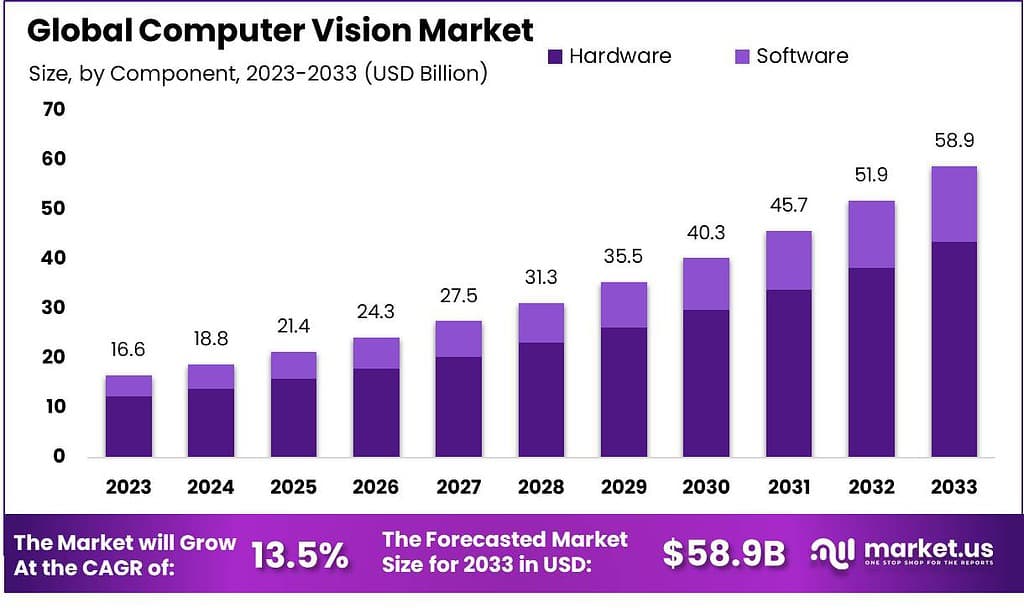
The Global Computer Vision Market reached USD 16.6 billion in 2023 and projects to achieve USD 58.9 billion by 2033, advancing at a 13.5% CAGR from 2024-2033. AI-driven visual analysis powers object detection, facial recognition, and automation across industries like manufacturing and healthcare, with hardware leading due to GPU and sensor advances. Demand rises from quality control needs and real-time processing in autonomous systems.
Computer Vision Market centers on technologies that let machines understand and process images or videos like humans do. These systems analyze visual data for tasks such as object detection, facial recognition, and quality checks in factories. They power everything from self-driving cars spotting road signs to medical scans finding tumors early.Fields like manufacturing, healthcare, and retail rely on computer vision daily, with over 80 percent of industrial robots now using it for precise movements. Cameras and sensors feed data into algorithms that learn patterns over time. This tech cuts down guesswork and speeds up decisions across operations.
Demand for factory automation tops the list, as vision systems guide robots to handle parts with 99 percent accuracy, reducing waste. Self-driving tech needs real-time image analysis for safe navigation, pushing hardware improvements. Healthcare scans improve diagnosis speed, catching issues humans might miss in busy workflows.
Retail stores use it for shelf monitoring, restocking faster with fewer staff. Government pushes for smart cities add surveillance layers, tracking traffic flow in real time. These needs blend to make vision tools essential in daily business.
Top Market Takeaways
- Hardware captures over 74% market share from high-resolution cameras and GPUs.
- Smart camera-based systems hold 51.3% in 2023 for real-time recognition.
- Quality assurance & inspection leads applications at over 25% share.
- Industrial vertical dominates with over 48% in manufacturing and automotive.
- Asia Pacific accounts for 38% global revenue, valued at USD 6.3 billion in 2023.
Key Statistics
- According to coolest-gadgets, engagement in classrooms increased by 67%, showing how effectively computer vision captures students’ attention.
- A 42% adoption rate indicates that computer vision technology has become mainstream in education.
- Administrative work has been reduced by 23%, allowing teachers to focus more on instruction and student support.
- An 89% accuracy rate in detecting student comprehension enables teachers to adjust lessons quickly based on real-time understanding.
- Learning outcomes improved by 31%, demonstrating the positive academic impact of computer vision tools.
- Student satisfaction reached 76%, reflecting strong alignment between the technology and student preferences.
- About 58% of schools expressed privacy concerns, signaling the need for careful and ethical implementation.
- Facial recognition technology experienced significant growth in 2021 with a 103.37% increase.
- Manufacturing holds 25.98% of the computer vision market because it enhances production efficiency and quality control.
- Healthcare accounts for 20.21% of the market, using computer vision to assist with medical image analysis, diagnosis, and patient care.
Benefits
- Firms gain from defect catches raising product quality to 95 percent pass rates. Workers shift to skilled jobs, boosting output without hires. Safety rises as cameras spot hazards before accidents.
- Retail personalizes shops via behavior reads, lifting sales through better displays. Data from visuals sharpens choices, like stock tweaks. Lean runs follow naturally.
- Fraud drops in finance with pattern checks at high precision. Inventory stays tight, avoiding 30 percent overstock losses. Edge stays ahead in customer pulls.
Emerging Trends
- Edge AI Processing: Systems now handle visual data right at the source, like cameras on factory floors, cutting delays and boosting privacy in real-time checks. This shift helps industries run smoother without constant cloud links.
- Vision Transformers Rise: These models scan whole images at once, beating older methods in spotting objects and segmentation for better accuracy in cars and security. Adoption jumped as they set new benchmarks across apps.
- Generative AI Tools: New setups create fake images or fill data gaps, speeding up training for scarcer datasets in medical scans or retail setups. This cuts costs and opens doors for custom visuals in ads and sims.
- 3D Vision Advances: Depth sensing and reconstruction make AR overlays sharper and robotics smarter in warehouses or surgery. It fuels growth in immersive training and precise navigation.
- Multimodal Models Blend: Vision pairs with text or sound for deeper insights, like drones reading labels while hearing commands in farms. This combo drives smarter decisions in mixed setups.
Growth Factors
- Automation Push: Factories and shops grab vision tech for quality checks and robot guides, slashing errors and labor needs. Demand spiked with Industry 4.0 rollouts hitting 68% hardware share in 2024.
- Autonomous Vehicles Boom: Cars and drones lean on vision for safe driving, with ADAS markets growing at 21% yearly through 2030. Rules worldwide speed this up for collision avoidance.
- AI and Deep Learning Gains: Smarter algorithms process images faster on GPUs, pulling sectors like health and retail into the fold. Investments from firms like NVIDIA fuel 19.5% CAGRs to 2035.
- Healthcare and Retail Uptake: Scans spot diseases early and shelves track stock live, with North America leading on diagnostics and theft cuts. This broad use lifts overall demand.
- Edge Computing and IoT Ties: Low-power chips link sensors for instant analysis in smart cities, growing markets at 13% CAGR. It cuts costs and scales for surveillance and agtech.
Key Market Segment
Component Segments
- Hardware
- Software
Product Type Segments
- Smart Camera-Based Computer Vision System
- PC-Based Computer Vision System
Application Segments
- Quality Assurance & Inspection
- Positioning & Guidance
- Measurement
- Identification
- Predictive Maintenance
- 3D Visualization & Interactive 3D Imaging Modelling
Vertical Segments
- Industrial
- Non-Industrial
Top Key Players
- Cognex Corporation
- Keyence Corporation
- Intel Corporation
- Matterport Inc.
- OMRON Corporation
- National Instruments
- Teledyne Digital Imaging Inc.
- Sony Semiconductor Solutions Corporation
- sony corporation
- cadence design systems, inc.
- teledyne technologies
- Basler ag(Germany
- allied vision technologies
- Other Key Players
Future Outlook
Computer vision technology promises deeper integration across industries, fueled by AI advancements and hardware innovations that enhance real-time object detection, predictive maintenance, and autonomous operations. Industrial applications in manufacturing and automotive will expand alongside non-industrial uses in healthcare diagnostics and retail automation, with Asia Pacific’s surveillance and investment lead extending to North America’s policy support and Europe’s automotive focus. Smarter cameras and GPUs will drive efficiency gains, tackling quality assurance and 3D modeling needs while addressing ethical concerns through better algorithms. Overall, the field eyes widespread automation and decision-making upgrades as data volumes grow and edge computing matures.
Opportunities
- Healthcare diagnostics via precise medical imaging analysis.
- Retail automation for cashier-less stores and inventory tracking.
- Autonomous vehicles and robotics with positioning guidance.
- Agriculture precision farming through crop monitoring.
- Surveillance enhancements from government camera deployments.
Challenges
- Privacy issues from extensive image and video data collection.
- High computational demands requiring powerful, costly hardware.
- Integration complexities with existing systems.
- Accuracy and reliability needs in critical sectors like medicine.
- Ethical concerns over facial recognition and bias in algorithms.
Recent Development
- June, 2022, Visionary.ai partnered with Innoviz Technologies for 3D vision in drones and smart cities using ISP and LiDAR.
- March, 2022, Intel launched healthcare solutions for patient rooms to boost outcomes and safety.
- January, 2022, AWS released Panorama SDK in Asia Pacific for visual inspections and safety.
Conclusion
Computer vision’s trajectory points to transformative automation across industrial and non-industrial sectors, anchored by hardware dominance and smart camera systems that excel in quality assurance and predictive maintenance. Asia Pacific’s lead, bolstered by massive surveillance investments and key players like Sony and OMRON, sets the pace, while North America and Europe advance through policy and automotive innovations. Opportunities in healthcare imaging, retail efficiency, and autonomous tech outweigh challenges like privacy risks and compute demands, as AI refinements ensure reliable visual insights. The sector’s blend of real-time processing and edge solutions positions it to redefine decision-making in manufacturing, surveillance, and beyond, driving sustained productivity gains worldwide.
Read more – https://market.us/report/computer-vision-market/

Sources