







Introduction
Customer Segmentation Statistics: Through customer segmentation, businesses reach their revenue goals and customer engagement targets while protecting their future marketing strategy investments. Companies create customized experiences that connect with their customers by analyzing audience data through behavioral patterns, user preferences, demographic information, and predictive models. The proof exists through numerical evidence in 2025.
The article presents data that includes current customer segmentation statistics, industry predictions, return on investment measures, and financial numbers and research results, which demonstrate how customer segmentation has developed into a data-driven competitive edge for multiple industries. Marketers and business leaders can use this evidence-based deep dive to create better business strategies.
Editor’s Choice
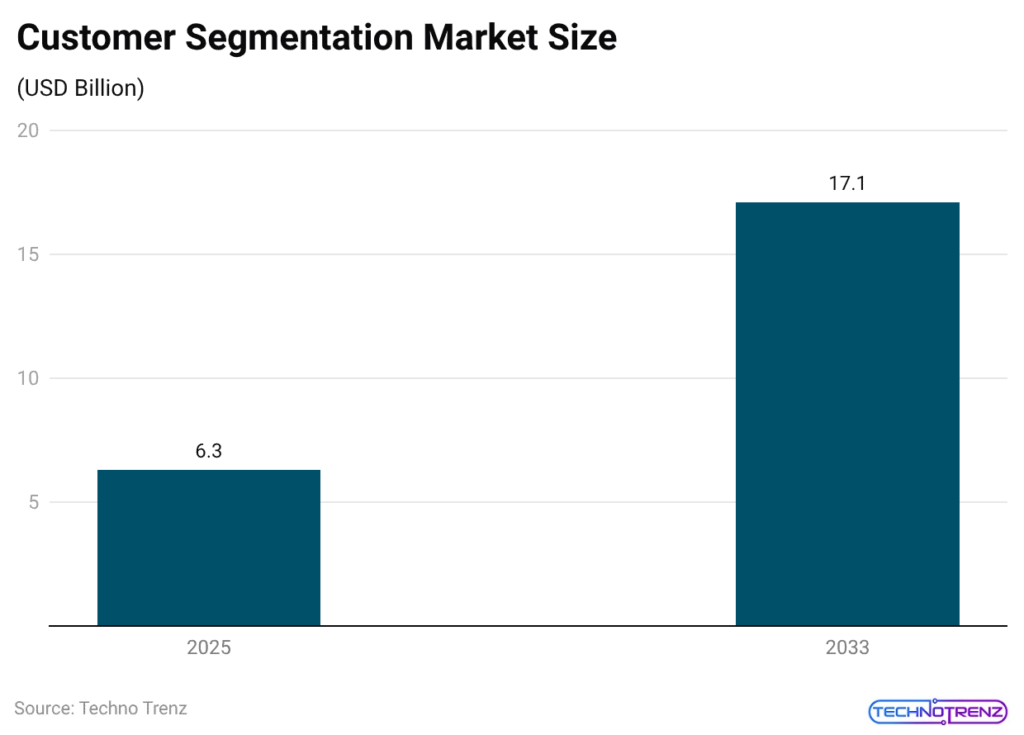
- The customer segmentation market is valued at USD 6.3 billion and projected to reach USD 17.1 billion by 2033.
- The market is growing at a 18.10% compound annual rate, indicating sustained demand.
- 70% of global marketers actively use customer segmentation in their strategies.
- Segmented email campaigns generate 100.95% higher click rates than non-segmented ones.
- Businesses that implement segmentation strategies are 80% more likely to achieve sales growth.
- Personalized offerings create 10 to 15% additional revenue growth, with some instances reaching 760% revenue growth.
- 73% of consumers expect brands to understand their needs through personalization.
- AI-based customer segmentation achieves 90% accuracy, which exceeds the performance of standard segmentation methods.
- The implementation of artificial intelligence technology leads to a 37% reduction in marketing expenses and a 39% revenue increase.
- Only 16% of organizations believe their segmentation strategy is fully optimized.
What Is Customer Segmentation?
Customer segmentation involves creating separate customer groups who share common characteristics through demographic information, psychographic data, their buying patterns, and their geographic distribution and predictive attributes. In 2025, modern segmentation has developed from basic age and gender information into advanced AI-generated profiles that use machine learning and real-time data analysis. The shift resulted in a substantial increase foinusiness performance.
Customer Segmentation Market
(Reference: htfmarketinsights.com)
- According to Htf Market Insights, the customer segmentation market has entered a period of rapid expansion because businesses now use data-driven marketing techniques together with AI-powered analytics tools.
- The market has a current value of USD 6.3 billion, which will grow at a strong rate of 18.10% CAGR until it reaches USD 17.1 billion by 2033.
- The 15.8% annual growth rate shows that customers keep buying products instead of showing temporary interest.
- Brands need to expand their understanding of customer behavior changes, which requires them to create personalized marketing strategies that will help them improve their return on investment in all their marketing channels.
- Machine learning technology, together with cloud infrastructure and real-time data processing capabilities, has become a driving force that enables organizations to implement their solutions across multiple platforms.
- Businesses must develop advanced customer segmentation systems because these solutions now serve as the main driver for their organizational development.
- Organizations that use intelligent customer segmentation to build their business strategies will gain a better chance to discover new revenue streams while maintaining their market leadership position.
Usage Of Customer Segmentation
| Campaign Metric | Average Performance |
| Opens: | 14.31% higher than non-segmented campaigns |
| Unique Opens: | 10.64% higher than non-segmented campaigns |
| Clicks: | 100.95% higher than non-segmented campaigns |
| Bounces: | 4.65% lower than non-segmented campaigns |
| Abuse Reports: | 3.90% lower than non-segmented campaigns |
| Unsubs: | 9.37% lower than non-segmented campaigns |
(Source: grabon.com)
- The above data demonstrates that Grabon shows that customer segmentation has transformed into an essential marketing discipline from its previous status as a tactical marketing method.
- About 70% of global marketers use segmentation as part of their strategic planning, showing that this practice has become common across different business sectors.
- Email serves as the most convincing evidence because 78% of marketers identify subscriber segmentation as their top-performing email strategy, while 64% of marketers use segmentation to create personalized campaigns.
- Companies use three and a half segmentation criteria, which they combine to develop better targeting through demographic data,d geographic data, psychographic information, and behavioral patterns.
- Segmented email campaigns deliver 14.31% higher open rates and 10.64% more unique opens than non-segmented efforts.
- More strikingly, clicks jump by 100.95%, which results in double the user interaction.
- Segmentation decreases bounce rates by 4.65% and, unsubscribe rates by 9.37%, and abuse reports by 3.9%, which helps improve sender reputation.
- The customer segmentation data shows that businesses achieve better results when they focus on relevant customer segments instead of trying to reach all customers.
- When brands invest in smarter audience definition, customer segmentation becomes a scalable growth lever rather than just a personalization tactic.
Customer Segmentation Drives Business Across Industries
- Customer Segmentation has become a vital growth driver for various business sectors.
- Companies that use segmentation to analyze their customers experience 60 % better customer understanding and 130 % better prediction of customer purchase behavior, which helps them make better business judgments.
- Businesses that use market segmentation report 80 % higher sales, while their customized product offerings generate 10 to 15 % additional revenue.
- Revenue growth in advanced use cases can reach 760 % because personalization operates at scale to create multiple revenue growth opportunities.
- Through AI implementation, 74 % of marketers improve their customer segmentation accuracy by using AI tools to enhance their results.
- Targeted campaigns now generate 77 % of marketing return on investment, which shows that customer segmentation drives continuous business success.
Emotional Engagement As A Loyalty Growth Lever
- Emotional engagement serves as a strong revenue driver, which also increases customer loyalty.
- Research shows that 70 % of emotionally engaged consumers buy their preferred brands at twice the rate of consumers who show low emotional engagement.
- The emotional bond between customers and brands increases annual revenue by 5 % because it functions as a key business driver.
- Strong customer segmentation enables brands to identify high-emotion segments and tailor messaging that deepens attachment.
- The loyalty gap is striking: 86% of highly engaged consumers instinctively recall their favorite brand while shopping, and 82% repeatedly purchase it, versus 56% and 38% among less engaged customers.
- Customers who feel emotional connections to brands will promote them at 80 %, whereas customers who feel no emotional connection will do so at 50%.
- When powered by precise customer segmentation, emotional engagement strategies convert insight into sustained loyalty, higher lifetime value, and organic brand amplification.
Behavioral Segmentation Powers Precision Marketing
- Behavioural data has become the most actionable layer of Customer Segmentation.
- Today, 61% of marketers segment audiences by purchase history, while 47% track interaction frequency and 41% leverage browsing behavior to personalize recommendations.
- Advanced Customer Segmentation strategies go further—35% target cart abandoners, and 52% of eCommerce brands clearly separate high-value repeat buyers from one-time shoppers.
- The performance upside is significant: predictive behavior models cut churn by up to 34%, trigger-based segmentation lifts remarketing conversions by 38%, and lapsed-customer segmentation improves reactivation rates by 25%.
- Overall, behavioral Customer Segmentation transforms raw actions into revenue-driving insights.
Customer Segmentation Enhances Experience
- The analysis of customer data allows companies to create targeted segments that serve as essential components for delivering effective customer experiences.
- The study showed that 73% of consumers expect brands to understand their needs, while 69% of online shoppers demand customized product suggestions, which makes personalized marketing essential for businesses.
- Companies that use improper marketing methods face dangerous outcomes because 61% of consumers become annoyed with generic advertisements, while 33% of shoppers switch brands when they receive inadequate personalized content.
- Customer segmentation reveals its advantages through measurable results because 45% of consumers make purchases after they receive messages that match their specific identity, and 18% of customers display increased contentment after businesses use segmentation methods to interact with them.
Personalized Recommendations Drive E-commerce Growth
- E-commerce websites use personalized recommendations as their main method to generate revenue.
- Amazon sets the benchmark, with over 35% of total sales generated through recommendation algorithms, while 44% of customers purchase items surfaced in “frequently bought together” or “customers also bought” sections.
- The results demonstrate that businesses can use customer segmentation methods to improve sales results through successful customer conversion processes, which begin from the initial stage of customer research.
- The model receives strengthened support through public data sharing because 57% of individuals permit their details to be shared when organizations handle their information securely, and 22% will provide restricted information to receive better product suggestions.
- The data shows generational trends, which show that 63% of Millennials, 58% of Gen X, and 46% of Baby Boomers accept data sharing in return for tailored discounts.
- The study shows that 63 % of users experience disappointment with marketing campaigns that use the same advertisements because these ads do not provide meaningful content.
- Customer segmentation methods enable companies to move from irrelevant content, which fails to connect with customers, towards building personalized experiences that increase sales and customer loyalty.
AI Transforming Modern Customer Segmentation
Artificial intelligence is redefining how brands approach customer segmentation by delivering sharper accuracy and stronger financial outcomes. AI segmentation models reach 90 % accuracy for audience targeting, which exceeds the 75 % accuracy of traditional rule-based methods. The use of marketing artificial intelligence leads to direct financial benefits because businesses that implement this technology experience a 37 % decline in operational expenses and a 39 % rise in income,e which improves their efficiency and return on investment.
AI-based customer personalization systems generate a 55 % increase in customer interaction, while machine learning email systems produce a 25% boost in email response rates. AI technology will enhance customer satisfaction by 25 % and increase conversion rates by 30 % because it improves customer experiences through its targeting capabilities. AI technology enables businesses to create personalized experiences that drive their customer development by using dynamic customer behavior data instead of fixed customer segments.
Regional And Cultural Targeting In Marketing
- The process of marketing to specific geographic areas and their associated cultural groups establishes a system that delivers authentic and pertinent marketing messages to customers.
- Nearly 50% of marketers now tailor campaigns by region, while 43% adapt language and slang to match local culture.
- Another 38% personalize offers based on climate and seasonal behavior, which allows customers to access products that meet their actual requirements.
- The results demonstrate that geo-targeted campaigns deliver 2.5 times better relevant results while localized product images increase consumer trust by 17%.
- The data shows that customer segmentation based on geographic and cultural factors helps to decrease message fatigue while increasing audience connection.
- As brands scale their operations across international markets, they need to implement region- based customer segmentation, which has developed into a fundamental business requirement.
B2B Firmographic Targeting Trends
- Firmographic customer segmentation is central to B2B growth strategies.
- About 71% of B2B companies segment prospects by industry, while 64% refine targeting based on company size or employee count.
- Revenue-based segmentation is also common, used by 52% of firms to prioritize high-value accounts, and 36% further segment by technology adoption levels.
- The impact is measurable: industry-specific messaging delivers 31% higher response rates, and segmenting prospects by business maturity shortens sales cycles by 11%.
- These results show that data-driven customer segmentation enables sharper positioning, faster deal closures, and more efficient pipeline management across competitive B2B markets.
Modern Tools Powering Segmentation
- Technology is the essential element that enables businesses to perform customer segmentation successfully.
- Marketers combine customer relationship management systems with audience segmentation features because 63% of them use these systems for audience management.
- Advanced stacks are emerging too—33% leverage Customer Data Platforms (CDPs) to unify fragmented data, and 28% integrate segmentation with predictive analytics.
- The outcome demonstrates that AI-based segmentation decreases data processing requirements by 40% while real-time segmentation increases message response rates by 21%.
- The numbers demonstrate that advanced tools convert unprocessed data into information that organizations can use to make immediate decisions.
Barriers Slowing Segmentation Maturity
- Although organizations have adopted new technologies, they still encounter challenges from existing technology.
- About 59% of marketers say their customer segmentation lacks sufficient behavioral data, while 47% struggle to integrate insights across tools.
- Data quality stands as another restriction, which 42% of survey participants identified, while 34% of participants said that their customer segments become obsolete after a brief period.
- The organization faces alignment problems because 29% of employees find it hard to connect their customer segmentation work with the sales department.
- The organization suffers from skill shortages, which affect 26% of its workforce, while 21% of employees acknowledge that they do not apply insights from their work.
- Only 16% of organizations consider their customer segmentation approach to be completely optimized, which shows that customer segmentation systems develop rapidly while organizations still fall short of their execution targets.
Conclusion
Customer Segmentation Statistics: The use of customer segmentation has become essential for business growth in 2025 because artificial intelligence, behavioral intelligence, and real-time data access drive its development. The statistics demonstrate that marketing strategies that use segmented audiences to create targeted content produce better outcomes than those that focus only on achieving widespread visibility. Through its capacity to divide markets between e-commerce and B2B usage, segmentation allows brands to forecast customer behavior while decreasing customer losses and providing better service to their clients.
The organization faces execution challenges because of insufficient data quality and integration capabilities, and a lack of necessary skills, which preventitm from achieving optimal results. Businesses that use AI-powered customer segmentation systems will gain permanent competitive advantages, which will lead to increased revenue growth, operational efficiency, and extended customer lifetime value.
FAQ
The market value begins at USD 6.3 billion and will grow to reach USD 17.1 billion by the year 2033.
The use of segmented campaigns leads to revenue increases between 10 and 15 % while achieving engagement levels that exceed 100 %.
AI technology enables precise customer segmentation with 90 % accuracy while increasing user engagement and conversion rates.
Segmentation leads to an 18 % increase in customer satisfaction while decreasing marketing-related frustration that stems from generic advertisements.
The common customer segmentation tools include CRM systems, marketing automation platforms, customer data platforms, and AI analytics tools.