







Introduction
FemTech Statistics: The year 2025 marks FemTech as the leading force that combines technology with women’s health to initiate a significant change in healthcare systems. FemTech emerged as a niche market, but it has grown into a mainstream industry because consumers demand its products, technological progress has developed its offerings, and the medical field finally acknowledges women’s health as a separate discipline.
FemTech has transformed into a vital health innovation field that provides essential reproductive care tools for approximately 4 billion women who need support in handling their menstrual health, fertility, pregnancy, and menopause, and general wellness needs.
The year 2025 marks a turning point for FemTech statistics because its worldwide market value reaches new heights, and more people start using its products, which will transform how women receive medical treatment throughout the entire planet.
Editor’s Choice
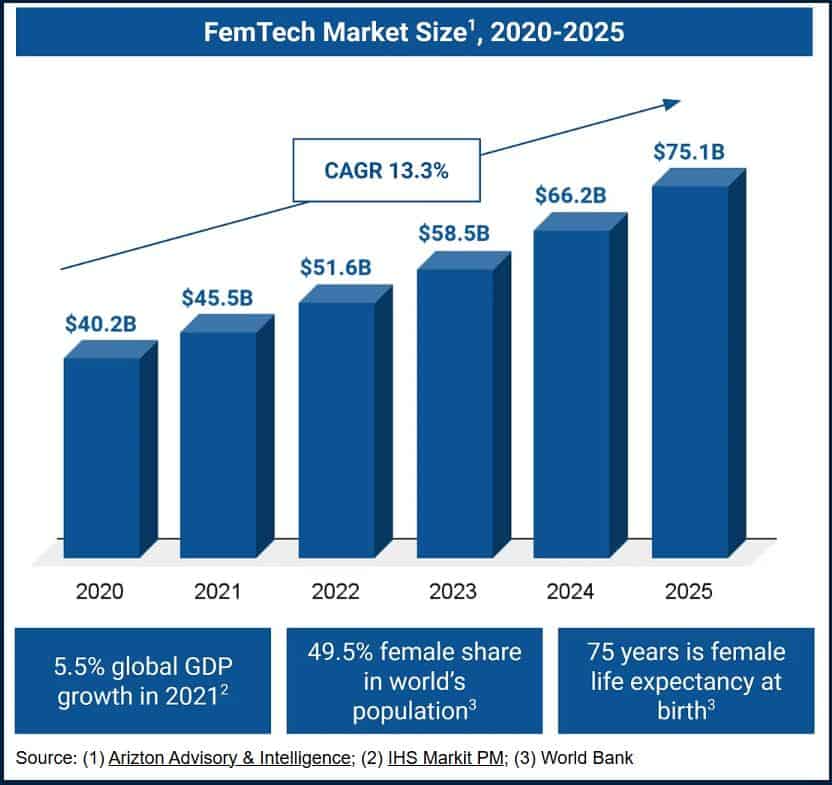
- The FemTech market is projected to grow from USD 40.2 billion in 2020 to USD 75.1 billion by 2025, reflecting a strong 13.3% CAGR.
- The valuation of Global FemTech will surpass USD 100 billion by 2030, which indicates that the industry will experience sustainable growth for many years.
- Women represent 49.5% of the global population, yet remain underserved in tailored healthcare solutions.
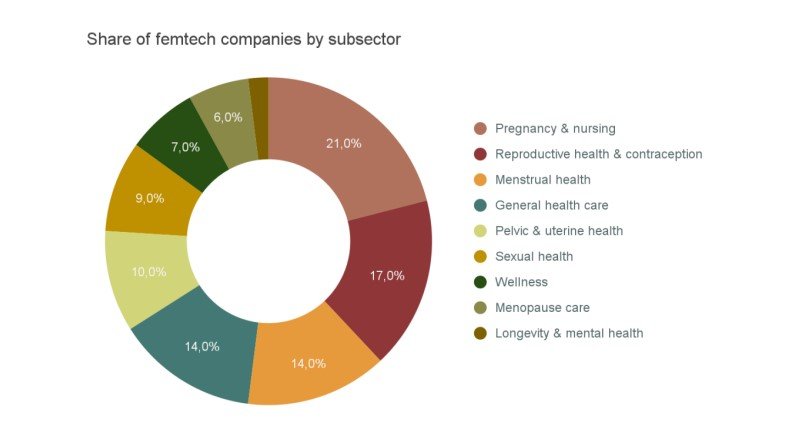
- FemTech companies dedicate 21% of their resources to pregnancy and nursing.
- The market landscape includes 17% of its share dedicated to reproductive health and contraception products.
- General healthcare and menstrual health each contribute 14% of the company’s share.
- The market ecosystem assigns 10% to pelvic and uterine health, while sexual health secures 9% of the total market share.
- Women show more than 60% of health professionals about digital health resources that extend beyond period tracking applications.
- Women make approximately 80% of global healthcare purchasing choices.
- Approximately 65% of women prefer at-home diagnostic testing, reinforcing decentralized care growth.
FemTech Market Growth
(Source: femtech.health)
- The FemTech market shows strong growth potential, which the available FemTech statistics support.
- The industry expands from USD 40.2 billion in 2020 to a projected USD 75.1 billion by 2025, which shows a strong 13.3% CAGR.
- The market value increases almost two times during the five years, which indicates growing investor trust and higher consumer interest in digital health solutions designed for women.
- The economy and population growth patterns drive the momentum of this expansion. Women represent 49.5% of the global population, yet healthcare solutions tailored specifically to them remain underpenetrated—creating a sizable opportunity gap.
- The global average life expectancy for women reaches 75 years, which generates demand for healthcare services that cover reproductive health and menopause, and chronic care needs.
- FemTech outperformed multiple traditional healthcare sectors, which maintained only 5.5% global GDP growth during 2021.
- The FemTech industry shows ongoing growth because of increasing digital use and the development of new products, which makes it an emerging investment market with substantial potential.
Share Of FemTech Companies By Subsector
(Source: theseus.fi)
- The chart shows that innovation concentrates on the main categories of women’s health research.
- The field shows sustained investor trust to develop fertility and maternal health solutions, which make up 21% of pregnancy and nursing and 17% of reproductive health and contraception.
- The health care system and menstrual health research both show 14% of their value from cycle tracking and telehealth, and preventive diagnostics, which have become standard practices.
- The market focuses 10% of its resources on pelvic and uterine health and 9% on sexual health, which indicates that people increasingly request customized health solutions.
- The wellness sector has 7% market share, while menopause care has 6% market share, which makes them emerging markets that will grow rapidly because menopause will affect more than 1 billion people worldwide by 2030.
- The organization holds strategic importance through its smaller share of longevity and mental health programs.
- The FemTech statistics demonstrate that the market in this sector is moving from services that focus on reproduction to services that support complete life cycles.
FemTech Risk Factor Or Untapped Growth Catalyst
- The FemTech ecosystem faces two impacts from restricted consumer knowledge because it creates both challenges and possibilities.
- According to Statista, industry surveys consistently show that over 60% of women lack familiarity with dedicated digital health tools beyond period tracking, a gap clearly reflected in recent FemTech statistics.
- The knowledge deficit about digital health solutions decreases investor trust, especially in a market that will reach over USD 100 billion worldwide by 2030.
- The Dobbs decision, which overturned Roe v. Wade, has led to fertility and cycle-tracking app downloads because users of some platforms now report double-digit user growth after 2022.
- The regulatory uncertainty surrounding FemTech products creates increased demand, according to these statistics.
- The organization needs to establish data privacy protection measures because current data privacy concerns create significant threats to its operations.
- FemTech builds cybersecurity frameworks because better protection against security breaches will enable it to transform customer awareness into business revenue.
Investment Accelerates Across The FemTech Ecosystem
- The first quarter of 2025 demonstrates that investors continue to support high-impact FemTech verticals, which include diagnostics and hormone health and fertility innovation, and menopause solutions.
- Ataraxis AI obtained funding of USD 20.4 million in March through a Series A round for their AI-based breast cancer diagnostic development project.
- Afynia obtained USD 5 million in funding to support its EndomiR blood test development, which detects a condition that affects approximately 1 out of every 10 women worldwide.
- Wingwomen Technologies received funding of USD 2 million to develop its digital speculum, which uses artificial intelligence technology, demonstrating that investors prefer advanced gynaecological tools.
- Epicore Biosystems raised USD 26 million in February to expand its production of sweat-sensing wearable technology. Level Zero Health raised USD 6.9 million to develop its hormone-tracking patch, which operates in a market that forecasts an annual growth rate above 8%.
- Snuggs raised €5 million, which demonstrates ongoing strong demand for consumer health products.
- Allara Health raised USD 26 million, and kegg raised USD 6.5 million, and Ema acquired USD 3 million in seed funding.
- The FemTech statistics demonstrate that the industry has expanded from its main focus on fertility to include the fields of AI diagnostics and hormone research.
FemTech Valuation
- The current capital influx into the FemTech industry brings more than just unicorn valuations, which capture public attention, because it shows market validation through existing market frameworks.
- The October 2024 Series F funding round, which brought in USD 125 million, raised Maven Clinic’s valuation to USD 1.7 billion.
- FemTech achievement leads to a larger trend, which emerging FemTech data shows with global FemTech funding reaching USD 2 billion per year in recent years and double-digit CAGR growth projections continuing until 2030.
- Flo Health achieved a valuation of USD 1 billion in July 2024 after raising USD 200 million, which made it the first FemTech unicorn in Europe.
- The investment landscape for Midi Health received support from two funding sources, which included a USD 60 million Series B funding round and a USD 5 million celebrity-backed funding round.
- Current FemTech statistics show that women make almost 80 % of healthcare choices worldwide, while digital health funding has historically given them less than 5 % of the total amount.
- The market transition from cycle-tracking applications to complete clinical care platforms creates new opportunities for revenue growth and business partnerships.
- The valuation milestones together show that the FemTech market has developed from a speculative niche into a growth sector that institutions now consider a liquid market.
Recent Developments
- The 2024–2025 product pipeline signals a decisive shift toward AI-enabled diagnostics, decentralized testing, and personalized reproductive care.
- The Breast Cancer Research Foundation, in collaboration with Clairity, Inc., introduced Clairity Breast (June 2025), an AI-powered mammogram platform predicting five-year breast cancer risk—targeting a disease affecting 1 in 8 women globally.
- Home-based and rapid diagnostics are driving widespread acceptance. Teal Health, Inc. launched Teal Wand for at-home cervical screening, while Visby Medical, Inc. developed rapid PCR STI testing, which delivers results within 30 minutes.
- The new health technologies support FemTech research, which found that more than 65% of women choose to use at-home health testing products.
- Sebela Pharmaceuticals Inc. brought new contraceptive solutions through MIUDELLA® while Femasys Inc. introduced FemaSeed® as a new infertility treatment.
- The prenatal and imaging diagnostics field uses AI technology through Sonio SAS and GE HealthCare to establish clinical-grade systems for medical applications.
- Qvin’s metabolic monitoring solutions extend FemTech services to areas beyond reproductive medical care.
Future Of FemTech
- FemTech has expanded its market reach from reproductive health to complete health care services.
- The first phase of development focused on menstrual and fertility products, but the second phase will introduce solutions for high-impact medical conditions that primarily affect women.
- The changing FemTech industry shows that companies are directing more funds towards solutions that treat chronic conditions and develop methods for early disease detection.
- The entire system will undergo its transformation through artificial intelligence that will serve as its main framework.
- The platforms that use artificial intelligence and machine learning technology have progressed from basic cycle monitoring to advanced forecasting systems that identify potential health hazards associated with PCOS, endometriosis, miscarriage, and first-stage cancer development.
- The latest FemTech statistics show that 60% of newly established digital women’s health startups now use artificial intelligence technologies, which marks a shift toward advanced data analysis methods.
- The integration of EHR systems will enable FemTech to transform from a consumer application into a clinical decision support system.
- The sector will establish itself as permanent infrastructure within standard healthcare services because FemTech statistics show actual health results.
Conclusion
FemTech Statistics: Companies that operate within the FemTech sector in 2025 function as an active market area that experiences rapid development through its combination of technological advancements and medical services and platforms that support women’s empowerment. The worldwide revenues of FemTech products reached more than 60 billion dollars because AI-powered solutions drive market innovation while consumers increasingly use products and companies expand their services to new areas.
The industry must develop its growth plans through efficient management systems because it faces two main problems, which include privacy issues, funding gaps, and unpredictable regulatory conditions. FemTech will become a fundamental component of global health innovation by 2030 because it will develop new methods to enhance women’s health outcomes.
FAQ
The market will grow from its current size of 40.2 billion dollars in 2020 to reach 75.1 billion dollars by the year 2025.
The FemTech industry experiences an annual growth rate of 13.3, which calculates to a compound annual growth rate of 13.3.
The market will reach a global total that exceeds 100 billion dollars by the year 2030.
Pregnancy and nursing operate as the leading segment, which contains 21 % of all companies within the ecosystem.
About 1 in 10 women worldwide suffer from endometriosis.
Women make approximately 80 % of all healthcare choices that occur around the world.
More than 60 % of people do not know about various FemTech products that exist beyond period tracking applications.