






Introduction
TSMC Statistics: Taiwan Semiconductor Manufacturing Co. is a key company in today’s digital world. It is the world’s largest “made-to-order” chipmaker, building the advanced chips used in phones, laptops, and the powerful servers behind AI. But TSMC’s role is now bigger than technology. Chips are vital for jobs, trade, and national security, so countries and global brands want a steady supply.
That’s why TSMC is investing heavily and expanding across Asia, the United States, and Europe. As it moves to smaller, faster chip technology, TSMC is helping decide how quickly the next wave of computing will grow.
Editor’s Choice
- TSMC company’s net revenue reached USD 122.42 billion in 2025, equivalent to NTD 3,809.05 billion.
- In 2025, Taiwan Semiconductor Manufacturing Company’s high-performance computing segment accounted for the largest share of net revenue, at 58%, totalling USD 71.00 billion.
- North America accounted for 75% of revenue, approximately USD 91.82 billion, making it the company’s largest revenue, according to investor.tsmc.com.
- 5 nm remains the leading node, accounting for 36% of wafer revenue, corresponding to USD 44.07 billion based on TSMC’s 2025 net revenue.
- TSMC’s market value (market cap) is USD 1.58 trillion as of 12/31/2025, up 22.5% from USD 1.29 trillion on 12/31/2025.
- As of October 2, 2025, Nvidia was the largest at USD 4,558 billion, followed by Broadcom (USD 1,574 billion), TSMC (USD 1,496 billion), Samsung (USD 413.02 billion), ASML (USD 389.41 billion), and AMD (USD 266.16 billion).
- Apple leads the pack with 23% of TSMC’s revenue, far ahead of any other customer.
- About 56% of TSMC shares were held by the general public, while about 38% were held by institutional investors.
- As of January 2026, TSMC reported a 35% jump in Q4 net profit to USD 16.01 billion (TWD 505.7 billion), beating the market estimate of about USD 15.14 billion (TWD 478.4 billion).
- TSMC targets peak carbon emissions in 2025 and aims to achieve 60% renewable energy for global operations by 2030 (RE60), 100% renewable energy by 2040 (RE100), and net-zero emissions by 2050.
About TSMC
| Metrics | Details |
| Company name | Taiwan Semiconductor Manufacturing Company Limited (TSMC) |
| Founded | 21 February 1987 |
| Founder | Morris Chang |
| Headquarters | Hsinchu Science Park, Hsinchu, Taiwan |
| Type | Public company |
| Stock tickers | TWSE: 2330 • NYSE: TSM • LSE: OLCV |
| ISIN | US8740391003 |
| Industry | Semiconductors |
| Area served | Worldwide |
| Key leader | Che-Chia Wei (President, Chairman, and CEO) |
| Main services | Chip manufacturing Mask services IC packaging Multi-wafer foundry services |
| 2024 Production Output | 13 million 12-inch-equivalent wafers |
| Division | SSMC (38.8% joint venture with NXP) |
| Subsidiaries | TSMC Washington TSMC Nanjing Company Ltd. JASM |
| Website | tsmc.com |
Financial Report of TSMC
- According to TSMC’s report, the company’s net revenue reached USD 122.42 billion in 2025, equivalent to NTD 3,809.05 billion.
- Earnings per share (EPS) were NTD 66.25 per common share in 2025, equivalent to USD 10.65 per ADR.
- Meanwhile, the gross profit was NTD 2,281.29 billion (approximately USD 73.33 billion).
- Gross margin was 59.9%, meaning the company kept about 59.9% of revenue after direct production costs.
- Operating expenses totalled NTD 345.65 billion (around USD 11.11 billion).
- Other operating income and expenses contributed a small net gain of NTD 0.45 billion.
- Operating income was NTD 1,936.09 billion (USD 62.23 billion) in 2025.
- Operating margin was 50.8%, indicating strong profitability after operating costs were deducted.
- Non-operating items added NTD 105.57 billion (USD 3.39 billion) on a net basis.
- Net income attributable to the parent company’s shareholders was NTD 1,717.88 billion (USD 55.22 billion) in 2025.
- Net profit margin was 45.1%, implying the company converted 45.1% of revenue into profit for shareholders.
- Wafer shipments were 15,022 thousand 12-inch-equivalent wafers (15,022 kpcs) in 2025.
- The average exchange rate used was USD/NTD 31.11, corresponding to approximately NTD 31.11 per USD 1.00.
TSMC Revenue Statistics
- TSMC reported consolidated net revenue of approximately NT$335 billion (approximately USD 10.69 billion) in December 2025, down 2.5% from November 2025 but up 20.4% from December 2024.
- For January-December 2025, total consolidated net revenue reached NT$3,809.05 billion (about USD 122.22 billion), a 31.6% increase from the same period in 2024.
- Consolidated net revenue of about NT$401.26 billion (approximately USD 12.73 billion) in January 2026, up 19.8% from December 2025 and up 36.8% compared with January 2025.
TSMC’s Net Revenue Breakdown By Industry/Platform
- In 2025, Taiwan Semiconductor Manufacturing Company’s high-performance computing segment accounted for the largest share of net revenue, at 58%, totalling USD 71.00 billion.
- Smartphone customers were the second-largest segment, accounting for 29% of net revenue, USD 35.50 billion.
- The Internet of Things (IoT) accounted for 5% of net revenue, around USD 6.12 billion.
- Automotive accounted for 5% of net revenue, about USD 6.12 billion.
- Digital Consumer Electronics accounted for a smaller share of 1%, corresponding to approximately USD 1.22 billion.
- Other platforms accounted for the remaining 2%, or almost USD 2.45 billion.
By Region
- As of 2025, North America accounted for 75% of revenue, approximately USD 91.82 billion, making it the company’s largest revenue, according to investor.tsmc.com.
- The Asia-Pacific accounted for 9% (almost USD 11.02 billion).
- China also contributed 9%, or approximately USD 11.02 billion, which is comparable in size to the Asia-Pacific region.
- Japan contributed 4%, which is approximately USD 4.90 billion.
- EMEA (Europe, Middle East & Africa) accounted for 3% of total revenue, or approximately USD 3.67 billion.
TSMC Wafer Revenue By Technology
- 5 nm remains the leading node, accounting for 36% of wafer revenue, corresponding to USD 44.07 billion based on TSMC’s 2025 net revenue.
- 3 nm is the next major driver, accounting for 24% (USD 29.38 billion).
- 7 nm remains a major pillar, accounting for 14% (USD 17.14 billion).
- 16/20 nm and 28 nm are evenly splitat 7% + 7% (14%), or approximately USD 8.57 billion each (USD 17.14 billion combined).
- Mature nodes above 28 nm still account for 12% (approximately USD 14.69 billion).
- Advanced nodes (7 nm and below) account for 74% of wafer revenue, or USD 90.59 billion, underscoring the concentration of TSMC’s production mix in leading-edge nodes.
TSMC R&D Spending Statistics
- TSMC spent USD 7.920 billion (NT$246.427 billion) on R&D in 2025, equal to 6.5% of net revenue.
- R&D increased by 20.7% year on year to NT$ 204.182 billion, underscoring continued heavy investment in leading-edge process technology.
TSMC Valuation Measures
- According to Yahoo Finance, TSMC’s market value (market cap) is USD 1.58 trillion as of 12/31/2025, up 22.5% from USD 1.29 trillion on 12/31/2025.
- TSMC’s total firm value (enterprise value) is USD 1.52 trillion.
- The trailing P/E (based on past earnings) is 34.69x
- The forward P/E (based on expected earnings) is 26.39x
- The PEG ratio (P/E adjusted for growth) is 1.28 now.
- The price-to-sales multiple is 15.65x
- The price-to-book multiple is 11.07x
- EV-to-revenue is 12.55x now versus 10.56x
- EV-to-EBITDA is 24.69x now, up 67.9% from 14.71x, indicating a much richer valuation relative to cash earnings.
Semiconductor and Chip Supply Chain Leaders By Market Capitalisation
(Reference: statista.com)
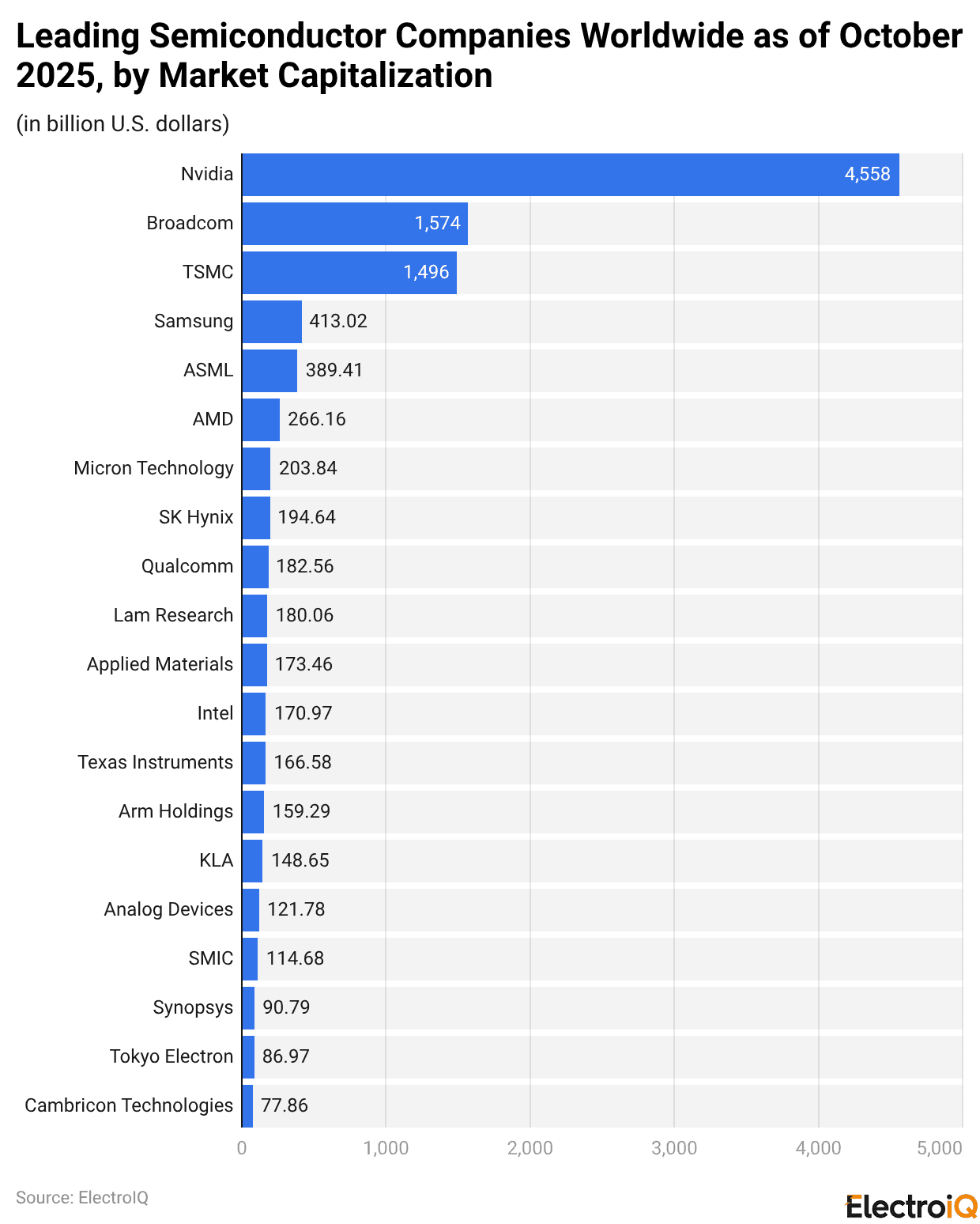
- As of October 2, 2025, Nvidia was the largest at USD 4,558 billion, followed by Broadcom (USD 1,574 billion), TSMC (USD 1,496 billion), Samsung (USD 413.02 billion), ASML (USD 389.41 billion), and AMD (USD 266.16 billion).
- Next come Micron Technology (USD 203.84 billion), SK Hynix (USD 194.64 billion), Qualcomm (USD 182.56 billion), Lam Research (USD 180.06 billion), Applied Materials (USD 173.46 billion), Intel (USD 170.97billion), Texas Instruments (USD 166.58 billion), Arm Holdings (USD 159.29 billion), KLA (USD 148.65 billion), Analog Devices (USD 121.78 billion), SMIC (USD 114.68 billion), Synopsys (USD 90.79 billion), Tokyo Electron (USD 86.97 billion), and Cambricon Technologies (USD 77.86 billion).
TSMC’s Biggest Customers By Revenue Share
(Source: substackcdn.com)
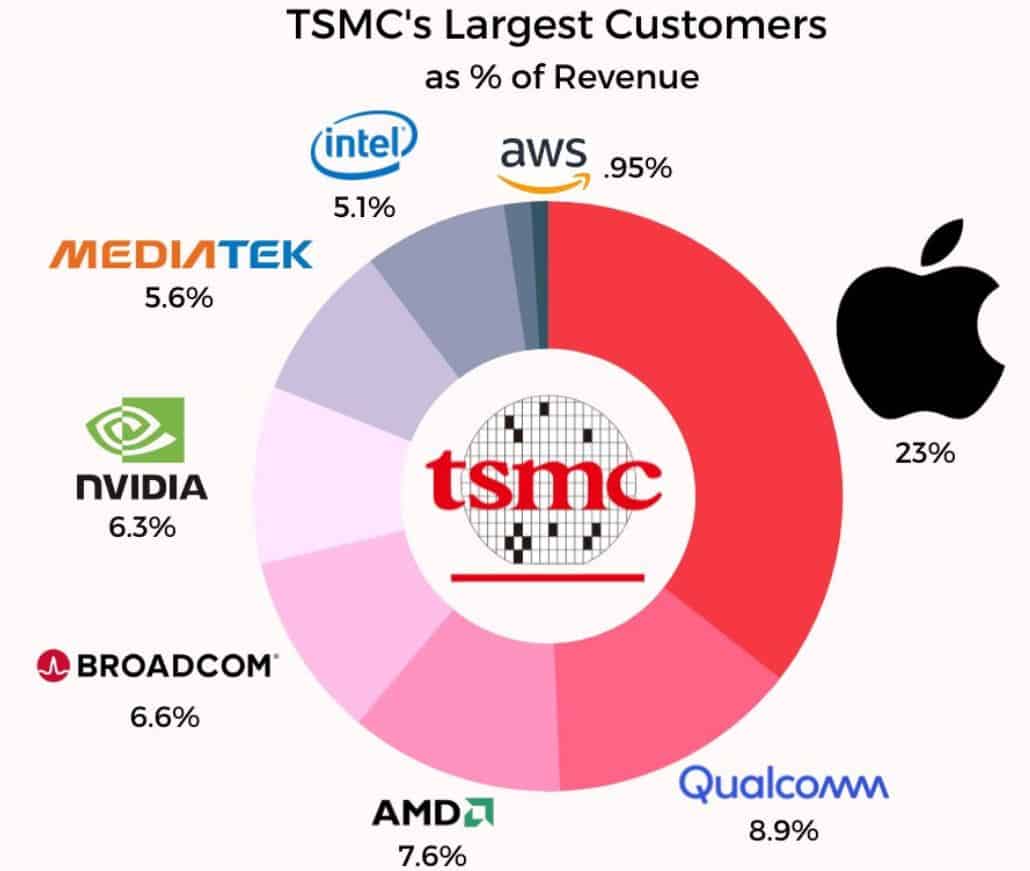
- Apple leads the pack with 23% of TSMC’s revenue, far ahead of any other customer.
- Qualcomm (8.9%), AMD (7.6%), Broadcom (6.6%), NVIDIA (6.3%), MediaTek (5.6%), Intel (5.1%), and AWS (0.95%) form the next tier.
TSMC Ownership Report
- About 56% of TSMC shares were held by the general public, while about 38% were held by institutional investors in 2025.
- The largest shareholder was Taiwan’s National Development Fund (Executive Yuan) with 6.38%.
- Among global asset managers, BlackRock held 5.09%, while Capital Research and Management held 3.61%.
- Other notable holders included GIC (Singapore) at 3.32%, Norges Bank at 1.59%, Fidelity Investments at 1.37%, New Labor Pension Scheme at 1.28%, Vanguard at 1.26%, and Yuanta at 1.02%.
- Additional positions were smaller but relevant, including JPMorgan Chase 0.83%, Fidelity International 0.80%, Baillie Gifford 0.76%, Fubon Life Insurance 0.75%, and Invesco 0.63%
TSMC Technology Roadmap Update
- In Q2 2025, N2 (2 nm) is on schedule for volume production in 2H 2025, using a new gate-all-around / nanosheet design.
- Versus N3E, N2 targets 10%-15% higher speed, 25%-30% lower power, and >15% higher chip density.
- Management expects N2 tape-outs in the first two years to exceed those of N3 and N5, driven primarily by flagship smartphones and HPC.
- N2P is the next upgrade in the family, with volume production planned for 2H 2026.
- A16 adds Super Power Rail (backside power delivery) and, versus N2P, targets 8%-10% higher speed, 15%-20% lower power, and 7%-10% higher density, with volume production also on track for 2H 2026.
- A14 is planned for volume production in 2028 and, compared with N2, targets 10%-15% higher speed, 25%-30% higher power efficiency, and approximately 20% higher density; an A14 + SPR version is planned for 2029.
TSMC’s Annual Energy Consumption
- According to esg.tsmc.com, TSMC’s latest disclosed annual energy use was 27,456 GWh in 2024.
- In the latest disclosure, purchased electricity accounted for 93% of total energy use, natural gas for 6.9%, and diesel for 0.1%.
- The report’s energy breakdown chart (units: 100 GWh) indicates approximately 21,940 GWh of non-renewable electricity, 3,610 GWh of renewable electricity, 1,900 GWh of natural gas, and approximately 20 GWh of diesel (rounded).
- Renewable energy usage ratio reached 14.1% in 2024.
- Management also notes that TSMC Arizona joined energy-saving efforts in 2025.
Recent Developments
- According to Wikipedia, in October 2024, TSMC alerted the U.S. Department of Commerce after TechInsights found a TSMC-made chip inside Huawei’s Ascend 910B, raising concerns about a possible export-control breach.
- As of June 2025, TSMC and the University of Tokyo launched the TSMC-UTokyo Lab, TSMC’s first overseas joint research lab with a university, to strengthen semiconductor R&D and talent training.
- In August 2025, Taiwan prosecutors said three people (including two current and one former employee) were detained over the alleged theft of 2 nm trade secrets, and later reports linked the case to a former TSMC employee who joined Tokyo Electron.
- As of January 2026, TSMC reported a 35% jump in Q4 net profit to USD 16.01 billion (TWD 505.7 billion), beating the market estimate of about USD 15.14 billion (TWD 478.4 billion).
Sustainability Initiatives
- TSMC has already planned to peak carbon emissions in 2025, then increase renewable electricity to 60% by 2030, reach 100% by 2040, and achieve net-zero by 2050, indicating a staged decarbonization roadmap.
- In April 2025, TSMC had secured its 53rd LEED Gold (or higher) certification.
- TSMC reports it has saved 810 GWh of electricity through internal energy-efficiency projects.
- From September 2025, its EUV Dynamic Energy-Saving Program reduced peak EUV tool power by 44% and is expected to deliver 190 GWh of electricity savings and reduce emissions by 101 kilotons by 2030.
- In Phoenix, TSMC’s 15-acre water reclamation facility is designed to initially achieve approximately 85% recycling, increasing to 90%, reducing freshwater demand from approximately 4.75 million gallons/day to below 1.2 million gallons/day for its first fab.
Conclusion
Demand remains strong, and AI customers are purchasing more chips. TSMC is expanding fast to stay ahead. Its significant January sales increase and substantial new-plant spending indicate that it expects this boom to persist. If TSMC delivers on its next-gen chip process and advanced packaging plans, it could remain a key winner in the AI supply chain. Still, investors should track heavy spending, profit pressure, and policy or geopolitical risks.
FAQ
TSMC manufactures advanced semiconductor chips for global tech companies, producing wafers using cutting-edge fabrication processes.
Leading-edge logic (FinFET, GAAFET roadmap), advanced nodes, EUV lithography, CoWoS/SoIC packaging, and specialty processes.
Primarily Taiwan (Hsinchu, Taichung, Tainan, Kaohsiung); also the U.S. (Arizona, Washington), Japan, and China.
Yes, geopolitical tensions, cycles, competition, supply disruptions, and export controls pose risks.
Yes, TSMC pays quarterly cash dividends to common shareholders and ADR holders in accordance with its dividend policy.