









Introduction
The global Smart Glass Market, valued at USD 5.5 billion in 2023 and USD 6.0 billion in 2024, is projected to reach USD 13.2 billion by 2032, growing at a CAGR of 10.5% from 2023-2032, driven by energy-efficient applications in architecture, automotive, and consumer electronics. Smart glass market covers advanced glazing that changes light or heat when powered or triggered to control glare, privacy, and energy in buildings, cars, and devices. This technology helps cut energy costs and fits into green building trends across offices, homes, and vehicles.
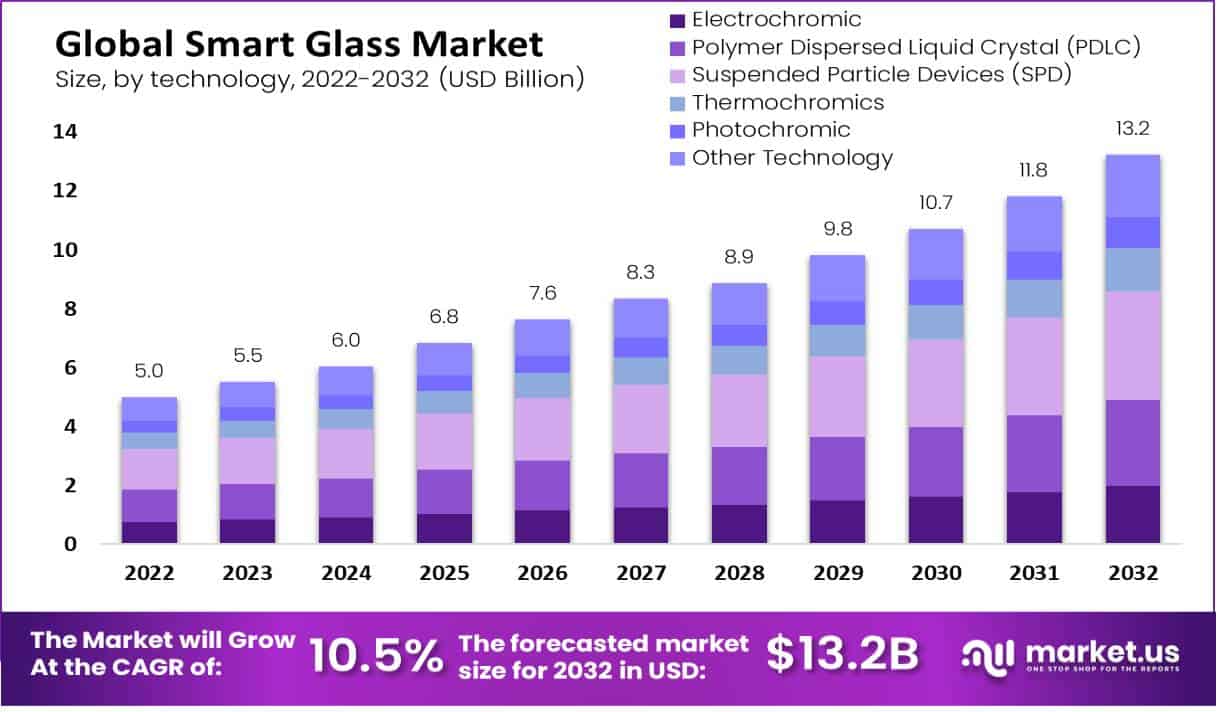
Top driving factors come from building rules that push energy savings and the need for better comfort in cars through adjustable windows and roofs. Car makers add it to new models to manage cabin heat while builders use it in walls and doors for light control. Demand also rises from smart city projects and high power costs that favor glass cutting air conditioning needs.
Demand grows as offices and airports install smart panels for better spaces, while car sales drive more use in sunroofs and sides. North America uses it most now but Asia builds fast with new city projects and factory output. Transportation leads volumes, followed by construction, with tintable glass holding the biggest share for its balance of speed and cost.
Top Key Takeaways
- North America leads with over 32% revenue share, fueled by energy regulations and value-added products like laminated glazing.
- Asia-Pacific transportation sector expected to grow fastest at over 12% CAGR through 2032, due to high-end auto demand and energy awareness.
- Construction and architecture dominated end-use in 2022, supported by urbanization, infrastructure, and building automation.
- Automotive integration in sunroofs, windshields, and panoramic windows boosts energy efficiency and passenger comfort.
Key Statistics
- According to scoop.market.us, the smart glass market shows a varied distribution of market share across key applications, reflecting the technology’s expanding role in multiple industries.
- Transportation leads the market with a 30% share, demonstrating strong adoption in automotive and aerospace sectors where smart glass enhances passenger comfort and supports better energy efficiency.
- Architectural applications follow with a 26% share, driven by rising interest in energy-efficient buildings and innovative designs that use smart glass for dynamic transparency control.
- Consumer electronics account for 21% of the market, reflecting increased demand for smart glass in smartphones, tablets, wearables, and augmented-reality-enabled devices.
- Power generation applications contribute 13% to the total market, indicating the use of smart glass in solar panels and energy-efficient window systems.
- Other applications make up the remaining 10%, covering diverse niche segments where smart glass provides specialized functional benefits.
- This market share distribution highlights the versatility and widening adoption of smart glass technology as it evolves to meet the needs of transportation, architecture, electronics, energy generation, and emerging niche sectors.
Key Market Segment
By Technology
- Electrochromic
- Polymer Dispersed Liquid Crystal (PDLC)
- Suspended Particle Devices (SPD)
- Thermochromics
- Photochromic
- Other Technology
By Application
- Architectural
- Transportation (Automotive, Aircraft, Marine)
- Consumer Electronics
- Power Generation
- Other Applications
Top Key Players
- Saint-Gobain S.A.
- Corning Incorporated
- Guardian Industries
- Nippon Sheet Glass Co., Ltd.
- Kinestral Technologies, Inc.
- Research Frontiers Inc.
- VELUX Group
- SPD Control Systems Corporation
- AGC Inc.
- RavenWindow
- Polytronix, Inc.
- Gentex Corporation
- Others
Use Cases
Building Energy Savings
Smart glass cuts cooling needs in offices by blocking heat on sunny days while letting light in. Homeowners use it on windows to lower energy bills and keep rooms comfortable year-round. Architects add it to skylights for natural light without glare.Privacy in Offices and HomesWorkers switch conference room walls from clear to frosted for private meetings. Bathrooms and bedrooms gain instant privacy without curtains or blinds. Hotels install it in suites to offer guests control over views.
Automotive Sunroofs and Side Windows
Car makers fit smart glass in sunroofs to block UV rays and reduce cabin heat during drives. Drivers adjust tint levels for better visibility at night or in glare. Luxury vehicles use it on rear windows for passenger comfort.
Healthcare and Retail Spaces
Hospitals replace curtains with smart glass in patient rooms for easy cleaning and quick privacy. Stores create dynamic displays that shift opacity to draw crowds or shield stockrooms. It boosts hygiene in clinics by cutting fabric use.
Solar Plants and Displays
Power plants integrate smart glass to manage heat around panels and improve worker safety. Consumer electronics firms embed it in screens for adjustable brightness. Projection walls in museums switch modes for immersive shows.
Recent Development
- September, 2024, Saint‑Gobain Glass showcased SageGlass Harmony electrochromic smart glazing at Glasstec, emphasizing gradient tinting for façade solar control without blinds.
- June, 2024, Corning promoted its ultra‑thin advanced glazing glass for next‑generation dynamic windows that integrate dimmable smart functions while keeping units lighter and slimmer.
Conslusion
The smart glass market shows strong growth potential through 2032, driven by demand for energy-efficient solutions in buildings, vehicles, and electronics.
Key segments highlight architecture’s lead in applications alongside rapid transportation advances, with North America dominating regionally and Asia-Pacific accelerating fastest.
Technologies like electrochromic and PDLC, paired with urbanization and automation trends, position smart glass to transform privacy, light control, and sustainability across industries despite initial costs.
Read More – https://market.us/report/smart-glass-market/
Sources
