











Introduction
Data Breach Statistics: The penetration of digital transformation, with the permanent change toward hybrid work models, has inadvertently created an unprecedented attack surface for cybercriminals.
As businesses store more sensitive information online, the financial and reputational stakes associated with a data breach have never been higher, transforming cybersecurity from an IT issue into a critical business imperative.
Industry forecasts underscore this escalating threat, with the global cost of cybercrime projected to surge, reaching US$10.5 trillion annually by 2025. I’d like to discuss everything and provide a data-driven analysis of the latest data breach statistics, revealing the true financial impact, the evolving tactics of threat actors, and the critical factors that separate organizations from the perpetually compromised. Without further ado, let’s get started.
Editor’s Choice
- The baseline financial damage for a typical breach worldwide is US$4.44 million.
- The United States holds the top spot with an average breach cost of US$10.22 million, reflecting its extreme regulatory and legal environment.
- The Healthcare industry faces the highest financial burden at US$7.42 million per breach, primarily due to highly regulated and sensitive PII.
- The Human Element (employee error, credential compromise, social engineering) accounts for 60% of all data breaches.
- Intellectual Property records are the most costly to lose, averaging US$178 per record, exceeding customer PII.
- The mean time to detect and contain a breach remains long, averaging 241 Days, giving attackers ample time for data exfiltration.
- Extensive use of Security AI and Automation is the most effective control, offering an average cost reduction of US$1.82 million per breach.
The Cost of a Data Breach in 2025
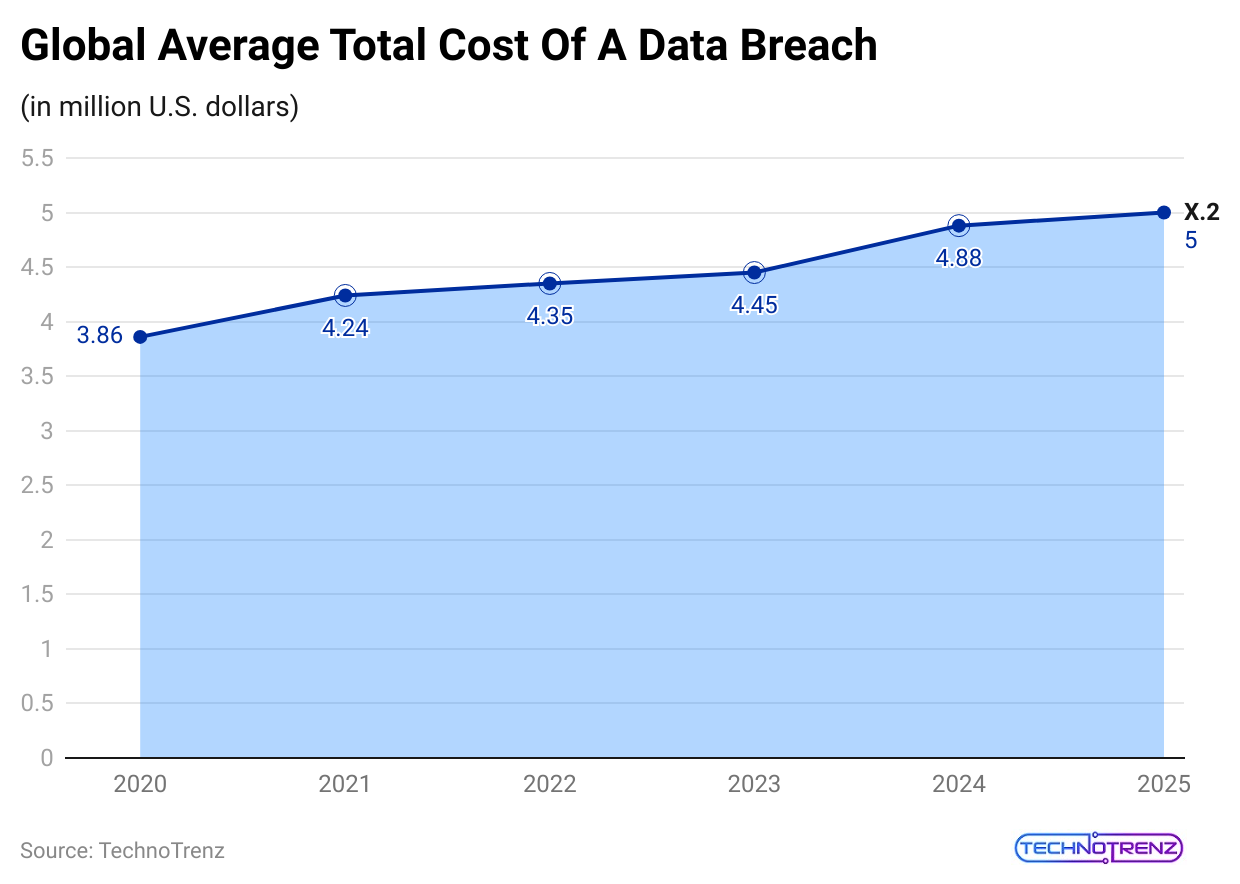
- The global average cost of a data breach in 2025 has settled at $4.44 million, marking a notable 9% decrease from the all-time high of $4.88 million recorded in the previous year.
- The United States, however, continues to bear the heaviest financial burden, with the average data breach cost soaring to an unparalleled $10.22 million.
- This is an increase of 9% and represents the 15th consecutive year the U.S. has held the undesirable position as the most expensive region for these incidents.
- The cost per compromised record, which serves as a crucial metric for data sensitivity, averages $160 per record globally for customer Personally Identifiable Information (PII) and an even higher $178 per record for intellectual property.
- The overwhelming majority of data breach costs, about 70%, are categorized as ‘mega-breach’ related, specifically referencing incidents that involve the compromise of between 50 and 60 million records, which can total an average of $375 million in damages.
- Lost business, including customer churn, reputational damage, and system downtime, remains the single largest component of the total cost, accounting for nearly 38% of the expense, which translates to an average of $1.68 million per incident.
| Global Average Cost | $4.44 Million |
| Highest Regional Cost |
$10.22 Million (United States) |
|
Cost per IP Record |
$178 |
| Lost Business Impact |
Approximately 38% of the total cost |
Industry-Specific Financial Trauma

- The Healthcare industry has cemented its position with the highest average data breach cost for the 14th consecutive year, with a staggering average of $7.42 million per incident, which reflects the extreme regulatory penalties and extensive patient notification requirements under laws like HIPAA.
- The Financial Services sector ranks second, facing an average breach cost of $5.56 million, driven by intense scrutiny from regulatory bodies and the high value of financial data, which translates quickly into fraud losses.
- In a surprising trend, the Industrial sector has seen a surge in costs, reaching an average of $5.00 million.
- The Technology industry, despite its inherent digital expertise, recorded a substantial average cost of $4.79 million.
- Retail and Hospitality sectors generally experience lower average costs, at $3.54 million and $4.73 million, respectively.
| Healthcare | $7.42 Million |
| Financial Services | $5.56 Million |
| Industrial | $5.00 Million |
| Technology | $4.79 Million |
| Retail | $3.54 Million |
Cybersecurity Market Growth and Key Segments

Global Market Size and Growth:
- According to market.us, massive Growth: The overall cybersecurity market is projected to grow from $215.9 billion in 2024 to $608.3 billion by 2033.
- This represents a Compound Annual Growth Rate (CAGR) of 12.2% from 2024 to 2033.
Key Segments (Based on 2023 Data):
- The Solutions segment (firewalls, antivirus, etc.) led the market with over a 57.6% share.
- The On-premises deployment segment held a dominant 62.4% market share.
- Network Security captured over 30% of the market share.
- Large Enterprises accounted for a significant 69.2% share of the spending.
- The BFSI (Banking, Financial Services, and Insurance) sector dominated spending with a 25% market share.
- North America led the market with a 36.8% share and $70.8 billion in revenues.
Healthcare Cybersecurity Specifics:
- The healthcare cybersecurity market is projected to grow from $20.6 billion in 2025 to $71.4 billion by 2034.
- The Services segment dominated the healthcare market in 2024 with a market share of 55.6%.
- Identity and Access Management (IAM) held the largest solution share at 19.7% in 2024.
- Malware was the dominant threat, holding 25.9% of the market share in 2024.
- Cloud-based deployment was the preferred method with 56.8% of the market share in 2024.
- Hospitals were the dominant end-user segment with a 40.2% market share.
- North America also led the healthcare cybersecurity market in 2023 with a 30% market share.
| Global Market Outlook | Projected Market Size (2024) | $215.9 Billion |
| Global Market Outlook | Projected Market Size (2033) | $608.3 Billion |
| Global Market Outlook | Compound Annual Growth Rate (CAGR) | 12.2% (2024 to 2033) |
| Global Market Composition | Solutions Segment | Over 57.6% (2023) |
| Global Market Composition | On-premises Deployment | 62.4% (2023) |
| Global Market Composition | Network Security | Over 30% (2023) |
| Global Market Composition | Large Enterprises | 69.2% (2023) |
| Global Market Composition | BFSI (Financial Sector) | 25% (2023) |
| Global Market Composition | North America | 36.8% Share ($70.8 Billion) (2023) |
| Healthcare Market Focus | Projected Market Size (2025) | $20.6 Billion |
| Healthcare Market Focus | Projected Market Size (2034) | $71.4 Billion |
| Healthcare Market Composition | Services Segment | 55.6% (2024) |
| Healthcare Market Composition | Identity and Access Management (IAM) | 19.7% (2024) |
| Healthcare Market Composition | Malware Threat | 25.9% (2024) |
| Healthcare Market Composition | Cloud-Based Deployment | 56.8% (2024) |
| Healthcare Market Composition | Hospitals | 40.2% (2024) |
| Healthcare Market Composition | North America | 30% (2023) |
The Human Element and Top Attack Vectors

- The human element, a combination of system or human errors, lost credentials, and social engineering, is confirmed to be the root cause in a staggering 60% of all data breaches in 2025.
- Credential abuse, specifically the use of stolen, weak, or default passwords, is the single most common high-level component, implicated in 32% of breaches, followed closely by direct social actions like phishing, which accounts for 23% of incidents.
- Phishing/Smishing/BEC (Business Email Compromise) collectively emerged as the most frequent initial attack vector, accounting for 19% of breaches, and breaches initiated by this method are historically the most expensive to resolve.
- The exploitation of vulnerabilities saw a notable increase, making up 20% of data breaches in 2025, a substantial 34% rise from the previous year, which is partially attributed to the rapid exploitation of 0-day flaws in edge and VPN devices.
- Attacks on the supply chain and third-party vendors are an escalating threat, being the root cause of 15% of incidents and representing the second costliest attack type at an average of $4.91 million
| Human Element (Total) | 60% |
| Phishing/BEC | 19% |
| Exploited Vulnerability | 20% |
| Third-Party/Supply Chain | 15% |
The Critical Timeline By Detection and Containment

- The total mean time to identify and contain a data breach has decreased slightly but remains high, now averaging 241 days in 2025, which, while representing a 9-year low.
- The average time it takes simply to identify a breach is 181 days, meaning that the containment phase, from discovery to full resolution, takes an additional 60 days.
- Breaches that are resolved in under 200 days cost organizations an average of $3.87 million, whereas those that persist for over 200 days see the cost increase significantly to $5.01 million.
- The method of discovery plays a crucial role in the financial outcome: when an internal security team or tool identifies the breach first, the average cost is lower at $4.18 million.
- Healthcare and Financial Services breaches consistently take the longest to resolve, with healthcare breaches requiring an average of 279 days for identification and containment.
| Mean Time to Contain | 241 Days |
| Cost for 200 Days | $3.87 Million |
| Cost for 200 Days | $5.01 Million |
| Fastest Detection Source | Internal Security/Tools |
The Automation Advantage By AI and Security Measures

- Organizations that have made extensive use of security AI and automation in their defense posture realize an immense average cost savings of $1.82 million on a data breach, reducing the total cost from $5.52 million (for those with no automation) to a significantly lower $3.70 million.
- The speed of breach resolution is drastically improved by automation: security teams using extensive AI and automation reduce the average data breach lifecycle by 80 days, completing detection and containment in just 241 days, compared to 321 days for those without it.
- The implementation of a Zero Trust security model is proven to be a formidable defense, lowering the average cost of a data breach by a substantial $1.76 million compared to organizations that have not fully adopted the framework.
- The simple act of forming an Incident Response (IR) Team and regularly testing the plan reduces the cost of a breach by an average of $2.66 million compared to those without an IR plan, illustrating the fundamental value of preparedness and clearly defined roles.
- The deployment of Extended Detection and Response (XDR) technology shortened the average breach lifecycle to 249 days, a measurable improvement over the 304 days observed in companies that are not leveraging this integrated security approach.
| Extensive AI/Automation | $1.82 Million Cost Reduction |
| Zero Trust Model | $1.76 Million Cost Reduction |
| Incident Response Team | $2.66 Million Cost Reduction |
| Breach Lifecycle Time | 241 Days with Automation |
The Shadow of Generative AI and Emerging Risks

- The increasing sophistication of cyberattacks is evident in the fact that one in six data breaches reported in 2025 were found to have involved AI-driven attacks.
- The rise of “Shadow AI”, the use of unsanctioned or ungoverned generative AI tools within an organization, adds an average of $670,000 to the cost of a data breach, pushing the total cost close to $4.74 million due to the unpredictable exfiltration of sensitive data through these platforms.
- Breaches involving data spread across multiple cloud environments incurred the highest average data breach cost, reaching $5.05 million.
- The exploitation of shadow IT, a perennial problem now worsened by a reliance on the remote workforce, remains a significant cost factor, as breaches where remote work was a factor cost approximately $173,000.
- The security skills shortage continues to widen the vulnerability gap, as organizations with a high shortage of qualified personnel see the average data breach cost increase sharply to $5.22 million.
| AI-Driven Attacks | 1 in 6 Breaches |
| Shadow AI Incidents | Added $670,000 to Cost |
| Multi-Cloud Breaches | $5.05 Million Average Cost |
| Security Skills Shortage | $5.22 Million Average Cost |
Conclusion
Overall, the landscape of cybersecurity is accelerating, driven by adversarial AI and the complexity of hybrid-cloud environments. The current data breach statistics give us a clear picture: while the global average cost has seen a slight dip, the attacks are becoming more frequent, more sophisticated, and disproportionately expensive for those who lag in cybersecurity. The financial penalty for complacency is measured not in thousands, but in millions of dollars.
The data unequivocally shows that the most effective strategy for managing data breach risk is a combination of advanced technology and preparedness. Organizations leveraging AI and automation slash their breach costs by close to $2 million and cut the response time by months.
Investing in an Incident Response Team and adopting proactive frameworks like Zero Trust are mandatory components of business resilience. By constantly tracking these definitive statistics and making them into clear action, businesses can move the needle, turning the high cost of a data breach from a passive threat into a containable risk. I hope you like this piece of content. If you have any questions, kindly let us know. Thanks for staying up till the end.
Sources
