











Introduction
Vauxhall Statistics: Founded in 1903, and now running under Vauxhall, Vauxhall moved through the 2025–2026 period right in the middle of one of the biggest changes in its whole history. The British carmaker pushed harder on electrification, and it also grew sales of electric passenger vehicles and electric commercial vehicles, while it tried to lock in a stronger place within the UK small-car space and the van segment.
With parent company Stellantis in the background, Vauxhall got a boost from EV demand that kept climbing, big manufacturing investments, plus fresh product introductions like the Frontera Electric and a refreshed Astra lineup. Still, it didn’t all go smoothly, because it had to deal with slower EV uptake, fierce Chinese competition, tightening regulatory demands, and the general financial instability that hit the broader European auto industry around the same time.
Editor’s Choice
- Vauxhall rolled out full price parity between diesel and electric Combo and Vivaro vans in 2026.
- The Combo Electric Pro and the diesel Combo both land at £305 per month under the same 36-month lease setup.
- The Vivaro Electric Prime matches the diesel Vivaro at £335 per month, even with higher EV list pricing.
- Vauxhall added another £1,000 customer saving across all LCV models as part of its 2026 Professional Days campaign.
- The Combo Electric has a list price of £34,569 compared with £29,917 for the diesel version, showing pretty aggressive EV financing support.
- On list price alone, the Vivaro Electric comes in at about 26% more than the diesel model, yet monthly payments stay the same.
- Vauxhall’s electric vans come with identical 6.9% APR finance rates and 60-month deals, so buying decisions are less complicated.
- Eligible EV purchases include free Ohme Pro home chargers worth as much as £1,050, including VAT.
- Vauxhall reckoned that its £1,000 retail incentive brings down monthly finance costs by about £20 each month over the span of four years, which kind of sounds small but adds up.
- Meanwhile, the Frontera Electric GS rolled out at £131 per month, with 0% APR, plus a £1,500 Vauxhall deposit contribution.
- EVs made up only 23.4% of UK new-car sales in 2025, so that was under the government’s 28% ZEV mandate target; there’s not much room there.
- Also, the UK ZEV non-compliance penalties were shaved from £15,000 to £12,000 per vehicle in 2025 after industry pressure, as they blinked first.
- Vauxhall then hit a 5.1% combined UK car and van market share, and at the same time became the country’s second best-selling retail EV brand in March 2026.
- About 91% of fleet drivers said they need kerbside charging infrastructure, so the same snag is still there for plenty of people.
- And electric vehicles on off-peak tariffs can come out to as little as 2p per mile, which cuts day-to-day expenses by up to 85% compared with petrol or diesel.
Vauxhall’s Price-Parity Strategy
(Source: media.stellantis.com)
- Vauxhall is making a kind of bold move in the UK light commercial vehicle scene by basically knocking out one of the largest obstacles to electric van adoption, the whole higher monthly cost thing.
- As Vauxhall UK and LEASYS Business Finance explain, they’ve rolled out full transactional price parity between the diesel and electric versions of its Combo and Vivaro vans.
- The approach feels extra important for SMEs and sole traders, because they make up a big part of Europe’s commercial van demand.
- There’s also this limited-time “Professional Days” campaign, running up to 31 May 2026, where customers get another £1,000 saving, which includes VAT across all LCV models and different powertrains.
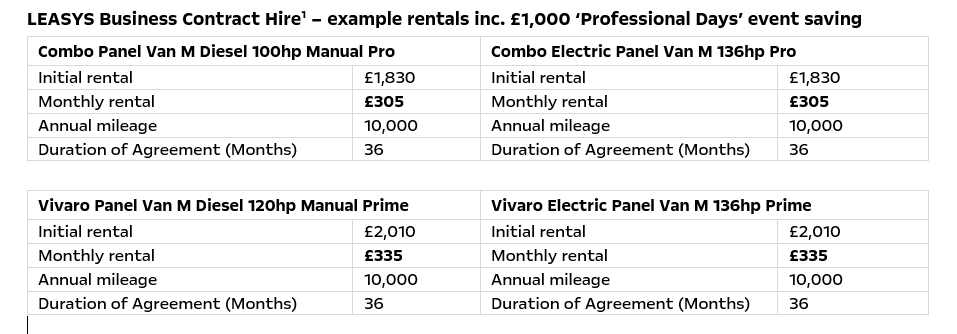
- Through LEASYS Business Contract Hire, the Combo Electric Pro comes in at £305 per month, and that’s the same as the diesel Combo, on a 36-month agreement with 10,000 annual miles and a £1,830 initial rental.
- In the same way, the Vivaro Electric Prime is £335 per month, matching its diesel counterpart with an identical £2,010 initial rental. Sources: Vauxhall UK, LEASYS.
- In the past, electric commercial vehicles often carried a pricing premium of 15–30% compared with diesel alternatives.
- By flattening that premium, Vauxhall is nudging the whole customer conversation away from upfront cost alone, and toward total ownership benefits, like reduced fuel expenses, less maintenance, and easier access to low-emission urban zones.
- Another important value addition is the inclusion of a complimentary Ohme EV home charger worth up to £1,050 including VAT for eligible electric van buyers. It sort of lowers the charging set-up costs while nudging off-peak charging, which may cut operating expenses even further, especially for small businesses.
- As governments tighten emissions regulations and cities expand clean air policies, fleet operators are feeling the growing pressure to electrify.
- So Vauxhall’s parity pricing strategy could end up as a real competitive benchmark across the European van market, making rivals rethink their pricing frameworks, just to protect market share. Sources: Vauxhall UK, Automotive Logistics, Fleet News.
Vauxhall EV Vans Aggressive Price-Parity Financing

(Source: media.stellantis.com)
- As Vauxhall Finance and Stellantis Financial Services (SFS) put it, they’ve put together the same monthly payments for both the diesel and electric versions of the Combo and Vivaro, which basically lowers one of the main obstacles to EV take-up for SMEs and fleet buyers.
- The Combo Electric Panel Van Prime-Plus comes out at £299 per month across 60 months, and that lands exactly on the diesel Combo equivalent, even though the electric one has a noticeably higher on-the-road cash price, £34,569 compared with £29,917 for diesel.
- Likewise, the Vivaro Electric Prime matches its diesel counterpart at £339 per month, despite the list price stretching to £47,075, which is around 26% higher than the diesel Vivaro at £37,291. Sources: Vauxhall UK, Stellantis Financial Services.
- Both electric and diesel models are on the same 6.9% APR, the finance period is also the same at 60 months, and the total credit amount is matched, too, which makes the buying decision a lot simpler for business owners.
- And here’s the interesting part, the electric trims even land slightly lower on the total payable side.
- For instance, the Combo Electric totals £25,772.64 payable, just under the diesel’s £25,851.22. That gives EVs a small psychological edge for adoption, while also reinforcing the point that electrification doesn’t automatically need to arrive with a premium price tag.
- Combined with the extra £1,000 Professional Days contribution, Vauxhall is sort of repositioning electric vans as a financially sensible business instrument, more or less not a small niche sustainability decision.
- A pretty direct competitive push, and could end up putting pressure on rival marques across the UK commercial EV scene.
Vauxhall Announces New Sales
- Vauxhall is turning up the competition in the UK automotive space with a fresh, nationwide sales campaign, designed to improve affordability and speed up electric vehicle uptake.
- As per Vauxhall UK, the company will add another £1,000 saving across its entire vehicle lineup between 8 May and 31 May 2026, layering that discount over top of current incentives, plus finance packages.
- Vauxhall figures the £1,000 reduction cuts the monthly finance cost by about £20 per month, assuming a typical four-year deal, so buyers who are price aware should find it easier.
- Every Vauxhall electric car remains eligible for a £1,500 Electric Car Grant.
- The “Electric All In” package brings additional ownership perks, like eight years of roadside assistance, help for emergencies when charging, and £500 in charging-related credits for home chargers, public charging, or Kerbo Charge installations. (Vauxhall UK, Octopus Energy, Tesco Clubcard)
- One of the strongest value pitches really shows up with the Frontera Electric GS, which you can get at 0% APR with a £1,500 Vauxhall deposit contribution for just £131 per month across four years.
- At the same time, the petrol-powered Corsa YES 1.2 Turbo 100PS is advertised for £262 per month, with 7.9% APR and a fairly small £2,000 customer deposit.
- Vauxhall is also leaning into retail tie-ups to reel in buyers. If someone buys a new car, they get 50,000 Tesco Clubcard points, which are worth £500, so there’s an extra added perceived benefit that sits next to the usual discounts.
Vauxhall’s The ZEV Mandate Impact – 2025–2026 Compliance
- Vauxhall isn’t treating electric vehicles as a sort of experimental niche growth thing anymore; it’s treating EVs like a regulatory must.
- The reason this shift is happening is the United Kingdom’s Zero Emission Vehicle (ZEV) mandate, launched in January 2024. This mandate pushes automakers to keep lifting EV sales from 22% in 2024 to 28% in 2025, 33% in 2026, then 52% by 2028, and eventually 80% by 2030, before a complete combustion-engine phaseout in 2035. Sources: UK Department for Transport (DfT), SMMT.
- The pressure on manufacturers is basically huge. As per the Society of Motor Manufacturers and Traders, EVs made up only 23.4% of UK new-car sales in 2025, which is still comfortably under the 28% requirement.
- At first, non-compliance penalties were £15,000 per car and £9,000 per van, which created an estimated potential exposure across the industry of around £1.8 billion.
- After industry pushback, the UK government moved the penalty down to £12,000 per car in 2025, and also rolled in more compliance flexibility. Sources: SMMT, DfT, RAC Foundation.
- In 2026, the company priced the Astra Electric, the Astra Hybrid, and the Astra Plug-In Hybrid in the same place at £29,995, basically stripping out the usual EV premium completely.
- Vauxhall moved into the UK’s second-best-selling retail EV brand status in March 2026, and the Frontera Electric has been landing in the UK’s top three best-selling EVs, year-to-date.
- Meanwhile, the combined car and van market share has climbed to 5.1%. Sources: Vauxhall UK, JATO Dynamics.
Vauxhall Infrastructure and Home Charging – The Ohme Integration
- Vauxhall is also using some more modern financing options to keep things affordable. A five-year PCP kind of agreement on EVs cuts monthly payments down to levels you’d usually expect from petrol cars, so mainstream buyers can switch over without that major payment shock.
- Brands that overachieve on compliance, such as Tesla, BYD, BMW, and Mercedes-Benz, can sell off surplus EV credits to manufacturers that miss the targets.
- According to Vauxhall and Ohme, the company’s latest incentive bundle seems to include a complimentary Ohme Pro home charger with installation, worth up to £1,050 including VAT. It also creates a bit of an immediate up-front value pitch for buyers moving into electric mobility, basically right away.
- In fact, research from the Vauxhall Electric Van Adoption Report 2025 found that 91% of fleet drivers say they need kerbside charging, while 81% of businesses reported that fitting workplace charging infrastructure would be awkward, or otherwise problematic.
- Data from Brumble, ChargeUK, and UK Government fuel-rate guidance indicates that electric vehicles topped up on off-peak tariffs can come to as little as 2p per mile, versus 17–22p per mile for petrol vehicles and 13–18p per mile for diesel vans.
- For a commercial vehicle doing around 50,000 miles every year, that can translate into savings of over £3,000 annually just on fuel costs.
- Looking specifically at Vauxhall’s electric van range, the gap is stark: a full charge for the Vivaro Electric works out at about £5.25, using the Octopus Intelligent Go tariff at 7p/kWh.
- By comparison, an equivalent diesel top-up lands around £28.69, based on April 2026 fuel prices published by the SMMT. In other words, it’s roughly an 82% drop in energy cost per operating cycle.
- Vauxhall’s partnership with Ohme and Octopus Energy also seems to mirror wider industry trends, the sort you see everywhere now.
- In the UK, there were roughly 119,080 public EV chargers running across 46,107 locations by Q1 2026, based on government-backed infrastructure statistics; meanwhile, about 80% of EV owners basically charge at home as their main move.
- On top of that, the company’s broader “Electric All-In” bundle pushes the offer further, with £500 charging credits, eight years of roadside assistance, and as many as 10,000 free charging miles via the Intelligent Octopus Go tariff.
Conclusion
Vauxhall’s 2025–2026 strategy kind of shows how the big, mainstream automakers are leaning harder into pricing innovation, help with charging infrastructure, and finance incentives, to get EVs into more hands faster.
In a nutshell, by removing that monthly payment gap between diesel and electric vans, Vauxhall is trying to move EVs away from being “nice but pricey” options, into something that works as a day-to-day business tool. Retail EV momentum is already strong, the government ZEV mandate is adding pressure, and the longer-term operating costs look lower, so the company is pushing electrification across both passenger cars and commercial vehicles.
Meanwhile, sharper pricing, complimentary charging solutions, and partnerships with Ohme and Octopus Energy make Vauxhall’s offer feel more solid in the fast-moving UK automotive space, and also across Europe’s wider shift toward zero-emission mobility.
FAQ
Vauxhall matches monthly finance costs between diesel and electric Combo and Vivaro vans, to speed up EV adoption.
The Frontera Electric GS is available from £131 per month with 0% APR finance.
Eligible buyers can get an Ohme home charger worth up to £1,050, plus charging-related incentives and ongoing support
EVs charged on off-peak tariffs can cut day-to-day running costs by as much as 85% compared with petrol or diesel vehicles.
The ZEV mandate pushes manufacturers to grow EV sales each year, and there can be major financial penalties.
Sources
