









Introduction
The global Facial Recognition Market, valued at USD 5 billion in 2023, is projected to reach USD 19 billion by 2032, growing at a CAGR of 14.6% from 2023-2032, driven by AI advancements, security demands, and adoption in sectors like retail and government.The facial recognition market is a fast‑growing part of the broader AI and computer vision ecosystem, as governments and enterprises adopt it for secure, contactless identity verification and real‑time surveillance. Vendors are embedding facial recognition into devices, cloud platforms, and industry‑specific solutions for applications such as access control, eKYC, payments, and public safety monitoring.
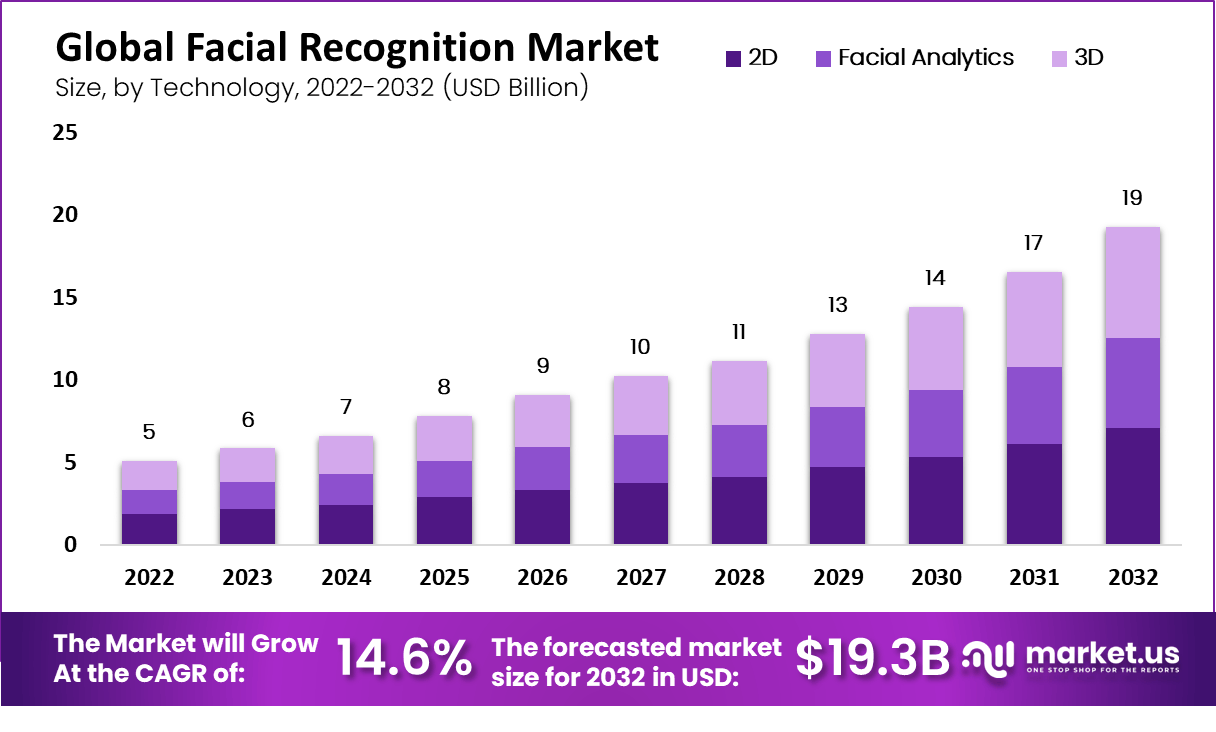 Facial recognition technology uses AI‑based image processing to capture, map, and match human faces from photos or video feeds against stored templates to verify or identify individuals. Over the last few years, it has moved from pilot projects to mainstream deployments in airports, banking, smartphones, retail stores, and government surveillance networks. Market estimates from multiple research firms show the global facial recognition market in the high single‑digit to low double‑digit billion‑dollar range, with double‑digit annual growth expected over the next decade, underlining its transition into a core digital identity and security layer.
Key growth is driven by rising security and identity threats, which push governments, border control agencies, and enterprises to adopt biometrics for accurate, real‑time verification instead of passwords or cards. Strong progress in AI algorithms, edge computing, and 3D/infrared imaging has improved accuracy across lighting and pose variations, making solutions more reliable for large‑scale deployments. In parallel, rapid expansion of smart cities, digital banking, and e‑commerce is creating new use cases, such as frictionless payments, customer analytics, and automated access control across sectors including retail, BFSI, transportation, and healthcare.
Request sample to get insights – https://market.us/report/facial-recognition-market/free-sample/
Key Market Takeaways
- Over 176 million Americans use facial recognition technology (FRT), with 131 million engaging daily as of 2023
- 80% of world’s governments and 70% of police forces utilize FRT; 40% of global workplaces and 80% of countries’ banks employ it
- U.S. Customs processed 300 million travelers, identifying 1,800 impostors; FRT used in 20% of countries’ buses, 30% trains/subways, and 40% during COVID
- Predicted usage growth of 45%, with accuracy at least 99.5%
- North America led with 37.8% share (USD 1.8 billion revenue) in 2022
Key Statistics
- According to sci-tech-today, 30% of homeowners say yes to installing security cameras at entrances, while 34% still reject this technology, indicating a mixed but growing acceptance of visual security systems.
- By 2025, hotel companies using facial recognition systems are expected to improve business safety and grow in importance by nearly 74%, showing strong momentum for biometric adoption in hospitality.
- Retail stores that deploy facial recognition techniques can reduce illegal activities by almost 91%, highlighting the technology’s effectiveness in loss prevention and in-store security.
- A study conducted in Spain found that nearly 70% of ATM users prefer facial recognition over PIN entry when withdrawing money, reflecting rising trust in biometric authentication.
- Around 62% of customers are willing to use facial recognition in hotels to enhance both customer experience and security standards.
- About 41% of customers are more likely to choose hotels with advanced security features, such as facial-recognition-based check-in systems, when given an option.
- The technology is highly efficient, requiring only two seconds to recognize an individual, which significantly speeds up verification and check-in processes.
- A strong 83% of the U.S. population is open to engaging with businesses that use facial recognition technology, indicating broad public acceptance and high adoption potential.
- Based on getsafeandsound, 68% of users rely on facial verification to unlock their devices, showing strong adoption at the consumer device level.
- Around 42% of users access banking services through facial authentication systems, indicating rising trust in biometrics for financial security.
- Facial recognition systems handle nearly 131 million daily interactions across users in the United States, reflecting large-scale operational usage.
- About 53% of the total U.S. population regularly engages with recognition systems, demonstrating widespread public interaction with biometric technologies.
- Nearly 51% of users use face recognition to log into mobile applications, reinforcing its role in everyday digital access.
Use Cases
- Security and Law Enforcement : Facial recognition identifies suspects and missing persons via CCTV integration in crowded areas like airports and public spaces. Police departments use it to match footage against databases, as in the NYPD’s rapid identification of a subway suspect. It enhances border control by verifying travelers against watchlists, reducing wait times.
- Retail and Marketing : Stores deploy it to prevent theft by tracking shoplifters and analyzing customer demographics for personalized recommendations. Examples include Walmart’s age verification at self-checkouts and KFC’s contactless payments in China. Digital signage tailors ads based on detected emotions and age.
- Healthcare and Access Control : Hospitals use it for patient identification, medical record tracking, and early detection of conditions like genetic disorders via facial analysis. It supports telemedicine authentication and remote pain monitoring through expression analysis. Device unlocking, as with Apple Face ID, and building access replace keys or cards.
- Finance and Workforce : Banks apply it for fraud prevention, eKYC, and secure mobile logins, as seen with HSBC. Employee attendance systems enable touchless check-ins with geofencing for field workers. Casinos and hotels use it for VIP access and seamless check-ins.
Key Market Segment
By Technology
- 2D
- Facial Analytics
- 3D (36.8% share in 2022)
By Application
- Emotion Recognition
- Security & Surveillance
- Access Control (dominant in 2022)
- Attendance Tracking and Monitoring
- Others
By End-Use
- Automobile & Transportation
- Healthcare
- Telecom & IT
- Government
- Media & Entertainment
- BFSI
- Retail & E-commerce (27% share in 2022)
- Other End-Uses
Top Key Players
- Aware Inc.
- Ayonix Corporation
- Cognitec Systems GmbH
- IBM Corporation
- FacePhi
- 3M Company
- Fujitsu
- Gemalto NV
- IDEMIA
- NEC Corporation
- Microsoft Corporation
- Nuance Communications
- i-PRO Co., Ltd.
- Clarifai, Inc.
- Thales e-Security, Inc
- Thales Group
- Animetrics inc.
- Other Key Players
Recent Development
- October, 2025, Achieved FIDO Alliance Certification for Face Verification with adaptive liveness detection.
- September, 2025, Introduced active presentation attack detection for biometric precision.
Conclusion
Facial recognition technology underscores robust demand driven by security needs and AI integration across diverse sectors, despite ethical and privacy hurdles. Emerging trends in healthcare, retail personalization, and smart city applications position industry leaders for sustained expansion amid ongoing innovations.
Read More – https://market.us/report/facial-recognition-market/
Sources
