









Topic Overview
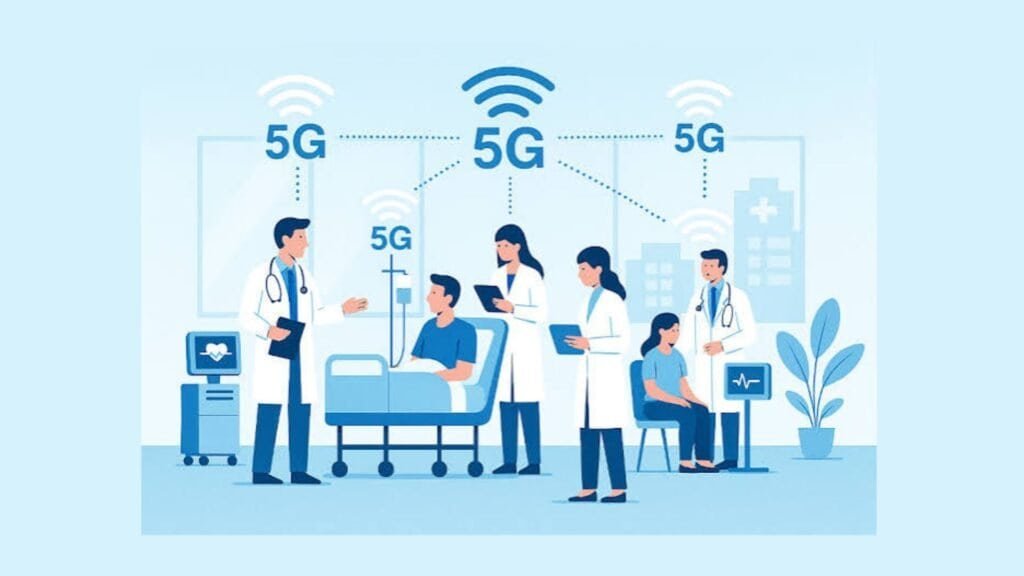
5G In Healthcare Statistics: The healthcare industry is moving towards faster and smarter digital services, and 5G is playing an important role in this shift. With faster internet speeds and minimal delays, the technology helps doctors monitor patients remotely, access medical records, and share critical information in real time. It also makes services such as telemedicine, robotic surgeries, and connected medical devices more practical.
Furthermore, hospitals can use 5G to improve communication and speed up medical decisions. As digital healthcare continues to grow, 5G is creating new opportunities for better patient care and more efficient medical services.
However, high deployment costs, limited network coverage, and data security concerns remain major barriers.
Featured Choice
- The global 5G in healthcare market is projected to grow from USD 109.9 billion in 2025 to USD 147.4 billion in 2026.
- Private 5G and standalone hospital networks account for the largest contribution at 8%.
- Network infrastructure and hardware remained the leading component, accounting for 42% of the market in 2026.
- North America dominated the market with a 38% share in 2026.
- 5G helps hospitals build smart infrastructure by connecting medical devices, IoT networks, and digital healthcare systems.
- The global 5G remote surgery system market is valued at around USD 2.34 billion in 2026.
- In the global healthcare market, 5G offers peak data speeds of up to 20 Gbps, significantly faster than 4G networks.
- In 2026, the total number of healthcare connections is projected to reach 648.05 million.
- AI-powered MRI technology is helping NHS hospitals in England perform 14% more scans without compromising image quality.
- Bordeaux University Hospital in France plans to begin rolling out 5G coverage across 18 buildings in the second half of 2026.
Global 5G in Healthcare Market Size

- The global 5G in healthcare market is projected to grow from USD 109.9 billion in 2025 to USD 147.4 billion in 2026.
- The market is forecast to reach USD 1,155.7 billion by 2033, with a compound annual growth rate of 34.2% during 2023-2033.
Key Drivers of Healthcare 5G Market Growth (2026-2034)
- Fortune Business Insights reported that private 5G and standalone hospital networks account for the largest contribution at 8%.
- Smart hospitals and healthcare digitalization add another 6.40% to market growth.
- Remote monitoring, telemedicine, and connected care support 5.10% growth.
- Edge AI, advanced imaging, XR, and robotics contribute 4.40%, while wider 5G coverage, spectrum access and public investment add 3.70%.
- Other applications and network upgrades contribute 2.68%, bringing the combined annual growth contribution to 30.28%.
Healthcare 5G Market: Segmental Analysis
- According to Fairfield Market Research, Network infrastructure and hardware remained the leading component, accounting for 42% of the market in 2026.
- Meanwhile, professional and managed services are projected to grow at a 30.1% CAGR through 2033.
- Public 5G networks maintained a 56% market share in 2026, whereas private 5G networks are expected to expand at a faster 32.4% CAGR.
- Remote patient monitoring held a 34% share in 2026.
- At the same time, connected medical devices and asset tracking are forecast to register a 31.8% CAGR from 2026 to 2033.
- Hospitals and clinical campuses were the largest end-user segment, accounting for 48% in 2026.
- In contrast, home healthcare is expected to grow at a 30.6% CAGR.
Regional Growth Trends in the 5G in Healthcare Market
- North America dominated the market with a 38% share in 2026.
- Europe captured 26% of revenue.
- Asia Pacific accounted for 28% of the market and is expected to record the fastest growth, with a 31.5% CAGR through 2033.
- Latin America held a 5% share.
- Middle East & Africa: Represented 3% of the market.
Key 5G Applications Transforming Connected Healthcare
- 5G helps hospitals build smart infrastructure by connecting medical devices, IoT networks, and digital healthcare systems.
- Wearable devices use 5G connectivity to transmit patients’ blood pressure, heart rate, and blood glucose data to doctors in real time.
- Faster connectivity improves telehealth services by supporting clear video consultations and remote diagnoses.
- Low-latency 5G networks allow surgeons to control robotic instruments during remote surgical procedures.
- AR and VR technologies support surgical planning, medical imaging, remote collaboration, and practical medical training.
- Pharmacists can remotely monitor patients’ vital signs and medication usage through connected devices.
- Faster data transmission supports AI-based diagnostics, medical research, and drug development.
- 5G-connected ambulances transmit live videos, patient vital signs, and CT images to hospitals.
Market Valuation of Major 5G Healthcare Companies, November 2026
| Company | Market Valuation (USD Billion) |
| Ericsson | 33.39 |
| Nokia | 42.95 |
| Samsung Electronics | 937.09 |
| ZTE | 19.86 |
| Verizon | 191.16 |
| AT&T | 150.15 |
| Vodafone | 35.33 |
| Deutsche Telekom | 141.45 |
| NTT | 86.80 |
| Cisco | 374.44 |
| Qualcomm Incorporated | 170.99 |
5G Remote Surgery System Market Outlook

- The global 5G remote surgery system market is valued at around USD 2.34 billion in 2026 and is projected to reach USD 3.06 billion by 2027.
- The market is forecast to reach USD 11.63 billion by 2032, growing at a 30.55% CAGR from 2027 to 2032.
- In 2026, hardware captured 55.46% of revenue, followed by non-standalone 5G at 66.89% and robotic surgical systems at 44.56%.
- Orthopedic surgery accounted for 36.67%, hospitals for 76.88%, and North America for 41.23%.
Remote Patient Monitoring Devices Market Report
- The global remote patient monitoring devices market is valued at USD 16.65 billion in 2026.
- The market is projected to reach USD 47.34 billion by 2033, growing at a 16.1% CAGR from 2026 to 2033.
- Home healthcare is projected to account for 33.7% of the market in 2026.
- North America is expected to lead with a 44.1% share.

- Cardiac monitoring devices lead with 23.3%, followed by respiratory monitoring devices at 18.5%.
- Blood glucose monitoring devices account for 17%, while blood pressure monitoring devices hold 15.5%.
- Neuro-monitoring devices account for 10%, multi-parameter monitors for 9.7%, and other devices for 6%.
- Oncology has the largest share at 28.3%, followed by cardiology at 20%, chronic respiratory diseases at 14%, and hypertension at 12.5%.
- Neurology and diabetes each contribute 10%, while other applications make up 5.2%.
Global Telemedicine Market Analysis

- The global telemedicine market is projected to grow from USD 157.9 billion in 2026 to USD 514.2 billion by 2033, registering an 18.4% CAGR.
- In 2025, the product segment accounted for the largest share of revenue at 51.2%.
- Real-time services dominated, accounting for 38.2% of revenue.
- Telepathology held the leading position with a 20.5% share.
- Web and mobile platforms captured 79% of market revenue.
- Tele-home services led with a 50.3% revenue share.
Main Telemedicine Applications

- The review found that telediagnosis led with 31% of studies, followed by telesurgery at 24%.
- Teleconsultation accounted for 18%, while telerehabilitation, telemonitoring, and teleassistance each represented 9%.
Connected Medical Device Market Statistics

- The connected medical device market is projected to grow from USD 75.99 billion in 2025 to USD 87.17 billion in 2026.
- It is forecast to reach USD 173.26 billion by 2031, with a 14.72% CAGR.
- Wi-Fi was the leading connectivity technology, accounting for 42.78% of the market in 2025, while wearable external devices held a 62.88% share.
- Remote patient monitoring accounted for 37.45% of the market, while hospitals and health systems accounted for 64.92%.
- North America remained the largest regional market, capturing a 40.42% share in 2025.
Healthcare Connections in 2026

- Total healthcare connections are projected to reach 648.05 million, including 46.40 million for healthcare equipment monitoring.
- Home monitoring connections are forecast at 252.30 million, while patient monitoring accounts for 56.31 million.
- Wellbeing wearables are expected to lead with 293.03 million connections.
Key Faster Medical Imaging Statistics
- According to a GOV.UK report, AI-powered MRI technology is helping NHS hospitals in England perform 14% more scans without compromising image quality.
- In 2026, the NHS aims to increase annual imaging capacity by 1 million scans by adding 125 CT and MRI scanners.
- AI acceleration software is already in use on more than 54% of compatible NHS MRI scanners.
- A 2026 study published in the Journal of Medical Internet Research found that AI-assisted radiology systems reduced average reporting time from 876.21 minutes to 82.25 minutes.
- Preparing chest X-ray reports took a median of 0.53 minutes with AI, compared with 2 minutes without it.
- According to a September 2026 review published in Frontiers in Medicine, AI-powered worklist prioritization helped reduce radiology reporting delays by up to 43.7% in certain clinical settings.
5G-Enabled Smart Hospital Statistics
- According to an Ericsson announcement, Bordeaux University Hospital in France plans to begin rolling out 5G coverage across 18 buildings in the second half of 2026.
- The planned 5G network will cover a 45-hectare hospital campus, supporting its connected healthcare infrastructure.
- Bordeaux’s SMART HOSPITAL project will run for 3 years, with initial clinical applications expected from 2027.
- Planned applications include connected ambulances, 3D surgical modeling, and connected surgical glasses.
- Singapore’s National University Health System had completed 180 mixed-reality-assisted surgeries by March 2026.
- According to a June 2026 case study published by the GSMA, mixed-reality guidance at Singapore’s NUHS reduced operating times by 10%-30% across various surgical procedures.
- Healthcare Business Outlook states that NUHS has deployed 19 indoor 5G radio units to provide connectivity across 10 operating theatres and 3 inpatient wards.
- NUHS trained 40 healthcare professionals in mixed reality and holographic 3D imaging.
How 5G Is Transforming Healthcare Compared With 4G
- According to a study published by the Association for Computing Machinery, 5G offers peak data speeds of up to 20 Gbps, significantly faster than 4G networks.
- 5G can reduce network response times to as low as 1 ms, compared with 30-50 ms for 4G.
- Technologies such as network slicing and multi-access edge computing help 5G deliver more stable and reliable connections.
- 5G networks can support more connected devices and handle higher data traffic than 4G.
- Improved encryption and network security features strengthen protection for 5G-connected devices and data.
- 5G supports advanced healthcare services, including telemedicine, remote patient monitoring, and real-time video consultations.
- Commercial 5G services are available in many countries, although network coverage and adoption levels vary by region.
Evolution of Wireless Technology in Healthcare: From 1G to 6G
- 1G supported basic voice calls at 2.4 Kbps, but limited coverage and call quality restricted its healthcare applications.
- 2G introduced digital communication at 64 Kbps, improving security and enabling SMS and MMS services.
- 3G delivered speeds from 384 Kbps to several Mbps, supporting mobile internet, video consultations, and early telemedicine services.
- 4G increased data speeds to 10-100 Mbps, improving video consultations, remote healthcare services, and medical data sharing.
- 5G offers speeds from 100 Mbps to 10 Gbps with lower latency, supporting connected medical devices, remote monitoring, AR, and VR applications.
- 6G is expected to deliver speeds of 100 Gbps to 1 Tbps, enabling AI-powered healthcare, holographic communication, and advanced connected medical systems.
Final Perspective
5G is bringing new possibilities to the healthcare sector. With faster connections and lower delays, doctors can monitor patients remotely, share medical data quickly, and perform robotic surgeries more effectively. It can also help hospitals improve their services and reach patients in remote areas.
However, network costs, security risks, and limited coverage remain major concerns. Despite these challenges, 5G can play an important role in improving patient care and making healthcare services more accessible.
FAQ
5G enables remote surgeries, telemedicine, real-time patient monitoring, connected medical devices, faster medical imaging, and emergency healthcare services.
Enables real-time health tracking, faster interventions, improved patient outcomes, and fewer hospital visits.
Yes, 5G can improve emergency medical services through faster communication, real-time monitoring, and quicker response times.
Sources
