










Introduction
Interactive Video Marketing Statistics: Interactive video marketing has turned into one of the fastest-growing digital engagement moves in 2026, as brands chase higher customer participation, deeper personalization, and clearer conversion wins. And, unlike the more ordinary video formats, these interactive videos let people tap, answer questions, pick story routes, finish forms, buy right inside, or browse products without bouncing out of the video player.
The broad take-up of AI-driven video creation, shoppable content, and personalized customer journeys has really sped up spending across retail, SaaS, healthcare, education, and financial services. Companies are putting bigger parts of marketing funds into video experiences that can show measurable ROI and also collect first-party customer data.
This article covers the newest interactive video marketing numbers, platform adoption direction, engagement and conversion benchmarks, how shoppable video performs, budget signals, device-by-device performance, and the main innovations that are shaping where interactive video marketing goes next in 2026.
Editor’s Choice
- Interactive videos bring 66% higher engagement and 44% longer watch time.
- Brands using interactive video report 25% higher conversions, 18% more leads, and 14% higher sales compared to earlier, traditional video campaigns.
- Interactive experiences can deliver 4–5× more pageviews, plus 10× higher click-through rates.
- Lead generation forms end up giving the best interactive performance, with a 19% click-through rate, beating everything else in the video setup.
- Long-form vids around 30–60 minutes stack up a very solid 23% click-through rate, which is also the top one across all the different lengths.
- Shoppable product videos land somewhere between 9% and 17% conversion rates, and they do about 3–5× more conversions than the usual product page approach.
- When shoppers get that more participatory nudge, they convert 50%–500% more often.
- Video-driven shopping brings in roughly 5%–25% of the whole online store revenue.
- On mobile, these interactive video campaigns bring 561%–591% higher user activity than standard pre-roll.
Top Performing Video Channels
(Reference: wyzowl.com)
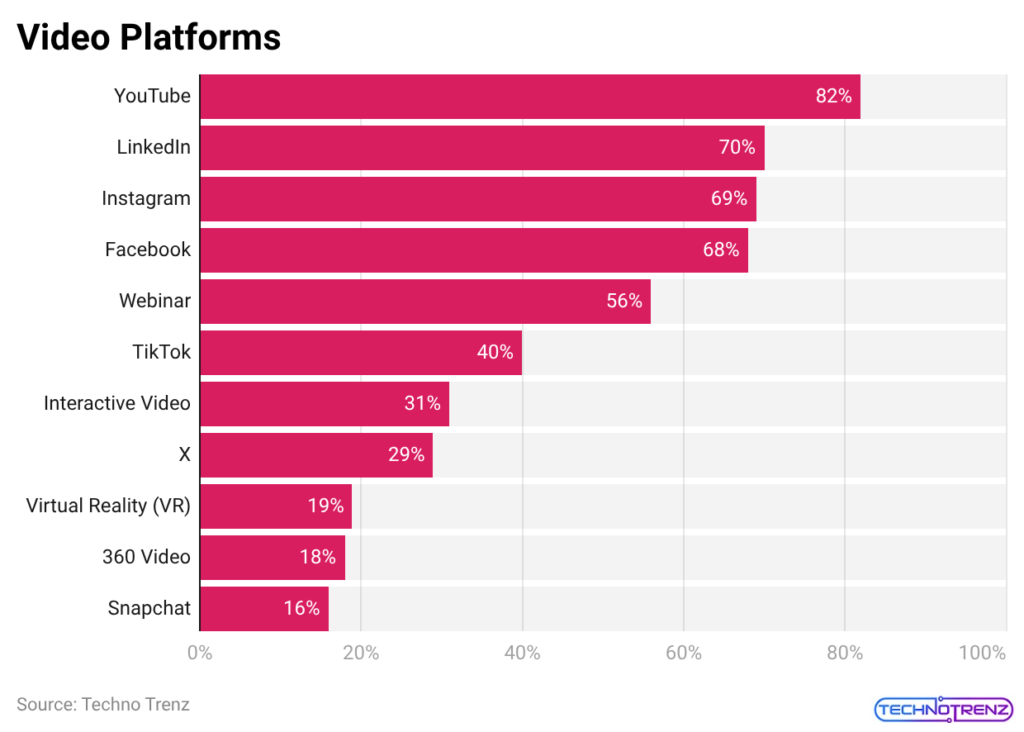
- Wyzowl State of Video Marketing 2026, the chart shows that businesses keep on prioritizing established digital platforms, while slowly drifting into emerging video formats, like kind of, you know.
- YouTube leads adoption, with 82% of companies using it for video marketing, which kind of locks in its position as the main platform for getting audience reach and distributing content.
- LinkedIn is next at 70%, showing how video keeps getting more important for B2B marketing and professional engagement, while Instagram at 69% and Facebook at 68% stay as core channels for brand awareness and for that day-to-day customer interaction.
- Outside of social platforms, 56% of companies fold webinars into their mix, which points to a steady appetite for teaching-oriented and lead-generation-style content.
- Adoption of short-form content is moving up too, with TikTok used by 40% of businesses, signaling its growing role in reaching younger audiences and the ones that are more highly engaged.
- More specialized formats are getting traction at a slower pace, with interactive video (31%), X (29%), virtual reality (19%), 360-degree video (18%), and Snapchat (16%) standing for niche but expanding openings for immersive and targeted customer experiences.
- Marketers are building diversified video strategies by pairing wide-reach platforms with more experimental formats, so they can maximize engagement, sharpen brand visibility, and back long-term digital marketing performance.
Interactive Video Delivers Higher Engagement and Better Marketing Results
- Interactive video is kind of proving itself as one of the more effective content formats for boosting customer engagement, and honestly, business performance as well.
- When you compare it to traditional video, interactive versions tend to pull in 66% more engagement, and they also stretch viewing time by 44%, which suggests people are more willing to stick around, especially when they can actively participate and not just watch.
- Interactive video is shared 29% more often, and at the same time, they push a 29% lift in brand and product awareness, so businesses can grow their organic reach.
- Marketers who use interactive video are seeing 25% higher conversion rates, 18% more leads, 21% growth in website traffic, 11% more referrals, and 14% higher sales, so the impact shows up across the whole marketing funnel, not only at the top.
- In performance terms, interactive experiences deliver 4–5 times more pageviews than static content, and interactive videos can reach click-through rates that are 10 times higher than passive videos.
- Even after someone clicks in, engagement still stays strong inside the interactive parts, like quizzes that bring a 62% interaction rate, and chapter-based interactions that land at 13.45%.
- 93% of marketers think interactive content really educates buyers, versus 70% for static content, and 43% of consumers say they prefer interactive videos because they can decide what information to look at.
Interactive Video Strengthens Engagement While ROI Measurement Continues To Evolve
- Interactive video is doing pretty strong on engagement and seems to help with business outcomes too, but a lot of marketers are still figuring out how they measure the financial impact, kind of in a more precise way.
- 18% of marketers think interactive video really boosts audience engagement, and then another 52% say it is an effective engagement tool.
- Only 1% say it actually hurts engagement, so the reception is mostly positive, even if some teams are still learning.
- When it comes to conversions, 29% of marketers report that interactive videos perform well or exceptionally well, and 30% say their conversion results are similar to traditional linear videos.
- But 33% are just not sure about how it performs for conversions, while 8% report results that are below average, which means tweaking, testing, and measurement are still kind of in progress.
- 28% report positive returns, and 30% describe ROI as neutral. Meanwhile, 34% can’t really evaluate ROI accurately yet, and 8% believe the returns are falling short of what they expected.
- Still, even with these measurement headaches, interactive videos are seeing a 36% higher completion rate than standard linear videos, which points to better viewer staying power and engagement.
- Interactive video is turning into an increasingly valuable marketing asset because it keeps people engaged and it can support conversions, even if performance attribution is still a bit tricky right now.
Interactive Video Elements And Click-Through Performance
(Source: wistia.com)
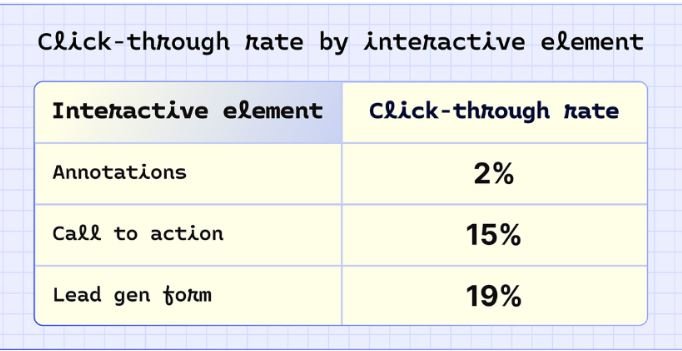
- According to Wistia, the data suggests that not every interactive video element quite generates the same sort of engagement, so choosing the right one really matters for campaign success.
- Lead generation forms show the top click-through rate at 19%, and yet they are also the least used interactive feature, which kind of highlights how well they can catch attention from viewers who are already in an engaged mood, and then turn that curiosity into actual next steps.
- CTA overlays sit at a 15% click-through rate, basically confirming that straightforward prompts, like booking a demo or grabbing a download, continue to drive conversions in a reliable way.
- On the other hand, annotation links only reach 2%, so they feel more suited for nudging viewers toward extra supporting resources and for reinforcing brand credibility, rather than pushing for immediate conversions.
- The report also mentions that CTAs are the most frequently used interactive element, with annotations next, while lead generation forms stay the least adopted option, even though they perform the best.
- One more meaningful takeaway is that interactive videos end up with a 36% higher completion rate than standard linear videos, meaning audiences are more likely to stick around and finish when the video includes interactive elements.
- The above statistics point to a strategy where you combine those high-performing lead generation forms with CTAs placed in smart, well-timed locations, which can boost engagement, expand conversion chances, and strengthen the results of interactive video marketing campaigns.
Long-Form Interactive Videos Generate The Highest Click-Through Rates
(Source: wistia.com)
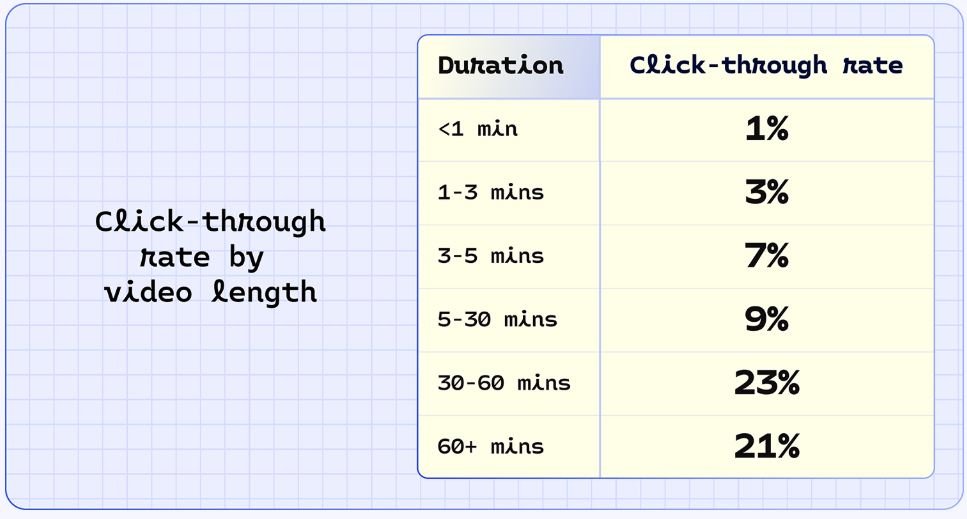
- The data shows a pretty strong tie between video length and what the audience actually does next, so it looks like people who stay longer are more inclined to react to those interactive bits as their watch time climbs.
- For the videos under 1 minute, the lowest CTR shows up at 1%, while the 1–3 minute range bumps it up to 3%, then it jumps again to 7% for content that runs 3–5 minutes.
- Then the mid-length stuff, like 5 to 30 minutes, reaches a 9% CTR, so you can say longer viewing keeps stacking engagement over time.
- The best numbers come when videos last 30–60 minutes, hitting a 23% click-through rate, and even for anything over 60 minutes it holds at 21% CTR, which means long-form generally feels like the top performer for pushing viewer action.
- So basically the results hint that viewers who invest more time become more open to calls to action, plus lead generation openings.
- Overall, the statistics imply that pairing long-form video with a thoughtfully placed end-of-video interaction can noticeably lift click-through performance, engagement, and conversion opportunities.
Interactive Video Budgets Reflect A Market Still In The Growth Phase
- Interactive video investment is growing, but money distribution still feels a bit uneven between different orgs.
- 22% of marketers don’t have any dedicated budget for interactive video production, so a lot of businesses are still pretty much in that first phase of adopting the format.
- At the same time, another 22% are working with a budget of USD 10,000 or less, which looks like a careful, almost guarded approach while companies try to figure out if the tech actually performs well.
- A smaller slice, 12% of marketers, puts aside between USD 10,000 and USD 20,000. That seems to hint at a slowly increasing confidence in interactive video as a marketing asset.
- Meanwhile, bigger spending is still not that common; only 1% to 5% of marketers say their budgets fall somewhere in the USD 20,000 to USD 150,000 range, across several different spending tiers.
- At the upper end, just 4% of marketers invest more than USD 150,000 in interactive video efforts, which basically points to large-scale adoption being concentrated in only a handful of organizations.
- Interactive video is becoming more strategic, but most companies are still leaning toward a cautious investment style, weighing innovation against budget efficiency.
Shoppable Video and Direct-to-Consumer E-Commerce
- Shoppable video has kind of evolved into one of the most effective e-commerce tools; it basically does product discovery and buying in the same moment, like one continuous flow.
- As Videowise and Rewarx describe it, regular product pages usually land around 2.1%–3.5% conversion, but product detail pages that are paired with shoppable video can reach 9%–17% conversion rates, which translates into about 3–5× more conversions than the standard setup.
- On top of that, Whatmore did controlled A/B testing across 200,000+ sessions and seven DTC brands, and they saw shoppable video widgets lift overall website conversions by 17%–33%.
- People who actively engaged with the videos were recording something like 50%–500% higher conversion rates. The median uplift came in at 125% versus visitors who didn’t watch.
- Webtonic reports 4.8% conversion with video versus 2.9% without video, so roughly a 65% improvement.
- Pixel8 Production, using insights from Levitate Media and Vidyard, found that landing pages featuring video can drive 80%–86% higher conversion rates.
- Meanwhile, AdCreate says explainer videos commonly bump conversions by about 20%–30%.
- 60% of U.S. shoppers report buying after watching social or influencer videos, 66% say they prefer product discovery via video, 75% lean toward video over text or images, 90% report that video supports purchase decisions, and 85% say video influenced at least one purchase.
- Contentmation, citing Shopify and TikTok, found that shoppable display ads convert at 1.8% vs 0.7% for the more standard display ads, so a 157% lift , right and shoppable video ads generate 3.1x more conversions than static image ads.
- Whatmore notes that video-driven sales can be 5%–25% of total store revenue, and those floating video widgets do better than carousel formats by 19.3%, while engagement rates sit somewhere around 10%–25% of sessions.
- On top of that, a representative Rewarx example showed conversion moving from 2.8% up to 11.4% after rolling out shoppable video.
- Wyzowl found that 92%–93% of marketers report positive ROI from video marketing, plus 89% say it boosts sales directly, which basically reinforces the idea that shoppable video is turning into a real revenue driver, not just a “clicky” engagement thing.
Interactive Video Performance By Device: Mobile Vs. Desktop
| Device/interaction type | Typical strength | Representative metrics |
| Mobile – gamified branching, swipes, taps | Highest interaction and engagement rates, strong time earned | Mobile seems to bring the biggest engagement on advanced video; you can see interaction rates more than double year on year, and the whole user activity jumps 591% compared with standard pre-roll. |
| Desktop – in-video lead generation forms | Highest quality lead capture, comfortable multi-field input | On average, about 19% of viewers actually go ahead and complete the in-video forms, and the lead conversion can land around 20–30% for sales clips and series videos, while long webinars go up to as much as 75% when the forms are inserted at the best timing points. |
| Cross-device – interactive CTAs and overlays | Balanced mix of engagement and direct response | Those interactive video campaigns generate roughly a 561–591% boost in total user activity and add about 41–44 seconds of earned watch time vs standard pre-roll, and this works across mobile, desktop and CTV too. |
Conclusion
Interactive video marketing has kinda turned into one of the more effective digital engagement plays in 2026, letting brands take passive viewers and make them real participants. When companies blend clickable bits, little quizzes, lead forms, and even shoppable moments, they’re seeing better engagement, tighter conversion paths, and measurable revenue growth. Also, the fast uptake of AI-powered video creation plus personalized experiences, and yes, mobile-first interactions is pushing more budgets across pretty much every industry.
Since people now expect more immersive and interactive content, organizations that actually put interactive video into their marketing mix will usually be in a better spot to boost customer engagement, pull in more qualified leads, improve ROI, and keep a competitive edge in the shifting digital landscape.
FAQ
Interactive video marketing is basically when viewers can take action inside a video using clickable elements, quizzes, forms, shopping links, and customized journeys.
Yes. Interactive videos can bring 66% higher engagement, 25% higher conversions, and about 14% more sales compared with standard videos.
Lead generation forms tend to win, with around a 19% click-through rate, so they often become the top conversion lever.
Shoppable videos can lift product page conversion rates to roughly 9%–17%, and they typically deliver 3–5× higher conversions than regular product pages.
Interactive videos improve engagement, increase viewer retention, generate qualified leads, and create measurable ROI, making them a key component of modern digital marketing strategies.
