









Preliminary Discussion
AI In Ultrasound Imaging Statistics: Ultrasound imaging is becoming smarter with the growing use of artificial intelligence in healthcare. AI-powered tools help doctors examine scans, spot unusual findings, and complete routine measurements more quickly. Earlier, the quality of an ultrasound examination relied largely on the operator’s skill and experience. Now, AI can guide image capture, analyze scan results, and support faster clinical decisions.
Its use is growing across several areas, including heart care, pregnancy monitoring, radiology, and emergency medicine. These advances are making ultrasound examinations more efficient and consistent.
However, concerns about diagnostic accuracy, technology costs, data quality, and clinical testing still need to be addressed before wider adoption.
Preferred Choice
- The global artificial intelligence market in ultrasound imaging is valued at USD 1.77 billion in 2025 and is projected to reach USD 2.33 billion in 2026.
- Image analysis software is set to remain the leading segment, accounting for 38% of the market in 2026.
- Hospitals are projected to remain the largest end-user segment at 43%.
- The United States market is estimated at USD 1.34 billion in 2026, representing 38.98% of global revenue.
- CT-based AI leads the market with a 41.6% revenue share in 2026.
- GE HealthCare’s Lung Guidance achieved a 95.2% success rate among non-experts, compared with 96.8% among experts.
- In 2026, Siemens Healthineers generated EUR 23.63 billion in revenue, with EUR 3.8 billion in EBIT and a 16.2% margin.
- Neurology accounts for 23% of the market, making it the largest clinical application, followed by cardiovascular applications at 21%.
- A November 16, 2026, meta-analysis in Scientific Reports examined AI-assisted ultrasound detection of kidney damage involving at least 25% fibrosis or tissue atrophy.
- AI-assisted fetal ultrasound reduced median scanning time from 19.7 to 11.4 minutes, a 42% improvement.
AI in Ultrasound Imaging Market Size

- The global artificial intelligence market in ultrasound imaging is valued at USD 1.77 billion in 2025 and is projected to reach USD 2.33 billion in 2026.
- The market is forecast to grow at a compound annual growth rate of 31.81%, reaching USD 9.27 billion by 2031.
Drivers and Restraints Affecting AI in Ultrasound Imaging Market Growth
| Market Driver | Estimated CAGR Impact (2026-2031) | Market Restraint | Estimated CAGR Impact (2026-2031) |
| Growing cases of chronic illnesses, along with an increasingly aging population. | +8.2% | High costs for purchasing and maintaining equipment. | -4.7% |
| Radiologists face heavier workloads amid ongoing staff shortages. | +7.8% | Rising concerns over data privacy and cybersecurity. | -3.2% |
| Government Support and Funding for AI Healthcare. | +6.1% | Clinician doubts and limited training hinder adoption. | -2.8% |
| AI integration is accelerating the adoption of point-of-care ultrasound. | +5.3% | Unclear regulations surrounding AI-guided home ultrasound systems. | -1.9% |
| AI Echocardiography Software CMS Reimbursement Codes. | +2.9% | – | – |
| Cloud-based AI platforms are expanding access to remote ultrasound in LMICs. | +2.8% |
AI in Ultrasound Imaging Market: Key Segment Insights

- Image analysis software is set to remain the leading segment, accounting for 38% of the market in 2026.
- Acquisition is forecast to account for 36% of the market, while general imaging is expected to hold a 40% share.

- Hospitals are projected to remain the largest end-user segment at 43%, with deep learning contributing an estimated 39% share.
Regional Analysis
- North America remained the largest regional market, growing from USD 0.80 billion in 2024 to USD 1.08 billion in 2025.

- The United States market is estimated at USD 1.34 billion in 2026, representing 38.98% of global revenue.
- Europe is projected to reach USD 0.79 billion in 2026, with a 26.69% growth rate.
- Germany and the U.K. are estimated at USD 0.20 billion (5.72%) and USD 0.16 billion (4.76%), respectively.
- Asia-Pacific is expected to reach USD 0.91 billion in 2026.
- China, Japan, and India are projected to generate USD 0.28 billion (8.05%), USD 0.20 billion (5.71%), and USD 0.12 billion (3.52%), respectively.
- Latin America is forecast to reach USD 0.18 billion.
- Meanwhile, the GCC and South Africa are estimated at USD 0.05 billion and USD 0.01 billion, respectively, in 2026.
Country-Wise AI Ultrasound Growth Forecast
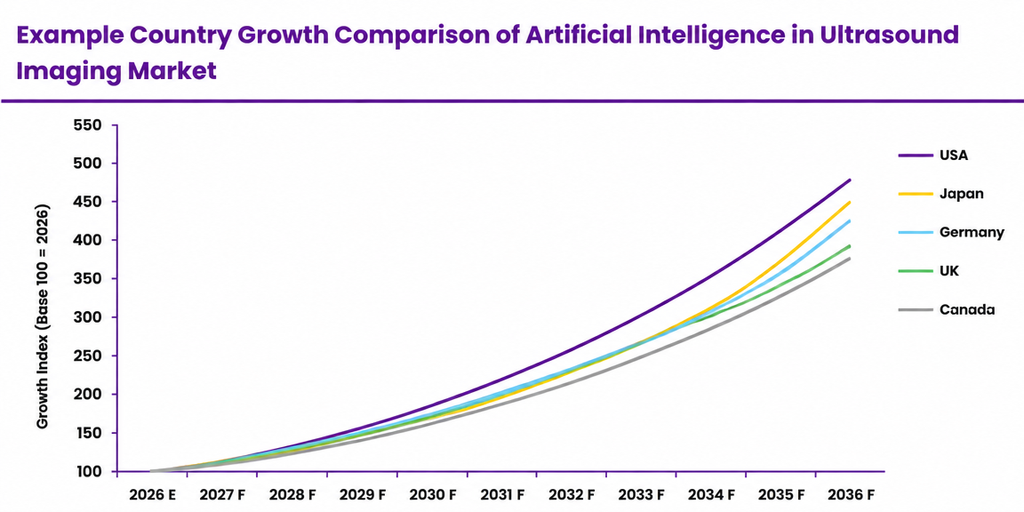
- The United States is projected to record the fastest growth at 17.1% CAGR, followed by Japan at 16.5%, Germany at 15.9%, and the U.K. at 15.4%.
- Canada, South Korea, and Singapore are expected to grow at 14.8%, 14.3%, and 13.8% CAGR, respectively.
Full-Body AI Ultrasound Imaging Market Statistics

- The global market is valued at USD 220 million in 2026 and is projected to reach USD 897.6 million by 2036, growing at a CAGR of 15.1%.
- AI algorithms are expected to capture 47.0% of the market as demand for automated ultrasound guidance increases.
- Diagnostics may account for 45% of the share, supported by increased use of ultrasound before CT scans.
- Hospitals could hold 54%, while handheld systems may reach 67.0% due to clinical convenience.
- North America is projected to secure a 39% share in 2026.
AI Adoption Across Medical Imaging Modalities
- According to SQ Magazine’s report, CT-based AI leads the market with a 41.6% revenue share in 2026.
- X-ray AI adoption is projected to grow at a 25%-30% CAGR through 2030.
- MRI-based AI is expanding at a 20%-30% CAGR, driven by neurological and musculoskeletal imaging.
- Ultrasound AI penetration has increased by over 15% since 2022.
- PET AI tools support 60%-70% of major nuclear medicine centers.
- Around 70%-80% of large health systems use at least one AI imaging tool.
- Multimodality AI platforms cover nearly 40% of enterprise imaging departments.
- AI-assisted CT workflows reduce false negatives by approximately 10%-15% in acute-care settings
AI Ultrasound Adoption and Availability

- GE HealthCare’s Lung Guidance achieved a 95.2% success rate among non-experts, compared with 96.8% among experts, demonstrating improved scanning accuracy.
- GE’s AI supports an 8-zone lung protocol that includes probe positioning, anatomical identification, image capture, and B-line assessment.
- AutoAS analyzes at least 2 echocardiographic views to identify moderate-to-severe aortic stenosis.
- GE announced FDA 510(k) clearance and CE marking on November 3, 2026.
- Butterfly’s pregnancy AI was trained using more than 21 million ultrasound images to estimate gestational age.
- The pregnancy assessment takes under 2 minutes and supports pregnancies between 16 and 37 weeks.
- Butterfly has deployed its pregnancy AI in Malawi and Uganda, expanding access to ultrasound-based pregnancy assessment.
- On July 2, 2026, Butterfly expanded into Brazil, making its iQ+ and iQ3 handheld ultrasound devices commercially available.
Top 10 Ultrasound AI Companies Financial Snapshot, 2026
| Company | Numeric Valuation |
| Siemens Healthineers | Siemens Healthineers generated EUR 23.63 billion in revenue, with EUR 3.8 billion in EBIT and a 16.2% margin; imaging growth reached 10%.The company has a USD 53.5 billion market capitalization and operates across 180 countries, with direct representation in 70+. |
| GE HealthCare | Q3 revenue reached USD 5.513 billion, increasing 7.2%, while nine-month revenue totaled USD 15.939 billion.Net income was USD 615 million, with a 16.6% adjusted EBIT margin and a USD 23.7 billion backlog.Market capitalization stood at USD 37.03 billion. |
| Philips | Q3 revenue reached EUR 4.4 billion, increasing 3%, while order intake grew 8%.Philips reported a 13% margin, EUR 544 million cash flow, and USD 28.7 billion market capitalization. |
| Samsung | Q3 2026 revenue reached KRW 195.3 trillion, reflecting 14% growth compared with the previous quarter.Operating profit totaled KRW 107.4 trillion, while market capitalization stood at KRW 1,176.66 trillion. |
| Butterfly | Q3 revenue reached USD 32.6 million, increasing 52%, while nine-month revenue totaled USD 91.74 million.Gross margin stood at 73%, with a net loss of USD 12.8 million and cash reserves of USD 122.3 million.In 2026, revenue guidance remains between USD 123 million and USD 126 million. |
AI Ultrasound Investment, Funding, and M&A
- According to AuntMinnie Europe, the average funding increased from USD 6 million in 2024 to USD 15 million in 2025, a 150% rise (2.5 times), despite limited deal activity.
- Business Wire announcement mentioned that in 2025, DESKi raised USD 6 million, ThinkSono secured GBP 4.5 million (approximately USD 6 million), and Ultromics raised USD 55 million.
- In 2026, BrightHeart raised EUR 11 million, while UltraSight secured USD 24 million.
- GE HealthCare announced a USD 35 million cost-shared expansion, Pulsenmore disclosed a USD 1 million project, and Exo received a USD 11.6 million grant.
- Surgical Science’s 2025 acquisition valued Intelligent Ultrasound’s equity at GBP 45.2 million and enterprise at GBP 4.7 million.
AI-Based Image Analysis Software Market by Clinical Application

- Neurology accounts for 23% of the market, making it the largest clinical application, followed by cardiovascular applications at 21%.
- Rest-of-body applications account for 20% of the market, followed by breast imaging at 15%.
- Lung imaging holds 14%, while liver imaging accounts for 7%.
AI in Oncology Imaging
- According to a report from SQ Magazine, AI-assisted breast imaging can improve cancer detection sensitivity by up to 9.4%.
- Lung cancer AI tools can reduce false positives by 11%-15%, while prostate MRI accuracy can improve by up to 20%.
- Early AI-based tumor detection may improve survival rates by up to 15%.
- Oncology accounts for over one-third of global AI imaging applications, and AI can reduce radiologists’ review time by 30%-50%.
- Multi-cancer algorithms achieve over 85% accuracy, and imaging biomarker trials increased by over 40% between 2022 and 2025.
AI in Cardiovascular Imaging
- AI detects coronary artery disease with over 90% accuracy and predicts major cardiac events with over 85% accuracy.
- AI-powered cardiac imaging speeds up diagnosis by 50%, while automated MRI analysis reduces interpretation time by 70%.
- AI-supported echocardiography improves measurement accuracy by up to 15%.
AI in Neurology and Brain Imaging
- AI can improve stroke detection accuracy by up to 30% and reduce diagnosis time by 50%.
- AI tools can detect brain hemorrhages with over 95% accuracy.
- AI models can improve early Alzheimer’s detection by up to 20%.
- AI-powered brain MRI analysis can reduce interpretation time by 30%-40%.
- Neurology accounts for approximately 15%-20% of FDA-cleared AI medical devices.
AI-Assisted Ultrasound for Kidney Fibrosis Assessment
- A systematic review and meta-analysis published in Scientific Reports on November 16, 2026, evaluated AI-assisted ultrasound for detecting kidney damage involving at least 25% fibrosis or tissue atrophy.
- The analysis covered 14 studies with 3,776 participants, of which 1,244 contributed to the pooled diagnostic estimates.
- AI-assisted ultrasound achieved 82.1% sensitivity, 82.8% specificity, and an AUROC of 0.880 (95% CI: 0.815-0.924).
AI’s Role in Improving Liver Ultrasound Screening

- Ultrasound HCC detection sensitivity ranges from 27.9%-100% across all stages and from 21.4%-88.9% for early-stage cases.
- AI can help less-experienced operators detect liver lesions more accurately, improving early diagnosis and follow-up.
AI-Based Ultrasound Shows High Accuracy in Detecting Infant Hip Dysplasia
- A Pediatric Radiology study published on April 10, 2026, evaluated AI-based ultrasound for detecting hip dysplasia in infants aged 12 months or younger.
- Researchers reviewed 29 studies, with 9 contributing data from 6,351 hips.
- AI-based ultrasound correctly identified 92% of cases (86%-95%) and ruled out 96% of unaffected cases (91%-98%).
AI-Assisted Ultrasound for Breast Cancer Subtype Identification
- Researchers published a meta-analysis in Frontiers in Oncology on March 12, 2026, exploring the ability of AI-assisted ultrasound to identify different breast cancer molecular subtypes.
- The analysis combined findings from 13 studies covering 13,615 patients. AI models achieved 89% sensitivity (95% CI: 82%- 93%) and 82% specificity (95% CI: 77%- 86%).
Impact of AI on Ultrasound Scan Time and Clinical Workflow
- A clinical study published in NEJM A1 reported that AI-assisted fetal ultrasound reduced median scanning time from 19.7 to 11.4 minutes, a 42% improvement, in a 2025 clinical trial.
- According to a study published by Springer Nature, AI-supported echocardiography shortened examination time from 18 to 13.4 minutes, saving 4.6 minutes, or approximately 26%.
- Another echocardiography trial reported an approximately 18% increase in daily scanning capacity.
- The Journal of Cardiovascular Imaging reported that a randomized trial of 585 examinations showed a reduction in scan time from 14.3 to 13 minutes, improving efficiency by approximately 9%.
- A 2026 pilot involving 40 examinations reduced image-analysis time from 490 to 94 seconds, achieving an approximately 81% reduction.
Summary
AI is improving the way ultrasound scans are performed and analyzed. It helps doctors spot health problems, examine images faster, and reduce manual effort. These benefits can also support better diagnosis and patient care.
However, high costs, data privacy, and accuracy still need attention. As the technology advances, AI is likely to become a useful part of everyday ultrasound procedures, helping healthcare professionals deliver faster, more reliable results.
FAQ
AI ultrasound enables image enhancement, automated measurements, disease detection, fetal monitoring, and diagnostic decision support.
Ultrasound images vary with operator technique, probe movement, patient anatomy, and noise, making AI interpretation harder.
Yes, AI can analyze ultrasound scans to detect diseases, identify abnormalities, and support doctors in making accurate diagnoses.
